How to Start a Dog Grooming Business: A Step-by-Step Guide

SMALL BUSINESS INTEL, IN YOUR INBOX
Table of contents
According to the American Pet Products Association, 71 million US households owned a dog in 2025. That's up four million from the year before, and Americans spent $158 billion on their pets that year. The demand for professional grooming isn't going anywhere.
Most guides focus on the craft. This one focuses on the business. If you already know how to groom a dog and you're ready to start getting paid for it, here's what you need to know.

Make work manageable.
See why small businesses use Homebase to organize everything that matters in one place.
TL;DR: What You Need to Know Before You Open A Dog Grooming Business
- Your business model (home-based, mobile, or salon) is the single biggest decision you'll make before opening. It determines your startup cost, your daily capacity, and your long-term ceiling.
- Price from your costs, not from what competitors charge. Most grooming businesses that fail do so because the math never worked.
- No federal certification is required to groom dogs in the US, but credentials from NDGAA, IPG, or the AKC Dog Grooming Institute build client trust and justify your prices.
- Set up your Google Business Profile before you open. It's free and it's how local clients find you.
- The day you hire your first groomer, you need scheduling, time tracking, and payroll working together. Build those systems before you need them.
Step 1: Choose Your Business Model
Before you spend a dollar, decide where you'll work. These three main models have different startup costs, different margins, and different ceilings:
- Home-based studio. You convert space at home (a garage, a spare room, a basement) into a professional grooming area. Startup costs typically run $5,000 to $30,000 depending on your zoning situation and how much work the space needs. Overhead stays low, hours stay flexible, and you skip the commute. The trade-off: zoning rules apply in many areas, and there's a natural cap on daily volume.
- Mobile grooming van. You bring the service to the client. Startup costs range from $30,000 to $100,000 or more, depending on the vehicle, conversion, equipment, and commercial registration. The margin per dog is typically higher than a salon, and clients pay extra for the convenience. The constraint: a single van handles roughly four to six dogs per day.
- Commercial salon. A dedicated space with multiple grooming stations. Startup costs vary the most here, from around $15,000 for a modest buildout to $75,000 or more depending on the location, size, and condition of the space. The highest ceiling of the three, but also the highest fixed costs.
Most new groomers start with a home studio or a mobile unit, then move to a salon once revenue justifies it.
| Business model | Est. startup cost | Pros | Cons |
|---|---|---|---|
| Home-based studio | 5K-30K | Low overhead, flexible hours | Zoning restrictions, limited scalability |
| Mobile grooming van | 30K-100K+ | Premium pricing, convenience | Vehicle costs, capacity 4–6 dogs/day |
| Commercial salon | 15k-75K+ | Scalable, multiple stations | High fixed costs (rent, utilities, buildout) |
Startup cost estimates are compiled from multiple industry sources and vary by location, equipment, and buildout scope. Use these as planning ranges.
Step 2: Write a Business Plan
A business plan doesn't need to be long. Five focused pages will do more than 40 pages of padding. The point is to run the numbers before you're locked into them.
What to include in your business plan:
- Executive summary. Your concept, your target client, and why your market has room for you.
- Services menu. What you'll offer and at what price (more on this in Step 6).
- Target market. What breeds, what neighborhoods, what kind of client.
- Marketing plan. How people will find you before and after you open.
- Financial projections. Revenue targets, operating costs, and a break-even timeline.
For pricing, start with your own costs rather than what competitors charge. A useful starting formula:
Target hourly rate = (Monthly fixed costs + target monthly profit) / total billable hours
Service price = (Target hourly rate x estimated groom time) + supply cost + complexity surcharge
Most grooming businesses that fail do so because pricing didn't cover costs. Run the math in your plan. That's the whole point of writing it.
Step 3: Handle the Legal and Insurance Basics
You don’t need a federal license to groom dogs in the US. But that doesn't mean you can skip the legal setup.
Business structure. Most groomers start with a Limited Liability Company (LLC). It's not complicated to set up, and it keeps your personal assets separate from your business liability. A sole proprietorship is simpler to establish but leaves you personally exposed.
Registrations (vary by state and city):
- Employer Identification Number (EIN) from the IRS. Free, takes about 10 minutes online. You need one if you plan to hire, and it keeps your Social Security number off business paperwork.
- Business license or general operating permit. Most cities require one. Fees typically run $50 to $200, though they vary by jurisdiction. The SBA's Business License Lookup tool is the fastest way to find your local requirements.
- Sales tax permit if you sell retail grooming products.
- Facility-level grooming permit in some cities (New York City, Colorado, and others require these). Confirm locally before you open.
Insurance. Don't skip this part. One incident without the right coverage can cost more than your entire startup budget.
- General liability covers dog bites, client injuries on your property, and property damage.
- Animal bailee policy covers injury, illness, or death of a pet in your care. This one is specific to groomers and non-negotiable.
- Commercial auto if you run a mobile unit. Your personal auto policy won't cover commercial use.
Step 4: Get Your Equipment
The equipment list isn't complicated, but quality matters from the start. Professional-grade gear is faster, safer, and lasts longer than the consumer equivalent.
The essentials:
- Grooming table with arm and noose
- Tub with grooming hose
- High-velocity dryer and kennel dryer
- Clippers, blades, and shears
- Nail trimmers and grinders
- Brushes, combs, and de-matting tools
- Shampoo, conditioner, ear cleaner, and bandanas
- Kennels or crates for managing multiple dogs
Start with what you need to groom safely and efficiently. Add specialty tools as your client list grows. Spending $3,000 on tools you haven't needed yet ties up money you might need elsewhere.
Step 5: Get Certified
No state requires groomers to hold a certification. But earning one before you open (or early in your first year) matters for client trust and for justifying your prices.
The three most recognized credentialing bodies:
- NDGAA (National Dog Groomers Association of America): credential NCMG, National Certified Master Groomer
- IPG (International Professional Groomers, Inc.): credential ICMG, International Certified Master Groomer
- AKC Dog Grooming Institute: credential AKC-MG, AKC Master Groomer
These are master-level credentials. Each organization also offers entry-level certifications, which are the right starting point for most new groomers.
Certification training will cover safe handling techniques, sanitation standards, canine anatomy, breed-specific cuts, coat type identification, and nail and ear care. Many groomers also work as bathers or apprentices under an experienced groomer for six to 18 months before opening their own businesses. Formal training compresses that timeline.
Step 6: Set Your Prices
Pet services prices have risen more than 35% since December 2019, with cumulative increases now exceeding 43% as of 2026, according to Bureau of Labor Statistics Consumer Price Index data. That means clients in most markets have already adjusted to regular price increases. Price to your costs, not to what you think the market will accept.
A full groom typically runs $30 to $90 on the lower-to-mid end. In metro areas, prices for a mid-sized dog are generally higher. Large breeds, double coats, and matted dogs warrant a surcharge that reflects the extra time involved.
What to build into every service price:
- Supplies used per groom
- Equipment depreciation
- Insurance cost
- Rent or van costs
- Your time, at your target hourly rate
- A complexity surcharge for difficult coats, temperaments, or breeds
Review your prices every six months. Clients who've been with you a while are usually more loyal than you'd expect, and a clear, communicated price increase will land better than most groomers assume.
Step 7: Get Your First Clients
Set up your Google Business Profile before you open. It's free. It's how local dog owners find groomers near them. Fill it out completely: hours, services, photos, and a link to book.
Post before-and-after photos. Instagram and TikTok are built for this service. A clean transformation is compelling content. Three or four posts before you open give potential clients something to look at when they find you.
Build a referral network. Introduce yourself to local vet clinics, pet shelters, dog trainers, and pet supply stores. They get asked for groomer recommendations regularly. A card and a quick conversation can produce a steady referral stream.
Run a first-client offer. One free add-on (a bandana, a nail file, an ear clean) for first-time bookings gives new clients a reason to try you without discounting your base rate.
Ask for Google reviews. After every successful groom, send a link to your review page. Online reviews are often what tips a potential client from "considering you" to booking you. In the first year, word of mouth is your most effective marketing channel. Do good work, and make it easy for people to share it.
Step 8: Build Your Operations and Your Team
Most grooming businesses launch solo. That's fine. The difference between groomers who stay solo and those who build something bigger usually comes down to one thing: systems.
When you're working alone:
- Track your time per groom from day one. Know what each service actually costs you in labor.
- Build client records and appointment notes in a consistent format. When your schedule fills up, you won't be able to rely on memory for every preference.
- Set up your scheduling and time tracking tools early. Switching from paper to a digital system mid-growth is harder than starting right.
When you hire your first groomer:
Bringing on even one team member changes the operation overnight. You need to post and fill shifts, track their hours, run payroll, file taxes, and handle onboarding paperwork. Each one is manageable. Together, they'll eat your evenings if you don't have a system.
Roberto Bustillos opened Lombard Doggy Daycare with no prior experience managing employees, and the operations side was what kept him up at night. "My biggest fear at the beginning was I'm getting into a very complicated business and I have no idea how to deal with — how to manage the schedules, how to deal with payroll," he says. "All of that was so simple with the software." He's been using Homebase since his first day in business.
With Homebase, you build your groomer's schedule, add shift notes, and publish it with a text notification. From there, your team can claim open shifts, swap coverage, and update their own availability.
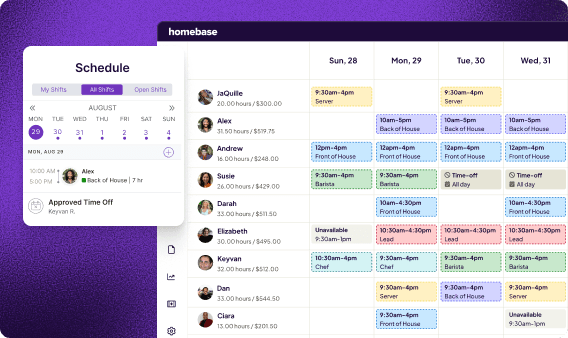
Todd Hayward, owner of WRTS Franklin Park, found that giving his team that visibility took the scheduling burden off his plate entirely. "It's reduced a lot of scheduling overhead for us so we can spend our time more wisely," he says.
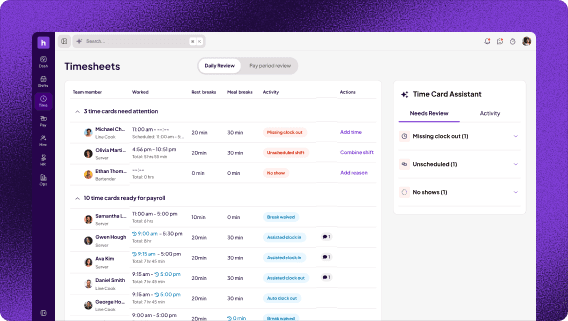
Homebase also offers time tracking, which connects directly to payroll. Your team clocks in and out from their phones, with photo verification to confirm who's on site. Hours are calculated automatically. When payroll runs, Homebase handles wages, taxes, W-2s, 1099s, and direct deposit.
And when you hire, onboarding paperwork (W-4, I-9, and direct deposit setup) is handled digitally before a new hire's first day.
Homebase’s time tracking and scheduling are free for one location with up to 10 employees. When you're ready to bring on your first groomer, get started with Homebase.
Frequently Asked Questions
How much does it cost to open a dog grooming business?
Startup costs vary by model. Home-based studios typically run $5,000 to $30,000; mobile vans range from $30,000 to $100,000 or more; commercial salons fall between $15,000 and $75,000+. A general business license costs $50 to $200 in most areas. Budget six to seven months of working capital beyond your startup costs.
How profitable are dog groomers?
The Bureau of Labor Statistics reports a median of $35,360 per year for Animal Caretakers (the category that includes groomers) as of May 2025. That figure doesn't capture tips, commission, or self-employed income, which meaningfully raise real earnings for many groomers.
What qualifications do I need to groom dogs?
None are legally required in the US. The most trusted credentials come from NDGAA (NCMG), IPG (ICMG), and the AKC Dog Grooming Institute. Entry-level certifications from the same organizations are the right starting point for most new groomers.
How much do most dog groomers make?
The Bureau of Labor Statistics reports a median of $17/hour ($35,360/year) for Animal Caretakers as of May 2025. Real-world earnings are often higher, since tips, commission, and self-employed income aren't captured in employer wage surveys.
What do you need to start a dog grooming business?
At minimum: grooming equipment (table, tub, dryers, clippers, shears, nail tools, and shampoo), a business license, an EIN from the IRS, general liability and animal bailee insurance, a business plan, and a pricing strategy. Home-based is the most affordable way to start.
Is dog grooming a good business?
For the right person, yes. Demand is consistent: 71 million US households owned a dog in 2025, per the American Pet Products Association. The market is highly fragmented, startup costs are lower than most service businesses, and the work is recurring. The most common failure points are underpricing, no contingency cash, and no client acquisition plan.
How do I get clients for my dog grooming business?
Start with a Google Business Profile. Post before-and-after photos on Instagram or TikTok. Build a referral network with local vet clinics, shelters, and pet stores. Run a first-time-client offer, and ask every happy client for a Google review.
Is mobile grooming more profitable?
Mobile grooming carries higher per-dog margins, and clients pay a premium for the convenience. The trade-off: a single van handles roughly four to six dogs per day. A salon has lower per-dog margins but no throughput limit. Mobile is often the faster path to early profitability; a well-run salon tends to outpace it long-term.
Treat Your Dog Grooming Business as Seriously as the Craft
The groomers who scale are the ones who treat the operations side as seriously as the work itself, from the time they write a business plan to the day they bring on their first team member. Build the systems early, before you need them.
When you're ready to hire, Homebase handles the team side: scheduling, time tracking, payroll, and onboarding in one place, so you can stay focused on the work. Try it for free.
Make work manageable.
See why small businesses use Homebase to organize everything that matters in one place.