2026 Main Street AI Gap Report: Who's Adopting AI on Main Street

SMALL BUSINESS INTEL, IN YOUR INBOX
Table of contents
New data from 750 small business decision-makers reveals AI adoption is surging on Main Street, but a stubborn divide is opening up between businesses that can afford to experiment and those still figuring it out alone.
This report is part of Homebase's ongoing commitment to giving small businesses the same technology advantages long available to big corporations. Learn more about how Homebase is building AI for hourly teams at joinhomebase.com/ai-assistants.
AI is evolving fast, and each leap forward creates new opportunities for the businesses that can put it to work. Nowhere is that truer than on Main Street, where a few hours saved can mean more time with family instead of another late-night shift. The 33.2 million small businesses that make up 99.9% of all U.S. businesses and nearly half the country's GDP stand to benefit the most from AI's time-saving impact, if they get the chance to adopt it in the first place.
To understand where that gap actually runs, we surveyed 750 U.S. small business owners, executives, directors, and managers involved in payroll, scheduling, timekeeping, or HR decisions. We call the results the 2026 Main Street AI Gap Report.
Key Findings
- 74% of small business owners/managers are now using or piloting AI tools, up from 64% in 2025 (a statistically significant 10 percentage point jump in one year).
- AI adoption ranges from 54% among businesses under $500K in revenue to 81% among businesses at $5M+, a 27 percentage point gap.
- 89% of AI adopters report a positive overall business impact.
- Owners using AI for both scheduling and payroll save an estimated 7.7 hours and $343 a month (about $4,100 a year).
- 62% of non-adopters are still interested in AI. What's holding them back hasn't moved: data privacy and fear of mistakes remain the top concerns, statistically unchanged from 2025.
- Small business decision-makers are more than 2x as likely to expect AI to help their business grow (49%) than to reduce headcount (22%).
The AI Gap Driven by Size and Revenue
Adoption on Main Street isn't stalling. 74% of small business owners and managers are now using or piloting AI tools, up from 64% in 2025. That's a statistically significant 10-percentage-point jump in one year.
But the data shows a clear divide in who is being swept along and who's being left at the dock.
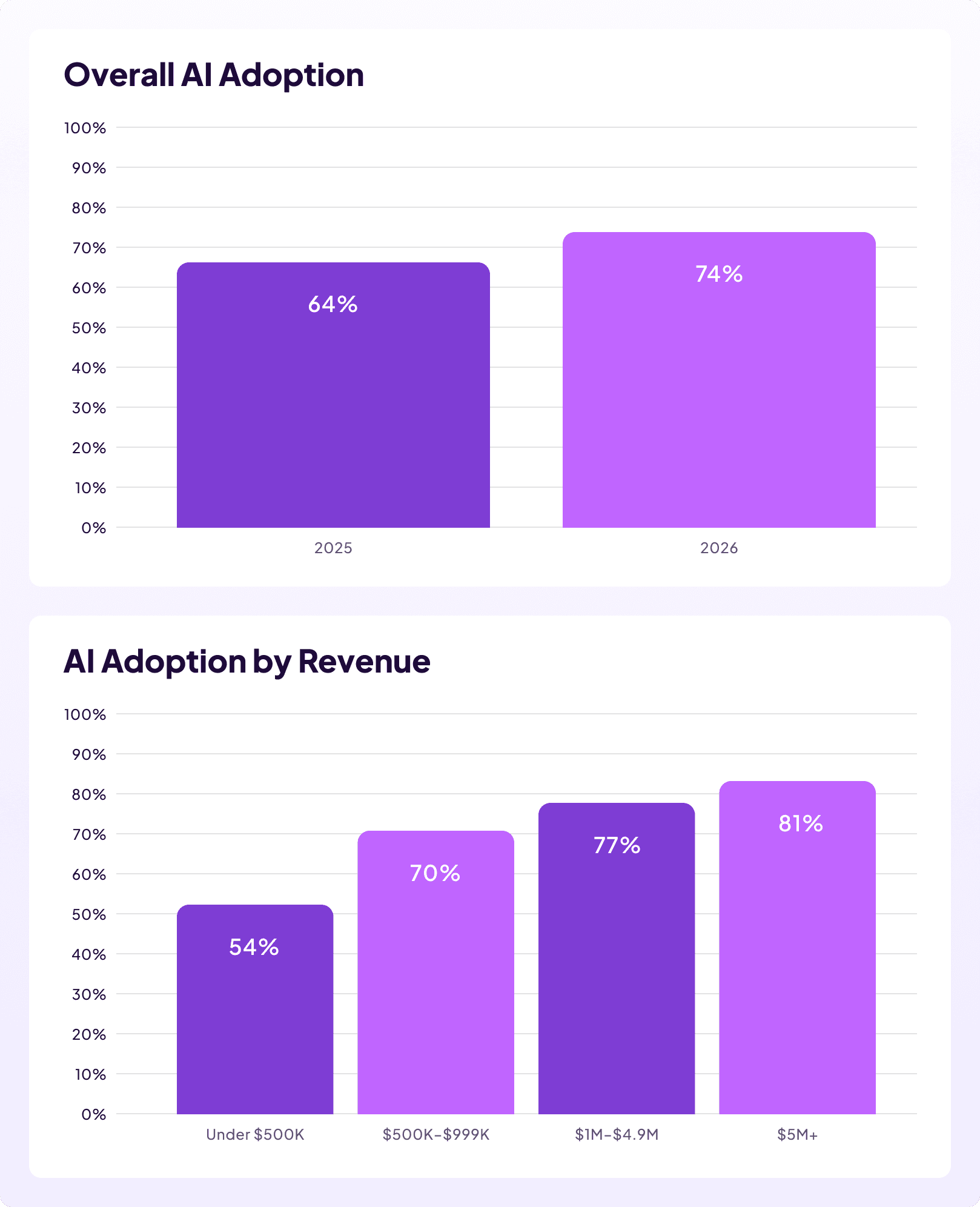
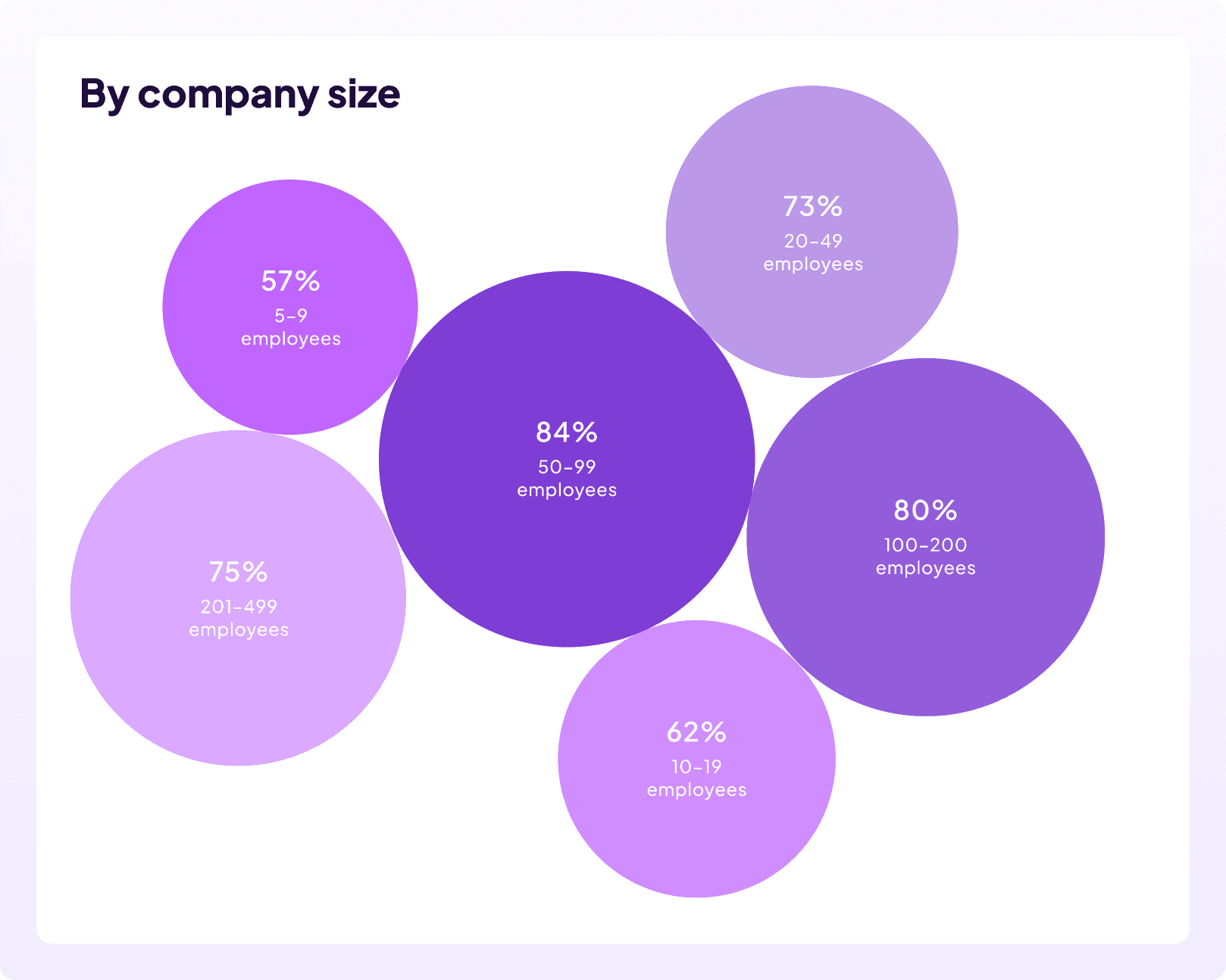
By company size, adoption climbs from 57% at businesses with 5–9 employees to 84% at businesses with 50–99 employees. By revenue, it's an even wider spread: just 54% of businesses under $500K in annual revenue are using AI, compared to 81% of businesses at $5M or more, a 27-point gap.
The pattern holds by industry, too. Computer hardware/software businesses lead at 94% adoption, while food service and restaurants trail at 65%. Healthcare has the highest share of decision-makers who say they're "not interested in AI at all" (16%, compared to 8% everywhere else).
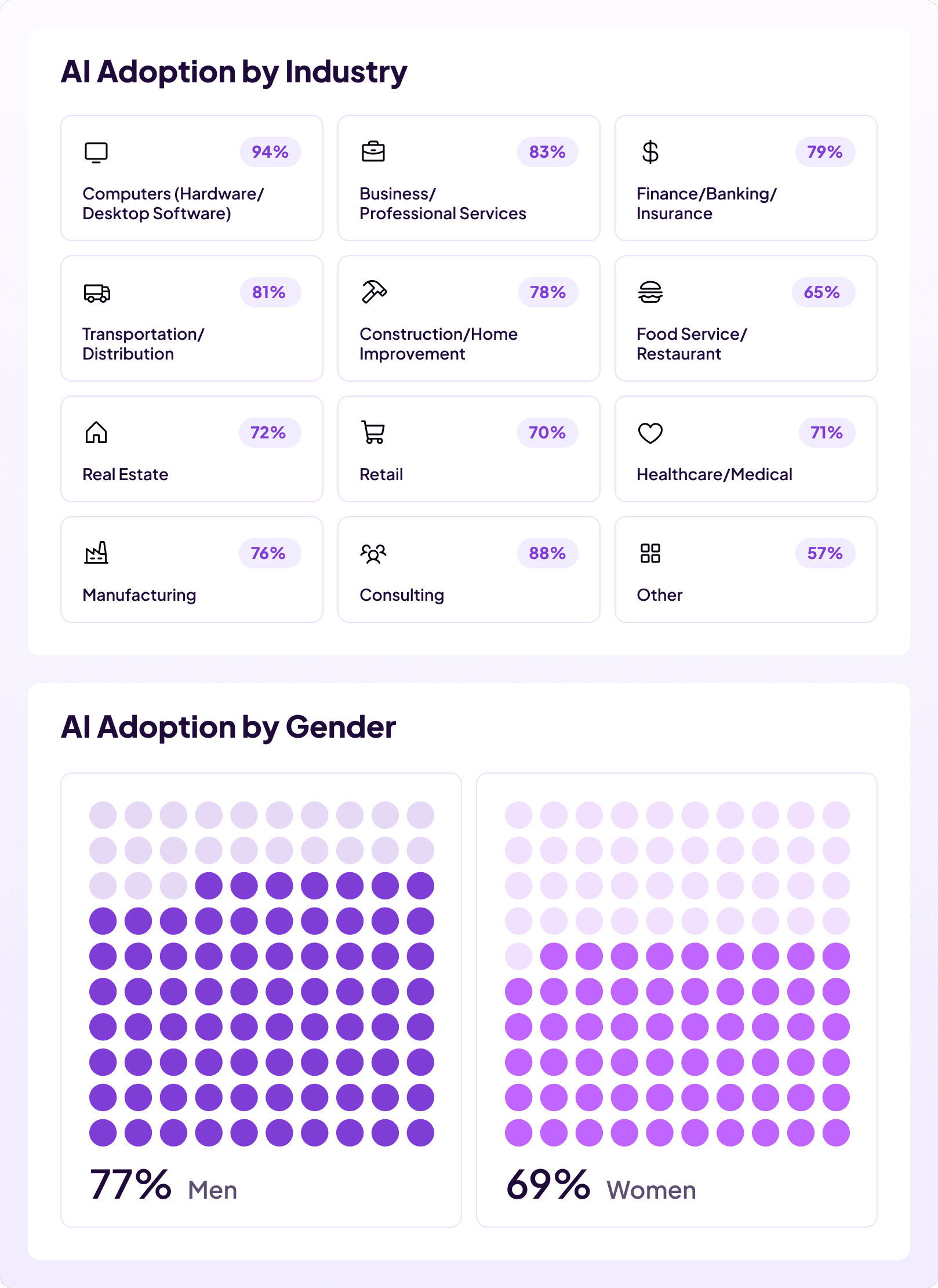
AI adoption isn't stalling on Main Street. But the smallest, newest, and lowest-revenue businesses, the ones with the least room for costly trial and error, are getting left behind.
AI Use Is Translating Into Real Time and Dollars Saved
Businesses that have adopted AI are seeing the results across time, money, and stress.
89% of adopters report a positive overall business impact. Just 0.4% report anything negative. 87% say AI has saved them time, and 74% say it's made running their business less stressful.
The dollars-and-hours story is concrete: owners who use AI for both scheduling and payroll save an estimated 7.7 hours and $343 a month (roughly $4,100 a year) on those two tasks alone. That's on top of the fact that 46% of all respondents estimate manual payroll and scheduling errors cost their business $500 or more a month, with 11% estimating $2,000 or more.
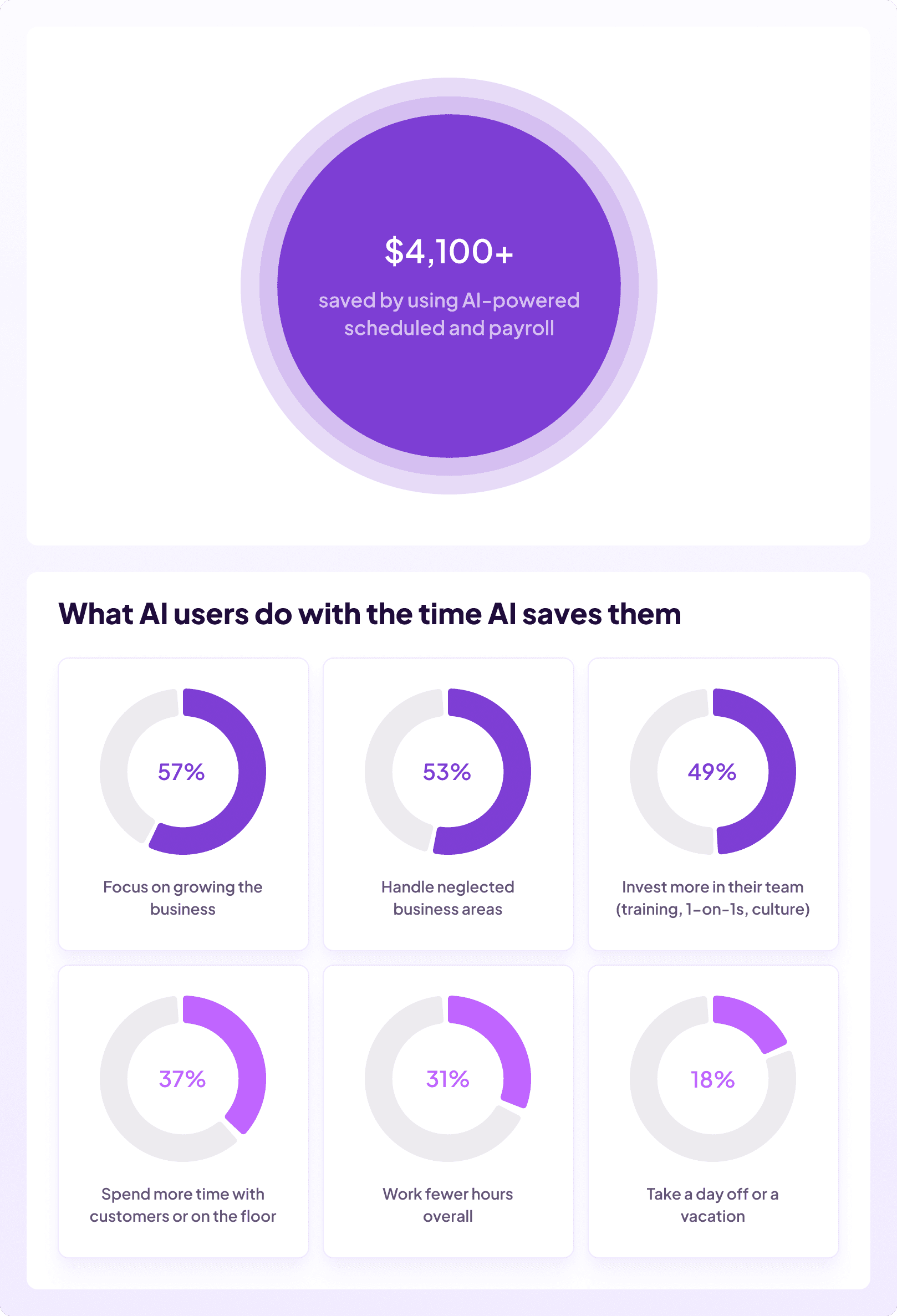
Owners aren't just leaving that time on the table. 57% say they're using it to focus on growing the business, and 53% are using it to handle previously neglected parts of the business, or the tasks that used to fall through the cracks at the end of a long shift.
Notably, this isn't an expensive proposition. Among adopters, the most common monthly AI spend is $41–$150, and 13% aren't paying anything extra at all, because they're using AI features already built into tools they have. Meaningful time savings, in other words, don't require an enterprise budget.
Trust, Not Cost, Is the Real Adoption Barrier
The 26% of small business decision-makers who haven't adopted AI aren't totally swearing it off. Most of them (62%) say they're still interested.
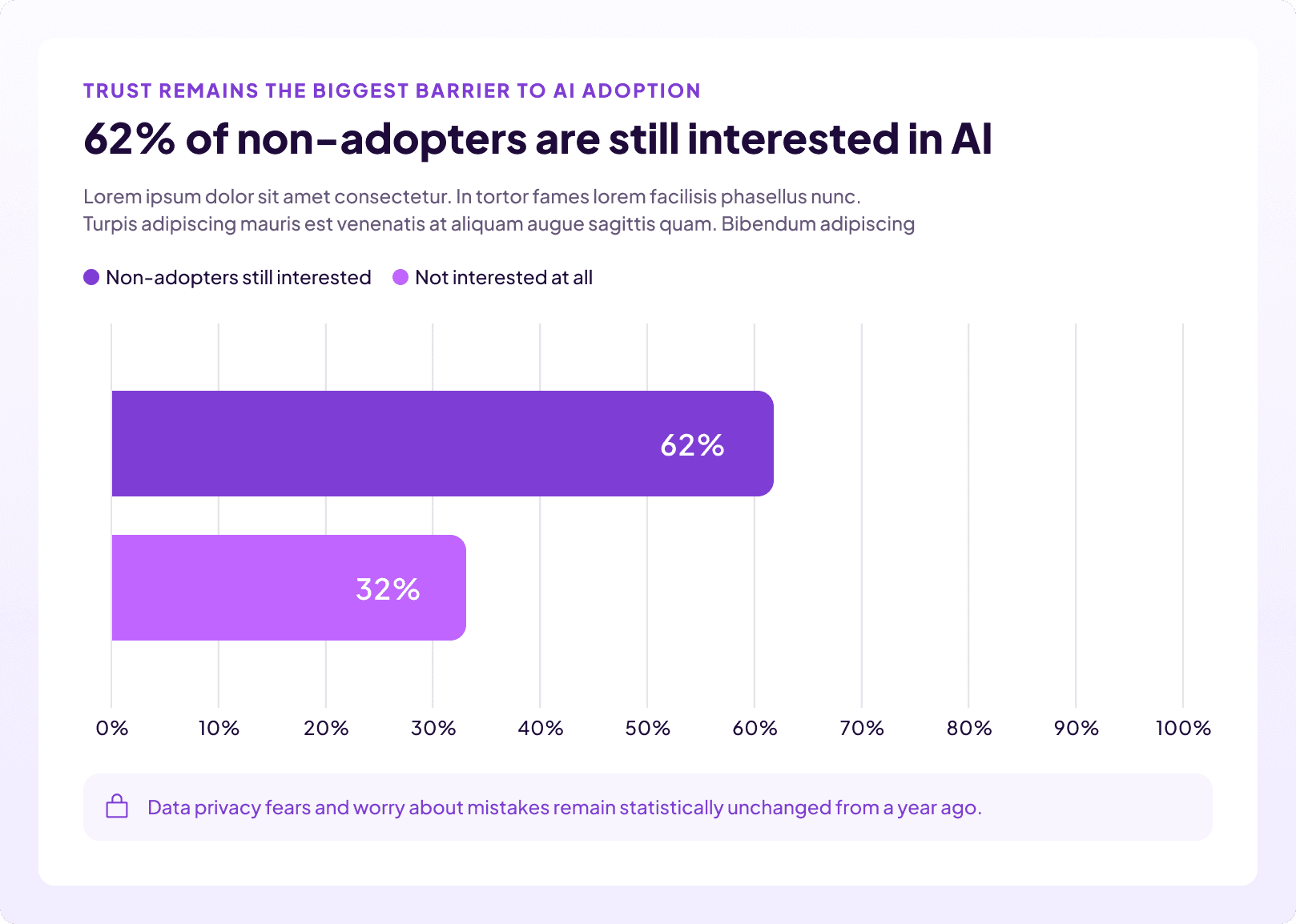
What's holding them back is the same thing that held them back a year ago. Data privacy and security concerns remain the #1 reason cited for not adopting AI (38% of non-adopters), followed by fear of mistakes (31%) and simply not trusting AI (27%). Across the full sample, data privacy (51%) and fear of mistakes (42%) top the list of concerns. These numbers are statistically unchanged from 2025, even as adoption elsewhere in the market surges.
Underneath the trust gap sits a simpler awareness gap. Only 20% of non-adopters say they've actually looked into specific AI tools for their business. 63% "knew something like this existed but not the specifics," and 18% had no idea AI tools for scheduling, payroll, or hiring existed at all.
What would move the holdouts is knowing their data is secure (37%), seeing evidence it saves money (33%), knowing a person remains in control and can override AI's decisions (31%), and seeing evidence of time savings (30%). In other words, non-adopters are asking for proof the AI is safe and proof it works before they commit.
The Next Chapter of Small Business AI Is About Growing Teams, Not Shrinking Them
Amid broader anxiety about AI and jobs, small business decision-makers see a different future at their own businesses. Looking ahead 1–2 years, owners and managers are more than twice as likely to expect AI to help their business grow (49%) than to reduce the number of employees they need for certain tasks (22%).
Saving time, for both owners/managers (46%) and employees (49%), and reducing operating costs (48%) all rank ahead of headcount reduction as the top expected impacts of AI. Only 20% expect AI to create entirely new types of jobs, suggesting most owners see AI's near-term role as augmenting the work they already do, not reshaping their org chart in either direction.

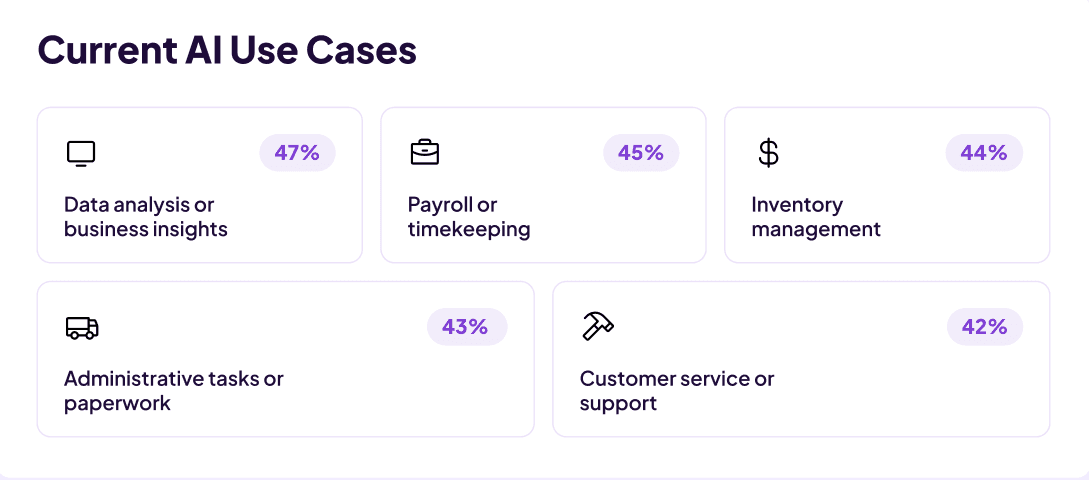
Among current adopters, the most common use cases today are data analysis and business insights (47%), payroll and timekeeping (45%), inven
tory management (44%), and administrative paperwork (43%). Interestingly, customer-facing industries lag in AI-powered customer service: retail (23%) and food service (24%) trail computer hardware/software (53%) and consulting (47%), despite being the industries with the most direct customer contact.
Bringing AI to the Businesses That Power Main Street
AI doesn't have to be flashy or enterprise-only to be transformative. It has to be practical, secure, and built around how small businesses actually operate.
That's the thinking behind Homebase's own AI Assistants. Since launching, they've handled 3.6 million administrative tasks for small businesses. Our goal for 2026 is to help small businesses save 100 million hours through AI and automation, time we believe owners will reinvest into their teams and their communities.
The AI gap on Main Street is real. But it's closing for the businesses that get the right tools, and it's closable for everyone else.
Methodology
The 2026 Main Street AI Gap Report was fielded by Propeller Insights. The survey canvassed 750 U.S. owners, executives, directors, and managers involved in payroll, scheduling, timekeeping, or HR decisions at small businesses with 5–499 employees and hourly teams. Comparison data is drawn from Homebase's 2025 Small Business AI Survey, which canvassed 828 U.S. decision-makers at small businesses with fewer than 200 employees, fielded May 30–June 11, 2025.
About Homebase
Our mission is to make small business teams unstoppable. Homebase is the leading AI-powered operating partner for hourly teams, with employee scheduling, time clocks, payroll, hiring, communication, HR, and more. More than 150,000 small businesses rely on Homebase to make work radically easy and give their teams superpowers.