
SMALL BUSINESS INTEL, IN YOUR INBOX
Table of contents
For millions of Americans, the local coffee shop is more than a place to grab caffeine. It is a morning ritual, an informal office, a meeting spot, and often one of the neighborhood businesses people know best. While major chains remain a familiar sight across the country, independent cafés continue to build loyal followings and contribute to their local economies.
Homebase data shows that the independent coffee industry grew nationally between 2024 and 2025. Local coffee shops employed nearly 6% more workers, total hours worked increased 2.7%, and payroll rose 8.4%. Average hourly wages for local coffee shop employees also climbed 5.6%.
To find where independent coffee culture is strongest, we used internal Homebase data and Joe Coffee data to analyze local shop availability and coffee shop workforce trends across the U.S. We ranked states using five industry-related factors, identified the major cities with the most independent coffee shops per 100,000 residents, compared local café locations with Starbucks and Dunkin, and examined average customer ratings of shops by city.
Whether you're planning a trip around the nearest pour-over or want to see how your hometown’s café scene compares, these are the Coffee Capitals of America.
Key takeaways:
- Local, independently owned coffee shops employed nearly 6% more workers nationwide in 2025 than in 2024. Over the same period, average hourly wages for local coffee shop employees rose 5.6%.
- Washington, Alaska, California, Ohio, and New York are the top five states leading the country in independent coffee growth.
- New Orleans, LA is the city with the highest share of local coffee shops compared with Starbucks and Dunkin locations. Independent shops make up 92.8% of its local, Starbucks and Dunkin locations, or nearly 13 local shops for every chain location.
- Birmingham, AL is America’s most coffee-dense city, with nearly 115 local coffee shops per 100,000 residents. Pittsburgh, PA, takes the #2 spot (109).
- Greensboro, NC has the highest-rated local coffee shops in the study with an average star rating of 4.64, followed by Portland, OR and San Antonio, TX (both 4.62 stars).
The states where independent coffee is thriving.
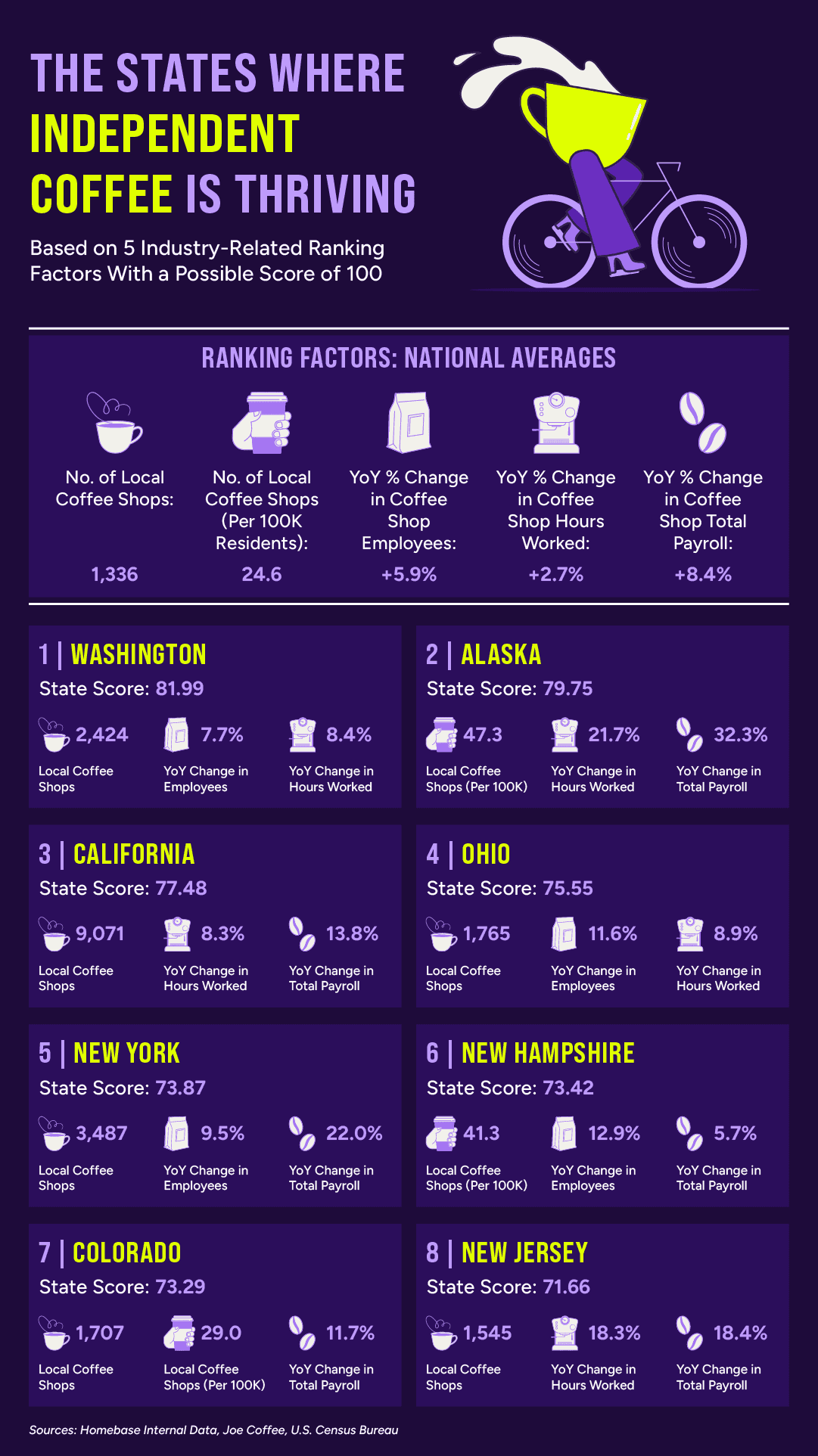
We ranked states across five measures: the total number of local coffee shops, local shops per 100,000 residents, and year-over-year changes in coffee shop employment, hours worked, and total payroll. Each state received a final score out of 100, with higher scores indicating a stronger combination of independent shop presence and industry growth.
The eight highest-ranking states and their respective scores are:
- Washington — 81.99 (out of 100)
- Alaska — 79.75
- California — 77.48
- Ohio — 75.55
- New York — 73.87
- New Hampshire — 73.42
- Colorado — 73.29
- New Jersey — 71.66
Washington takes the top spot with 2,424 independent coffee shops, or 31 per 100,000 residents. Its coffee shop workforce also expanded faster than the national average: employment increased 7.7% and hours worked rose 8.4% between 2024 and 2025. Those gains were well above the respective national increases of 5.9% and 2.7%.
Alaska ranks second and combines a high concentration of cafés with some of the strongest workforce growth in the study. The state has 47.3 local coffee shops per 100,000 residents. Coffee shop hours climbed 21.7% year over year—about eight times the national increase—while payroll rose 32.3%.
California places third and leads the country by sheer scale, with 9,071 local coffee shops, far more than any other state. The state also recorded growth across all three Homebase workforce measures: employment rose 6.6%, hours worked increased 8.3%, and payroll grew 13.8%.
Ohio comes in fourth, supported by 1,765 independent coffee shops and broad workforce momentum. Employment increased 11.6%, hours worked rose 8.9%, and payroll climbed 15.9%—all faster than the corresponding national averages.
New York ranks fifth with 3,487 local coffee shops, the third-highest total in the study. Its coffee shop payroll jumped 22%, and employment rose 9.5%, although total hours worked dipped 1% year over year.
New Hampshire lands at No. 6 with 41.3 local shops per 100,000 residents, one of the highest concentrations among the ranked states. Employment grew 12.9%, more than twice the national increase, while payroll rose 5.7%.
Colorado takes seventh place with 1,707 local coffee shops, or 29 per 100,000 residents. The state posted positive movement across employment, hours, and payroll, including an 11.7% increase in total payroll.
New Jersey rounds out the top eight after recording some of the strongest operational growth in the country. Coffee shop hours worked increased 18.3%, and payroll rose 18.4%, while employment grew 5.8%. Together, these figures suggest that independent coffee is not only widely available in the top states, but it is supporting a growing workforce, too.
Local coffee shops vs. chains in major U.S. cities.
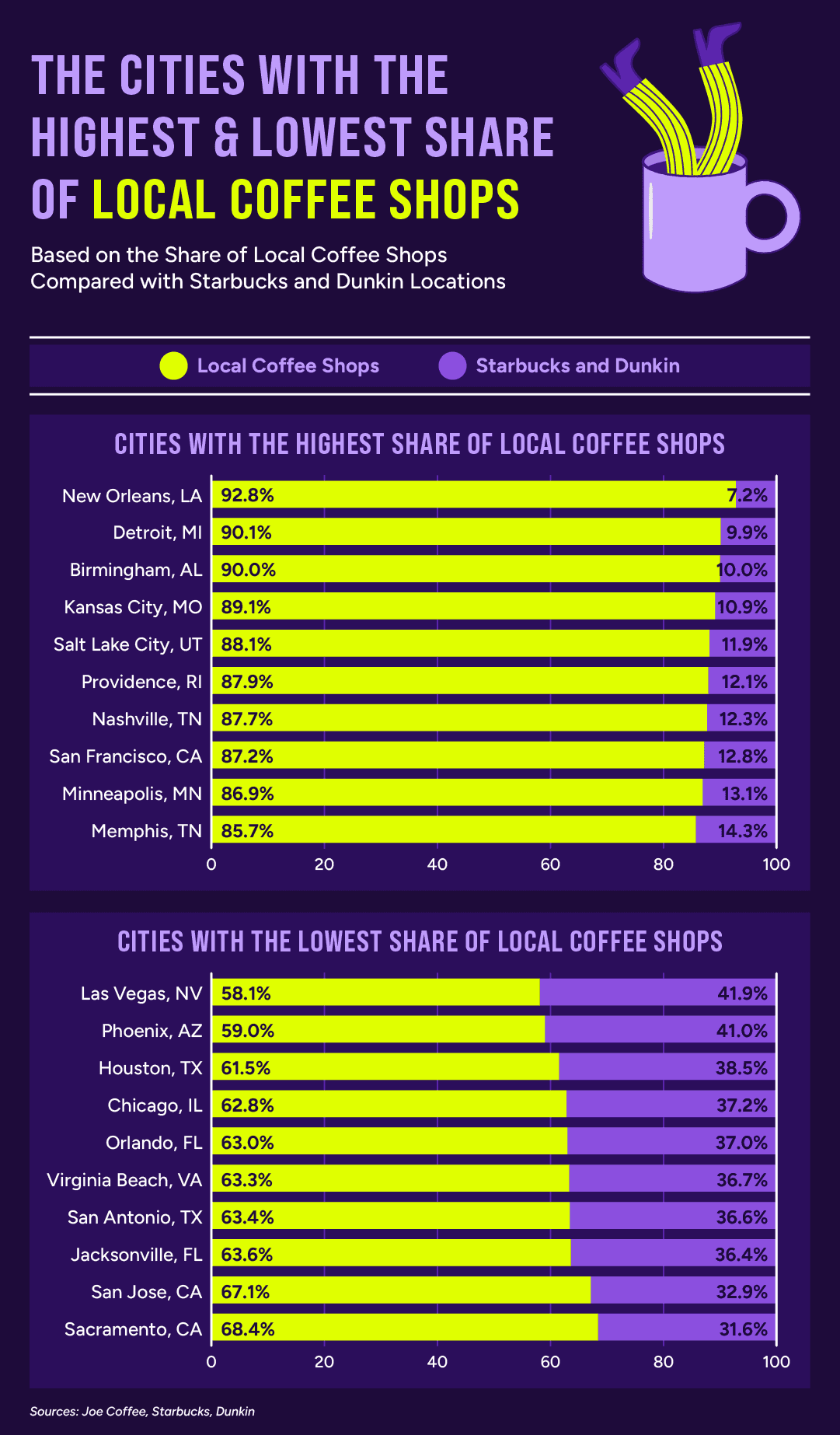
To compare local cafés with major chains, we analyzed Joe Coffee’s independent coffee shop listings alongside Starbucks and Dunkin store-locator results across 50 major U.S. cities. We calculated the share of locations that were independent coffee shops in this three-part comparison and ranked cities from highest to lowest.
Independent coffee shops outnumber Starbucks and Dunkin in every city in this analysis, but the balance varies widely. In some places, the local café is simply the more common option. In others, chains barely register by comparison.
New Orleans, LA has the strongest local-coffee presence of any city examined. Independent shops account for 92.8% of the local, Starbucks, and Dunkin locations in the city—nearly 13 local cafés for every one chain location. Detroit, MI, and Birmingham, AL are close behind, with local shops making up about 90% of the locations analyzed in each city, or roughly nine local shops for every Starbucks or Dunkin.
Las Vegas, NV has the strongest Starbucks and Dunkin presence in the ranking. Even there, local shops remain the majority, but the city has just 1.4 independent cafés for every Starbucks or Dunkin location, far from the local-to-chain ratio found in New Orleans (13).
U.S. cities with the most local coffee shops per capita.
To account for differences in city population, we ranked 70 of the largest cities in the U.S. by the number of independent coffee shops per 100,000 residents. These are the 10 most coffee-dense cities in the analysis:
- Birmingham, AL — 114.9 local coffee shops per 100,000 residents
- Pittsburgh, PA — 108.9
- Salt Lake City, UT — 108.5
- Providence, RI — 108.0
- St. Louis, MO — 93.8
- Richmond, VA — 88.5
- Cincinnati, OH — 85.9
- Charleston, SC — 80.9
- San Francisco, CA — 75.9
- New Orleans, LA — 74.6
Birmingham claims the title of America’s most coffee-dense city, with 225 local cafés serving a population of roughly 196,000. That equals nearly 115 independent shops per 100,000 residents.
The competition is tight immediately below Birmingham. Pittsburgh, PA, Salt Lake City, UT, and Providence, RI, each have more than 108 local coffee shops per 100,000 residents. Pittsburgh has the largest independent-shop count of the three at 335, while Salt Lake City has 237 and Providence has 211.
St. Louis, MO and Richmond, VA, take fifth and sixth place, respectively. St. Louis has 261 local coffee shops (about 94 per 100,000 residents) while Richmond has 210, or nearly 89 per 100,000.
The top 10 also stretches across several distinct coffee regions. Cincinnati, OH, represents the Midwest with nearly 86 shops per 100,000 residents, while Charleston, SC, brings the South into the top eight. San Francisco, CA, long associated with specialty coffee, ranks ninth with 627 independent shops and a density of nearly 76 per 100,000 residents. New Orleans, LA rounds out the list, pairing its high density with the strongest local shop share in the chain comparison.
U.S. cities with the highest-rated local coffee shops.
Coffee shop quantity tells only part of the story. We also compared the average customer rating of local coffee shops in each city. These 10 cities received the highest average star ratings:
- Greensboro, NC — 4.64 out of five stars
- Portland, OR — 4.62
- San Antonio, TX — 4.62
- Knoxville, TN — 4.61
- Jacksonville, FL — 4.61
- Charleston, SC — 4.60
- Nashville, TN — 4.59
- Indianapolis, IN — 4.59
- Cincinnati, OH — 4.58
- Miami, FL — 4.58
Greensboro, NC, earns the best average star rating in the study, with its local coffee shops receiving 4.64 out of five stars. The city stands out for quality rather than volume: Greensboro ranks 51st for shop density, demonstrating that a smaller per-capita café scene can still leave an especially strong impression on customers.
Portland, OR, and San Antonio, TX, tie at 4.62 stars, despite having very different coffee shop landscapes. Portland ranks 15th for local shop density with nearly 65 shops per 100,000 residents, while San Antonio ranks 65th with approximately 13 per 100,000.
Several Southern cities perform especially well on customer ratings. Greensboro leads the list, while Knoxville, TX, Jacksonville, FL, Charleston, SC, Nashville, TN, and Miami, FL, also appear in the top 10. Charleston is the only city to place in the top 10 for both coffee shop density and average rating, ranking eighth for density and sixth for customer reviews.
Closing thoughts.
A single formula does not define America’s strongest coffee destinations. Washington leads at the state level because it combines a substantial independent shop presence with workforce growth. Birmingham, AL has the greatest concentration of local cafés among the cities analyzed, Greensboro, NC earns the best customer ratings, and New Orleans, LA gives independent shops their largest advantage over Starbucks and Dunkin.
Together, the findings show how deeply independent coffee shops are woven into local communities. They create jobs, give neighborhoods places to gather, and let small-business owners turn a daily ritual into a distinctive local experience.
Homebase helps small businesses spend less time on administrative work and more time building the teams and customer experiences that make their communities special. Coffee shop owners can explore Homebase for tools that support scheduling, time tracking, team communication, hiring, and payroll.
Methodology.
To identify the states where the independent coffee industry is thriving most, we ranked states across five industry-related factors. Local coffee shop counts came from Joe Coffee, and state population figures from the U.S. Census were used to calculate the number of local coffee shops per 100,000 residents. Year-over-year percentage changes in coffee shop employment, hours worked, and total payroll were calculated using Homebase internal data from more than 25,000 independent U.S. coffee shops and 222,000 coffee shop employees in 2024 and 2025.
Each state’s performance across the five factors was indexed to create a final ranking score out of 100. Higher scores indicate a stronger combination of local coffee shop presence, concentration, and workforce growth. Delaware, Rhode Island, and Vermont were excluded from the final state ranking because the samples of active coffee shop locations in those states were not large enough.
Table for state ranking factors:
| Ranking factor | Weight | Source |
| Number of local coffee shops | 3 | Joe Coffee |
| Local coffee shops per 100,000 residents | 5 | Joe Coffee and U.S. Census Bureau |
| Percentage change in coffee-shop employees, 2024–2025 | 3 | Homebase Internal Data |
| Percentage change in coffee-shop hours worked, 2024–2025 | 5 | Homebase Internal Data |
| Percentage change in coffee-shop total payroll, 2024–2025 | 4 | Homebase Internal Data |
To identify the major U.S. cities with the most local coffee shops, we analyzed 70 of America’s largest cities with populations of at least 100,000, using 2025 U.S. Census population data. Using Joe Coffee data, we identified the number of independent coffee shops in each city and calculated the number of local coffee shops per 100,000 residents. Cities were then ranked from highest to lowest local coffee shop density.
For the customer rating analysis, we used the same list of 70 cities and collected Joe Coffee star ratings for every independent coffee shop in each location. We averaged those ratings by city, then ranked cities from highest to lowest to identify where local coffee shops receive the strongest average reviews. Ratings were rounded to two decimal places. Because online ratings can change, these results represent a snapshot from the period in which the data was collected.
Finally, we analyzed 50 major U.S. cities to compare independent coffee shop locations with Starbucks and Dunkin locations. Local coffee shop counts were sourced from Joe Coffee, while chain counts were collected from the Starbucks and Dunkin store locators. We added the three location counts, calculated the percentage represented by local shops, and ranked cities from the highest to lowest independent share.
Fair use.
You are welcome to use, reference, and share non-commercial excerpts of this study with proper attribution. If you cite or cover our findings, please link back to this page so readers can view the full methodology, charts, and context.