Hostess Job Description: Roles, Responsibilities, and Skills


SMALL BUSINESS INTEL, IN YOUR INBOX
Table of contents
First impressions matter, and in a restaurant, that moment belongs to your host or hostess. They set the vibe with a warm welcome and keep things flowing, which means smoother days, happier teams, and less turnover. Turnover is a real cost right now. Across small businesses on Homebase, turnover was up 6.5% year over year in September 2026.
If you’re bringing someone new on board, a clear hostess job description is key for attracting the right fit. In this article, we’ll turn the skills, qualifications, and duties of a hostess into a job description you can post today. You’ll also get pay data, interview questions, and a free template.
Quick note: “host” and “hostess” are gendered terms, so we use them interchangeably here.
TL;DR: Duties, Responsibilities, and Skills of a Great Hostess
A strong hostess job description covers who greets guests, how seating works, and which skills the job takes. In a rush? Here’s the quick breakdown of a hostess or host job description.
The basic duties and responsibilities of a hostess include:
- Greeting and welcoming guests.
- Keeping the front of house and dining area clean and tidy.
- Answering phone calls and guest questions.
- Managing reservations and the waitlist.
- Escorting guests to their tables or the waiting area.
- Helping servers during rushes.
- Handling guest complaints professionally.
- Introducing the server to the guests.
- Processing customer payments in smaller restaurants.
- Scheduling and training, for lead hostesses.
The must-have skills for a hostess:
- Excellent interpersonal and communication skills.
- Ability to work well under pressure.
- Great memory and organizational skills.
- Basic (but accurate) math for cash and POS.
- Cooperative attitude and willingness to learn.
- Previous restaurant experience or transferable skills.
The middle half of hosts earn about $13 to $17 an hour, with a median near $15. Details are in the salary section below.

What Does a Host or Hostess Do at a Restaurant?
What does a host do at a restaurant? They’re the front-of-house greeter who welcomes guests, manages reservations and the waitlist, seats each party, and coordinates with servers. What does a hostess do? The same job, and it sets the tone for the entire meal, so the role matters more than the title suggests.
As the first friendly face guests see, a restaurant hostess sets the stage for their dining experience. Depending on the business, their daily tasks can vary widely, but their impact on both guests and operations is undeniable.
A hostess’s duties fall into four categories:
- Delivering top-notch customer service.
- Making sure the restaurant is tidy and welcoming.
- Managing front-of-house tasks like reservations and phone calls.
- Coordinating with kitchen and back-of-house team members.
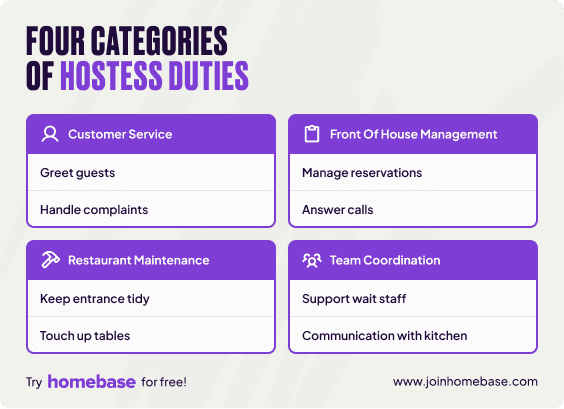
When you’re writing a restaurant hostess job description, it’s important to highlight that the work isn’t just about greeting guests. It’s about creating a smooth experience that supports the entire team and keeps customers coming back.
Host vs. hostess: is there a difference.
What is a hostess? A hostess is a host. It’s the same job with the same duties, and the only difference is the gendered title. What is a hostess job? In a restaurant, the hostess meaning and the hostess job meaning are the same: the person who greets guests and gets them seated.
The U.S. Department of Labor lists the job as “Hosts and Hostesses”, so using both terms in your hostess job description helps candidates searching for either one find you.
Host vs. server: how the two jobs differ.
The easiest way to tell the two jobs apart is this: the host gets guests to the table, and the server takes it from there. Here’s the split at a glance:
| Host or hostess | Server | |
|---|---|---|
| Greeting | First point of contact at the door | Introduces themselves at the table |
| Seating | Seats guests and rotates tables between servers | Serves the section they’re assigned |
| Orders | Usually none, though some hosts take carryout | Takes orders and brings out food and drinks |
| Tips | Vary by restaurant, often through a tip pool or tip-out | Often a large part of pay, alongside a lower cash wage |
| Typical path | A common starting point for front-of-house careers, according to working hosts | Can grow into a lead server or manager role |
A host and server job description can share a few lines, like teamwork and a positive attitude. The core duties are different, though, so write them separately. Our server job description guide covers the other side of the pass.
What does a host do during a first shift.
Job descriptions list duties. They rarely tell you how a first shift feels. In this r/TalesFromYourServer thread, a brand-new hostess with no restaurant experience says the first shift was beyond overwhelming.
The advice from working servers and hosts was practical. It also doubles as a host training plan for your next hire:
- Write down every wait time you quote, along with the time you quoted it.
- Tell servers when you open a new table in their section.
- Stick to the floor plan and the server rotation as closely as you can.
- Call a manager early when a guest issue comes up.
- Double-check the phone number for a text waitlist.
Double seating, which means putting too many tables in one server’s section at once, is a common source of tension between hosts and servers. Good hosts avoid it, and good managers train for it.
Hostess Duties and Responsibilities
A hostess job description can vary from place to place, but here are some common hostess responsibilities. The same host responsibilities apply under either title:
- Greet and welcome guests with warmth and energy. A friendly first impression sets the tone for excellent customer service. Nobody wants to be met by someone glued to their phone.
- Keep the entryway and host stand clean and organized. Whether it’s casual or upscale, a tidy space makes guests feel more comfortable.
- Answer phone calls and guest questions. From menu items to hours and dietary needs, a helpful and knowledgeable hostess builds trust and keeps customers coming back.
- Manage reservations and waitlists. Staying organized during busy hours helps the dining room run smoothly.
- Escort guests to tables or the waiting area. Keep the flow moving and make sure accessible seating is handled with care.
- Support the team when needed. Whether it’s running food or refilling waters, a great hostess helps out during busy shifts.
- Touch up tables between guests. Bussers usually clear and reset, but hostesses handle those final details that make everything guest-ready.
- Handle guest complaints calmly and kindly. If something’s off, a good hostess listens, responds professionally, and helps make it right.
Depending on the type of restaurant you’re running, a hostess job might also include:
- Providing menu and server information to get the interaction started. This is common in high-end restaurants, or when training new servers.
- Taking food and beverage orders and offering recommendations. In some places, especially smaller or fast-casual spots, a hostess may help with simple orders or suggest popular menu items.
- Operating POS systems to process customer payments efficiently. In some restaurants, hostesses handle takeout payments or help with checkout at the front. It’s similar to a cashier role, but more guest-focused than transaction-focused.
Restaurant hostess duties by type of restaurant.
No two host jobs look alike. In this r/restaurant thread, working hosts describe the same title with very different workloads. Here’s a snapshot of what they report. These are examples from individual hosts, not standards.
| Restaurant, as the host describes it | Core work reported | Extra tasks reported | What to put in your posting |
|---|---|---|---|
| Fine dining | Rotation sheets, seating charts, reservation and special-request checks, controlling wait times | Helping the dish area, bussing, sweeping the lobby and wiping menus | Opening and closing duties, plus who backs up the host |
| Chain steakhouse | Phones and seating | Bussing without bussers, restrooms, trash, sweeping, rolling kids’ silverware, closing until every table leaves | Bussing, restroom upkeep, and closing responsibilities |
| Bar and grill | Wait estimates, entering guests in the POS, seating by a server circulation chart, reservations | To-go orders, cashing out guests, sweeping the entrance, restocking restrooms, sanitizing menus | Carryout and payment handling |
| Neighborhood restaurant with heavy carryout | Phones, seating, carryout, register | Restrooms, lobby cleaning, cutting bread for carryout, making to-go desserts and salads, rolling silverware | Carryout prep and register duties |
The pattern is clear. Host duties grow with every role one host covers, so your posting should say so.
Side work to list in a hostess job description.
Side work is the part of the job nobody mentions in the interview. Hostess duties on paper rarely match hostess duties on the floor. Hosts in the thread above report bussing, restroom and lobby cleaning, rolling silverware, wiping menus, and taking carryout orders. Surprises like these frustrate new hires, and a restaurant host job description that skips them sets up a rough first week. Name yours up front.
A complete hostess job description lists:
- Opening and closing duties, including who stays until the last table leaves.
- Bussing and table resets.
- Restroom, lobby, and entrance upkeep.
- Carryout orders and register duties, if the host covers them.
- Menus, silverware, and other prep.
- How tips work for the role, including whether servers tip out the host team.
Spell it out, and candidates select themselves. You’ll get applicants who want the job you actually have.
Specific Duties of a Lead Hostess
A lead hostess job description, or lead host job description, will typically include a few extra responsibilities:
- Supervising and training the host team. A lead hostess offers formal and on-the-fly training to new team members, and answers questions that help them get confident on the floor.
- Overseeing front-of-house operations and scheduling. They help manage the flow at the host stand, adjust the seating chart as needed, and schedule host shifts.
- Maintaining high standards of service. A great lead hostess models warm, attentive service, as well as the flexibility to make good judgment calls about customer service.
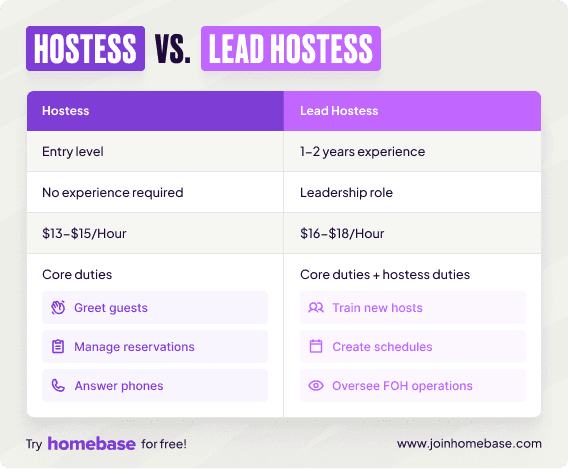
If you’re specifically hiring for a lead hostess role, someone with previous hosting experience will likely be a stronger fit than someone who’s never worked in a restaurant.
Ask an expert: “If hiring someone with no experience, you can use hypothetical examples to gauge how they would approach scenarios and how that would align with the culture.” Josh Dunton, Lead Talent Acquisition Advisor at Homebase
Essential Hostess Skills and Qualifications
Whether you’re hiring fresh talent or promoting a trusted team member, certain hostess skills help anyone shine at the host stand:
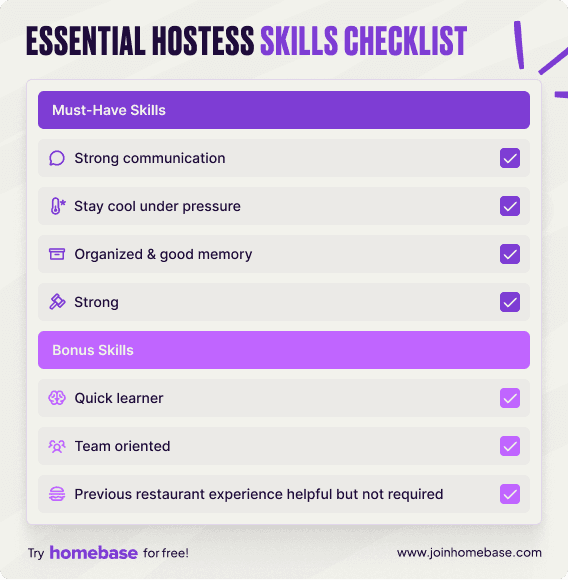
- Strong communication and people skills. A friendly, confident communicator makes guests feel welcome and can handle sticky situations with ease.
- Ability to stay cool under pressure. Hostesses often navigate dinner rushes, waitlists, and last-minute changes. Experience in fast-paced event management or barista roles can be game changers.
- Organized with a good memory. Juggling seating charts, special requests, and server rotations takes multitasking magic.
- Basic math for POS or wait times. Some hostess jobs involve payments or estimating wait times, so cashier or retail associate experience can be a big bonus.
- Certifications (if needed). Depending on the restaurant, a food handler or alcohol service certification might be needed, but they’re quick to get, especially for folks with prior food service experience.
- Entry-level friendly. Many hostess jobs are perfect for summer students or those new to hospitality, but lead hostess roles usually need more experience.
- Comfortable asking questions. Great hostesses don’t guess, they ask. Entry-level hostesses who are eager to learn can be promoted to lead roles once they have experience.
- Team-oriented mindset. Restaurants thrive on teamwork. A hostess who communicates and collaborates well can step in where needed and keep the energy upbeat during busy shifts.
Need the short version? The five core skills of a host are communication, organization, composure under pressure, teamwork, and basic math.
Quick tip: restaurant experience is great, but don’t overlook someone new to the field. Transferable skills can go a long way, and they’re how many hostess careers begin. That’s also the short answer to how to become a hostess.
Recommended Hostess Qualifications, Education, and Certifications
Hostess qualifications are mostly about attitude, not paperwork. No federal law requires hostesses to hold certifications, but some states and counties require food handler cards for employees who handle food. Some employers may also prefer candidates who hold certifications. A couple of common certifications include ServSafe Alcohol for hostesses who serve alcohol or check IDs, or ServSafe Food Handler to cover general food safety.
OSHA doesn’t require CPR training, but it does require someone trained in first aid when there’s no clinic or hospital nearby. It’s also a bonus if front-of-house team members have CPR and First Aid certification in case of choking or allergy emergencies.
Some states have different health and safety requirements, so check your local laws before you put up your official hostess job description.
Hostess Salary Expectations
How much does a hostess make? Restaurant hosts and hostesses earn a median of $15.00 an hour, according to the Bureau of Labor Statistics’ 2025 wage data. Half of hosts earn between about $13.25 and $17.43 an hour, and the highest-paid tenth earn more than $21.
In the United States, the middle half of hostesses earn about $13 to $17 an hour, depending on a few factors:
- Location. In high-cost states like New York and California, hosts earn well above the national average, according to BLS state wage data. In lower-cost states, they might be closer to the federal minimum wage, which is currently $7.25.
- Type of restaurant. Upscale or busy restaurants in cities will often have higher pay, but casual or small-town spots might offer more flexible hours.
- Tips. Pay from tips varies by restaurant, and in some, hostesses might be included in the tip pool.
Lead hostesses often earn more, since they take on extra responsibilities like guiding the host team and helping run the front of house (FOH).
How much does a hostess make per hour.
So how much do hosts make, and what does hostess pay look like at the low and high ends? The BLS breaks hostess salary data into percentiles, which shows how wide the range really is:
| Percentile | Hourly pay |
|---|---|
| 10th | $10.74 |
| 25th | $13.25 |
| Median | $15.00 |
| 75th | $17.43 |
| 90th | $21.15 |
For a second lens, we checked our own payroll data. Food and drink businesses on Homebase paid an average of $14.24 an hour in September 2026, up 5.8% from $13.46 a year earlier, per our monthly small business labor report. That covers every food and drink role, not just hosts, so treat it as context rather than a host benchmark.
When you’re posting a job description for a hostess, don’t forget to include the salary range. This provides extra transparency and can attract quality candidates if your pay is competitive.
Do hosts get tips.
Do hosts get tips? Sometimes. Some restaurants include hosts in a tip pool or have servers tip them out, and others pay a higher base wage instead. Because tips affect how you pay and what you promise, it helps to know the basics.
Federal rules are specific. According to the Department of Labor’s Fact Sheet #15, a tipped employee is someone who customarily and regularly receives more than $30 a month in tips. A traditional tip pool, used when an employer takes a tip credit, is limited to roles that customarily receive tips, like waiters, bussers, and service bartenders.
Working hosts see it differently from restaurant to restaurant. In that same r/restaurant thread, one former host says servers tip them out, and another says carryout orders can bring tips. That’s why your posting should state exactly how tips work for the role. A clear tip policy helps you stay compliant and keeps your team on the same page.
For a deeper look, see our guides to tip pooling and tipped minimum wage by state.
Hostess Job Description Template for Employers
A great job description for a hostess does two things: it helps employers attract the right people, and it gives applicants a clear picture of what the role is really like. Feel free to use this hostess job description template for your next posting, and make any tweaks you need to personalize it for your restaurant.
We’re hiring an enthusiastic hostess to create memorable guest experiences and deliver exceptional customer service!
Looking for a fun, team-driven job in hospitality? We’re hiring a hostess to be the smiling face at the door and the calm in the dinner rush.
You’ll greet and seat guests, support your coworkers, and help the whole place run like a dream. If you love working with people and can multitask like a pro, we think you’ll fit right in.
What you’ll do: duties and responsibilities.
- Give guests a warm welcome.
- Manage reservations and the waitlist.
- Answer phone calls and questions from guests.
- Keep the front of house looking spotless.
- Coordinate seating and escort guests to their tables.
- Step in to support servers as needed.
- Answer questions about the menu.
- Provide exceptional customer service.
- Handle side work: [list yours, such as bussing, restrooms, carryout, and menus].
What you bring: soft and hard skills.
- Positive energy and people skills.
- The ability to work (and thrive!) under pressure.
- A team-player attitude and willingness to learn.
- Basic math skills and experience with POS operation.
- Confident conflict resolution.
- Organization skills and a sharp memory.
- Availability for shift work (days, evenings, weekends), minimum 15 hours a week.
Bonus points for:
- Previous restaurant or hosting experience.
- Food safety certificates (we can help you get one if not!).
What we offer:
- Competitive hourly wage: [$15 to $18] per hour (plus tips!). This is an example range, so adjust it to your local pay.
- Tips: [explain how tips work for this role].
- Time-and-a-half pay on holidays.
- Flexible schedules and the option to pick up shifts.
How to apply, and what happens next. [Add your application instructions, required materials, and next steps.]
Tired of writing job posts from scratch and pasting them into one job board at a time? Write it once, and reach Indeed, ZipRecruiter, Google, Facebook, and Craigslist in one click (btw, exactly what Homebase hiring does for free).
Hostess Interview Questions to Ask
The best hostess interview questions are scenario based, because the job is mostly judgment under pressure. Ask candidates how they’d handle a long wait, an upset guest, or a server who feels overloaded, and listen for calm, clear, team-first answers.
Once your hostess job description brings in applicants, the interview is where you find the right one. For more general questions, see our list of restaurant interview questions.
Host interview questions that use real scenarios.
These six host interview questions draw on situations new hosts and servers describe in the Reddit threads above. Each one includes what a good answer sounds like:
- A guest points to an empty table in a section with no server. What do you say? A good answer stays friendly and firm, explains that no server is available there, and offers the next open table.
- You quoted a party 20 minutes, and now it’s 35. What do you do? A good answer checks in with the guests, updates the wait honestly, and keeps a record of every quote.
- A server says you’re seating them too much. How do you respond? A good answer listens, adjusts the rotation, and communicates with that server going forward.
- A guest asks about an allergy, and you aren’t sure of the answer. What’s next? A good answer never guesses and checks with a manager or the kitchen first.
- A guest seems intoxicated. What do you do? A good answer lets a manager know right away.
- A guest is rude about the wait. How do you handle it? A good answer stays professional, sticks to restaurant policy, and calls a manager if it escalates.
Interviews go best when you only meet people who fit. Add deal-breakers, like required availability, and screen out everyone who doesn’t meet them. Put those must-haves in your hostess job description too, so applicants see them first.
Reading every application by hand while the dining room fills up? Applicants who complete the screener are reviewed right away, and matches are flagged for you. Your 30-day free trial of Unlimited starts when you post your first job, so give Hiring Assistant a try.
Hostess Description for Resume: What Employers Should Look For
A strong hostess resume makes your screening easier. When scanning a hostess job description resume, here are the details that’ll help you pick out rockstar candidates for the job:
- Busy restaurant experience? Big plus. If they’ve worked in a fast-paced spot, they’re probably great at handling crowds and keeping things moving.
- Knows how to upsell and wow guests. Look for examples where they boosted sales and made people feel welcome. It’s a winning combo.
- Essential skills clearly listed. Things like POS systems, multitasking, and general restaurant know-how show they’re ready to jump in and keep things running smoothly.
Highlighting these details on a resume shows you who’s polished, prepared, and ready to dive into the job. If those key points are missing? It might be a sign they’re not quite the right fit for your hostess role.
Finding (and Keeping) the Right Restaurant Hostess
Writing a clear hostess job description makes it way easier to find the right people. The more details you include, the better your chances of finding that perfect fit. Use the tips and templates above to build a post that fits your vibe and attracts the candidates you want to keep.
The best new hires walk in knowing the plan. Post the job, meet the right people, and, on the paid plan, move your new host onto your roster and payroll in the same app. Post your first job free, with no credit card required, on Homebase.
Frequently Asked Questions About Hostess Job Descriptions
What is a hostess?
A hostess is a restaurant’s front-of-house greeter who assists both guests and servers in creating a welcoming dining experience. As the first point of contact, a strong restaurant hostess sets the tone for great service while keeping things like reservations and waitlists organized.
What is the typical job description of a hostess?
A typical job description of a hostess includes greeting guests, managing seating and reservations, answering phones, and coordinating front-of-house flow. Depending on the restaurant, it can also cover carryout orders, bussing, and light cleaning, but customer service is always the priority.
How do you describe a hostess job on a resume?
To describe a hostess job on a resume, use short action phrases that show what you handled during a shift. Here are a few examples:
- Facilitated guest seating with a friendly attitude.
- Managed reservations and the waitlist.
- Pitched in serving food and drinks during rushes.
- Used POS systems to coordinate front-of-house tasks.
- Tidied final touches on tables.
What is the difference between a hostess and a waitress?
The difference between a hostess and a waitress comes down to when they meet the guest. A hostess greets guests and handles the seating, while a waitress takes orders and brings out the food.
Both jobs are important, and they focus on different parts of the dining experience.
What kind of skills do you need to be a hostess?
The skills you need to be a hostess include strong communication, multitasking and organization, customer service, and a team-player attitude. Knowing how to use a POS system is a bonus, and staying calm and friendly under pressure goes a long way.
Do hosts get tips?
Hosts get tips in some restaurants, usually through a tip pool or a tip-out from servers, and not at all in others. Because tips vary, spell out how they work for the role in your job description so candidates know what to expect.
Is being a host hard?
Being a host is hard in the moments that matter: rushes, long waits, and upset guests. Some new hosts describe a first shift as overwhelming.
The skills, like staying calm and communicating clearly, can be taught. A clear plan for the first week makes the job much easier.