How to Write a Massage Therapist Job Description (+ Free Template)

SMALL BUSINESS INTEL, IN YOUR INBOX
Table of contents
Before you post an opening for a massage therapist, there's one detail most job listings skip: massage therapy is a licensed profession in 49 U.S. states and territories, according to the Federation of State Massage Therapy Boards (FSMTB). Your posting needs to require proof of an active state license, not just any credential. Hire someone with a lapsed license and the liability falls on you.
This guide gives you a ready-to-use massage therapist job description template, a clear breakdown of duties and qualifications, salary benchmarks, and a simple onboarding checklist for once you've made your hire.

Hiring shouldn't be tirin
Keep an eye on your potential hires, from job postings all the way to onboardings. You’ll never be out of the loop again.
What to Know Before You Hire a Massage Therapist
- Licensure is required in 49 U.S. states and territories, per the FSMTB. Your posting should require proof of an active license.
- Core duties include client consultations, hands-on massage sessions, Subjective, Objective, Assessment, and Plan (SOAP) note documentation, and treatment room maintenance.
- The median annual wage is $58,450, per the Bureau of Labor Statistics (BLS, May 2025). Compensation structures vary: hourly, per session, commission, and tips all factor in.
- Decide on W-2 or 1099 before you post. If your therapist works your schedule, at your location, with your equipment, they're likely a W-2 employee under IRS guidelines. Getting this wrong creates back-tax liability.
What Does a Massage Therapist Do?
A massage therapist uses hands-on techniques to manipulate soft tissues (muscles, tendons, ligaments, and connective tissue) to reduce pain, relieve stress, and support recovery. They conduct client intake assessments, perform sessions tailored to each client's needs, recommend follow-up care, and maintain accurate treatment records.
The day-to-day looks different depending on the setting. A therapist at a spa runs back-to-back relaxation sessions. One at a chiropractic clinic writes clinical notes and works alongside the chiropractor. A sports massage therapist may work on-site at events. What stays the same: the consultation, the treatment, the documentation, and the room reset between clients.
Massage Therapist Duties and Responsibilities
Session duties:
- Conduct client health history intake and screen for contraindications before each session
- Perform Swedish massage, deep tissue, trigger point therapy, and other trained modalities
- Adjust pressure and technique based on client feedback during the session
- Maintain proper draping and professional boundaries throughout every appointment
- Document sessions using SOAP notes after each appointment
- Clean, sanitize, and reset the treatment room between clients
Administrative and client management:
- Manage appointment scheduling and maintain a consistent booking cadence
- Follow up with clients on home care recommendations and rebooking
- Maintain client confidentiality in line with applicable privacy standards
- Recommend retail products or service add-ons where appropriate
- Track continuing education requirements to keep state licensure current
One thing to include in your job posting: most massage therapists perform four to six sessions per day. The BLS notes that many therapists cannot perform massage services eight hours a day due to the physical demands of the work. Build your scheduling expectations around it from the start.
What Are the 7 Types of Massage?
The seven most commonly practiced types of massage are Swedish, deep tissue, sports, hot stone, prenatal, trigger point, and aromatherapy. Each addresses different client needs, from general relaxation to injury recovery to pregnancy support. Not every massage therapist is trained in all modalities.
- Swedish: Long, flowing strokes designed for relaxation and stress relief; the most widely practiced modality
- Deep tissue: Firm, sustained pressure targeting deeper muscle layers; suited for chronic tension and injury recovery
- Sports massage: Pre- and post-event work focused on performance and injury prevention; common in athletic and clinical settings
- Hot stone: Heated basalt stones applied to key muscle groups; promotes deep relaxation; most common in spa settings
- Prenatal (pregnancy) massage: Adapted techniques for pregnant clients to reduce discomfort and swelling
- Trigger point therapy: Sustained pressure on hypertonic muscle knots to release tension and reduce referred pain
- Aromatherapy massage: Swedish technique combined with therapeutic essential oils
Your job posting should list only the modalities you offer. A chiropractic clinic probably doesn't need hot stone. A day spa likely does.
Massage Therapist Qualifications and Skills
Required:
- Active state massage therapy license (Licensed Massage Therapist [LMT]), required in 49 U.S. states and territories per the FSMTB
- Completion of an accredited massage therapy program (typically 500 to 1,000 hours, depending on state; see the FSMTB's state-by-state requirements)
- Passage of the Massage and Bodywork Licensing Examination (MBLEx), administered by the FSMTB, or a state-equivalent exam
- Current CPR and first aid certification (required in many states, recommended for all)
Preferred:
- Specialty certifications in prenatal, sports, or lymphatic drainage massage
- Experience with the specific modalities your practice offers
- Strong rebooking and client retention record
- Comfort with scheduling and documentation tools
One thing most employers skip: before your new hire's first day, look up their license on your state board's website and confirm it's active. Most state licensing boards offer a free online lookup. The FSMTB's license lookup tool is a good starting point. Hiring someone with a lapsed or suspended license creates liability.
What Is the Average Salary for a Massage Therapist in the US?
According to the BLS, the median annual wage for massage therapists was $58,450 as of May 2025. Earnings range from around $33,640 at the lower end to more than $100,200 for the top 10%, depending on specialization, experience, and setting.
A few other figures worth knowing:
- Median hourly rate: $28.10
- Chiropractic offices pay the highest median at $72,800; spa and hotel settings typically run lower
- Compensation structure varies: hourly pay, per-session flat fees, and commission-based pay are all common. Tips are standard in spa settings and should factor into your total compensation picture.
One classification issue that catches small business owners off guard: if your massage therapist works set hours at your location with your equipment, they're likely a W-2 employee, not a 1099 contractor. Per IRS worker classification guidelines, misclassifying that relationship can trigger back taxes and penalties. Talk to an accountant before you post if you're unsure.
Massage Therapist Job Description Template
Here's a template you can copy and customize. Everything in brackets is yours to fill in based on your setting, pay structure, and open role.
[Job title] | [Full-time / Part-time / Contract]
[Business name] | [City, State]
About us
[Two to three sentences about your practice, who you serve, and what makes working there worthwhile.]
What you'll do
- Conduct client health history intakes and screen for contraindications
- Perform [list your modalities, e.g., Swedish, deep tissue, trigger point therapy]
- Document sessions using SOAP notes and maintain accurate client records
- Sanitize and reset treatment rooms between each appointment
- Recommend home care practices and follow up on rebooking
What we're looking for
- Active [state] massage therapy license (LMT) required
- Completion of an accredited massage therapy program (minimum [X] hours)
- MBLEx certification or state-approved equivalent
- [X]+ years of professional experience preferred
- [Any specialty modalities or certifications your setting requires]
- Current CPR and first aid certification
Compensation
- [$X per hour / $X per session / [X]% commission]
- Tips [standard / included / not applicable]
- [Benefits: free or discounted services, flexible scheduling, health coverage, etc.]
To apply
[Your application instructions or link.]
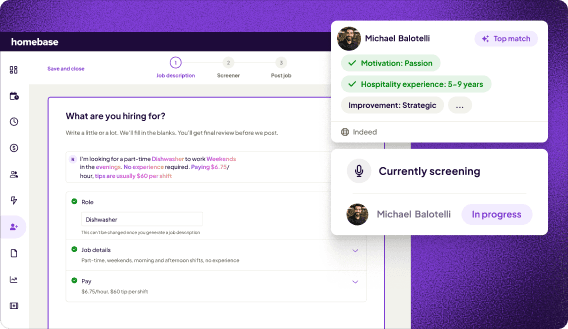
Once your description is ready, Homebase posts it to Indeed, ZipRecruiter, Google, Glassdoor, and more from a single place, no separate accounts required.
Shelly Betz, owner of Modern Chiropractic Center, relies on exactly that: "I love that when I have hiring needs I can create the job on Homebase and then they do all the work posting it to various sites."
How to Customize Your Job Description by Setting
The template above works across settings, but a few details shift depending on where you're hiring.
Spa or wellness studio: Lead with relaxation modalities: Swedish, hot stone, and aromatherapy. Highlight product knowledge and the ability to recommend service add-ons. Soft skills like creating a calming client experience matter as much as technique. In full-service spas, massage therapists often share clientele with estheticians and nail technicians, so the job description structure for those roles follows a similar pattern if you're building out a full team.
Chiropractic clinic: Prioritize deep tissue, trigger point therapy, and clinical documentation (SOAP notes). Candidates should be comfortable working alongside a chiropractor and following clinical protocols. Medical or clinical massage experience is worth calling out as preferred.
Sports or athletic facility: Focus on sports massage, pre- and post-event work, and injury prevention. If you work with athletic trainers, mention it. Specialty certifications like the AMTA Sports Massage Certificate are worth adding to your preferred qualifications.
How to Post a Job Description That Attracts the Right Candidates
A good job description does two things: it gets the right people to apply and filters out everyone else. A few things that help on both counts:
- State the LMT requirement upfront. Don't bury it in the qualifications section. If it's in the first two lines, unqualified candidates self-select out before you spend time reviewing their application.
- List only the modalities you need. Posting every type of massage you've heard of sends the wrong signal.
- Be specific about session volume. If a therapist expects four sessions per day and you're booking six, that misalignment surfaces fast.
- Name a real pay range or structure. "Competitive pay" gets skipped by experienced therapists who know what they're worth. A specific number or clear commission structure gets more applications.
- Post on the right job boards. Massage therapists don't always search the same platforms as restaurant or retail workers, so casting a wider net matters more than sticking with a single site.
- Add one detail about your practice. Your team culture, client mix, or facility: something concrete makes your posting stand out from the identical templates elsewhere.
Homebase's job posting tool distributes your listing across major boards at once, and you can add screening questions to filter applicants before they reach your inbox.
Onboarding Your New Massage Therapist
A strong hire can still get off to a rough start if the first week is disorganized. Working through a new employee onboarding checklist before day one makes a real difference, especially with licensed professionals who need time to absorb your service protocols before seeing clients.
Before they arrive:
- Verify their state license is active using the FSMTB's license lookup tool and collect a copy for your records
- Send their onboarding packet with the I-9, W-4, direct deposit authorization, and state tax forms
- Run a background check if required by your setting or insurance carrier
- Share your booking system access and walk them through how scheduling works
On day one:
- Go through your client intake forms, consent documents, and SOAP note templates
- Set session volume expectations clearly: how many bookings per day, how breaks work, who manages the schedule
- Walk them through room setup, supplies, and your specific service protocols. Training beauty and wellness employees on your house standards often takes a few guided sessions before it sticks, so build that time in before their first solo client.
Frequently Asked Questions About Massage Therapist Job Descriptions
What are the duties of a massage therapist?
A massage therapist's core duties include performing therapeutic massage sessions, conducting client health history intakes, documenting sessions using SOAP notes, maintaining clean treatment rooms, and recommending follow-up care. Most also handle appointment scheduling and client communication between sessions.
What are the 7 basic massages?
The seven most commonly practiced types of massage are Swedish, deep tissue, sports, hot stone, prenatal, trigger point, and aromatherapy. Swedish is the most widely practiced. Not all massage therapists are trained in every modality, so your job posting should specify which techniques the role requires.
What is the average salary for a massage therapist in the US?
According to the BLS, the median annual wage for massage therapists was $58,450 as of May 2025. Earnings range from around $33,640 at the lower end to more than $100,200 for the top 10%, depending on specialization, experience, and setting.
Do massage therapists need to be licensed to work in my business?
In most U.S. states and territories, yes. The FSMTB reports that licensure is required in 49 U.S. states and territories. Requirements typically include completing an accredited training program (500 to 1,000 hours) and passing the MBLEx. Employers are responsible for verifying that a candidate's license is currently active.
Should I hire a massage therapist as a W-2 employee or 1099 contractor?
If your massage therapist works set hours, uses your equipment, and follows your schedule, they're typically a W-2 employee under IRS guidelines. Misclassifying an employee as an independent contractor can result in back taxes and penalties. When uncertain, consult an accountant or HR professional before making an offer.
How many clients can a massage therapist see in a day?
Most massage therapists can comfortably perform four to six sessions per day, depending on session length and modality. Deep tissue and therapeutic sessions are more physically demanding than relaxation work. Setting realistic session volume expectations upfront, in your job posting and your scheduling, helps reduce burnout and turnover.
Ready to Post Your Massage Therapist Job Description?
You now have a job description built to attract qualified, licensed candidates, along with a clear picture of what it takes to get a great massage therapist hired and set up for day one.
When you're ready to post, Homebase puts your listing in front of candidates on the boards they're already using and gets your new hire's paperwork signed before they walk in the door. Get started for free.
Hiring shouldn't be tiring.
Keep an eye on your potential hires, from job postings all the way to onboardings. You’ll never be out of the loop again.