Employee Evaluation Template and Performance Review Examples

SMALL BUSINESS INTEL, IN YOUR INBOX
Table of contents
If you’ve ever walked out of a performance review thinking “that could have gone better,” you’re not alone—and you’re probably also the manager who wants to do it right. A well-built employee evaluation recognizes great work, surfaces problems before they build up, and gives your team a clear sense of where they’re headed.
This guide gives you everything you need to make that happen. You’ll find a free employee evaluation template, real-world employee evaluation examples, and practical advice on providing employee feedback that actually means something.
TL;DR: Employee evaluation template
Short on time? Here’s the quick version.
A solid employee evaluation template covers four things:
- Employee info — name, role, review period, manager
- Performance assessment — rate key areas like quality of work, reliability, communication, and teamwork (use a point scale, something like: Needs improvement / Meets expectations / Exceeds expectations)
- Goals and development — review the last period’s goals, set new ones, note any training or development opportunities
- Comments + sign-off — space for manager and employee to add notes, then both sign off
A few tips for writing a strong employee performance evaluation:
- Lead with outcomes (what they did), then move to behaviors (how they did it)
- Use the Situation → Behavior → Impact formula to keep feedback specific
- Avoid vague language — “clocked out early on four shifts without notifying a supervisor” hits harder than “needs to be more responsible”
- End every review with clear, measurable goals for the next period

What’s the best employee evaluation template?
The right employee evaluation template depends on two things: when you’re doing the review, and who’s giving the input. Get those two factors right and the rest of the form practically writes itself.
Here’s a quick breakdown of the main types of performance reviews you could use:
- Simple performance review template. Use this for quick check-ins or informal one-on-ones. It covers the basics: what’s going well, what needs work, and what’s next.
- Annual performance evaluation template. Your full-picture, once-a-year deep dive. Use it to document growth over time and back up decisions about raises or promotions with something more than a gut feeling.
- Quarterly performance review template. Review goals every 90 days and small problems stay small. This cadence works especially well for fast-moving teams where waiting a full year to course-correct just isn’t an option.
- 30-60-90 review template. New team members need structured checkpoints. A 30-60-90 day review helps you assess fit and progress before the probationary period is up, so there are no surprises for either side.
- 360-degree feedback. More effort to set up, but the payoff is real. You get a picture of how someone operates that no single manager could put together alone, as peers, direct reports, and leadership all weigh in.
- Employee self-evaluation. Ask team members to assess themselves before sitting down with you. The conversations that follow tend to be richer, more honest, and a lot less one-sided than a traditional performance review.
Free employee evaluation template
This free employee evaluation template covers everything you need for a solid review. You’re welcome to copy and adjust it to fit your business.
Employee information
Employee name:
Job title:
Department:
Manager name:
Review period: (e.g., Q1 2025 / Jan 1 – Mar 31, 2025)
Review date:
Employment start date:
Performance assessment
Rate each area using this scale: 1 – Needs improvement | 2 – Meets expectations | 3 – Exceeds expectations.
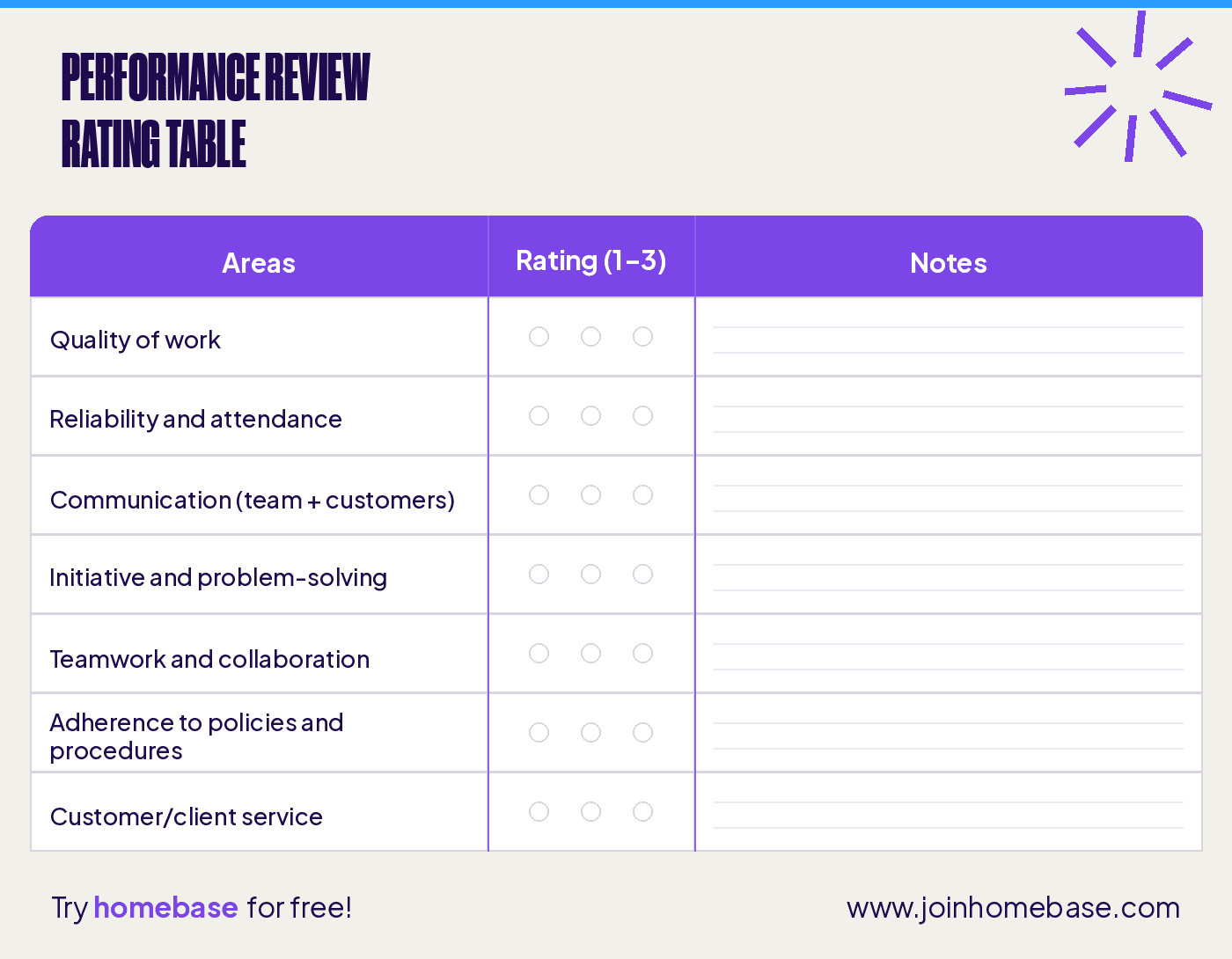
Overall performance rating: ___ / 3
Top strengths observed this period:
- Strength 1
- Strength 2
- Strength 3
Areas that need improvement:
- Area 1
- Area 2
- Area 3
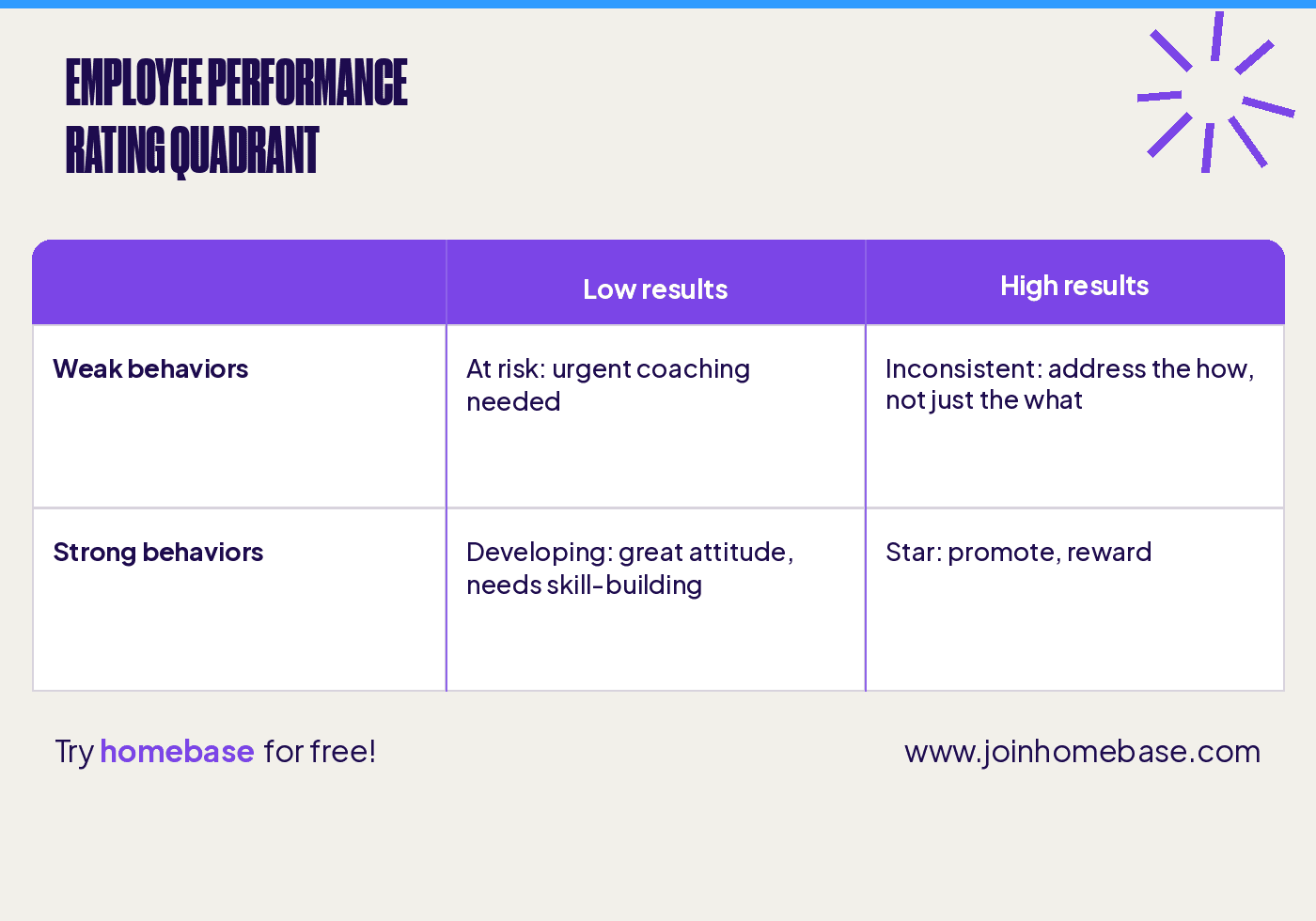
Tip: This section is entirely yours to mess with. Some managers love a straight numerical rating: clean, fast, done. Others prefer a performance quadrant, which maps employees across two dimensions: results (did they actually hit their targets?) and behaviors (did they show up the right way while doing it?). It looks something like this:
Discussion points:
- Point 1
- Point 2
- Point 3
There’s no universally correct method here. A 3-point scale is plenty for a tight-knit crew doing weekly check-ins. The quadrant shines when you’re managing a bigger team and want a visual that sparks a real conversation. Try one, see how it feels, and swap it out if it doesn’t click.
Goals and development
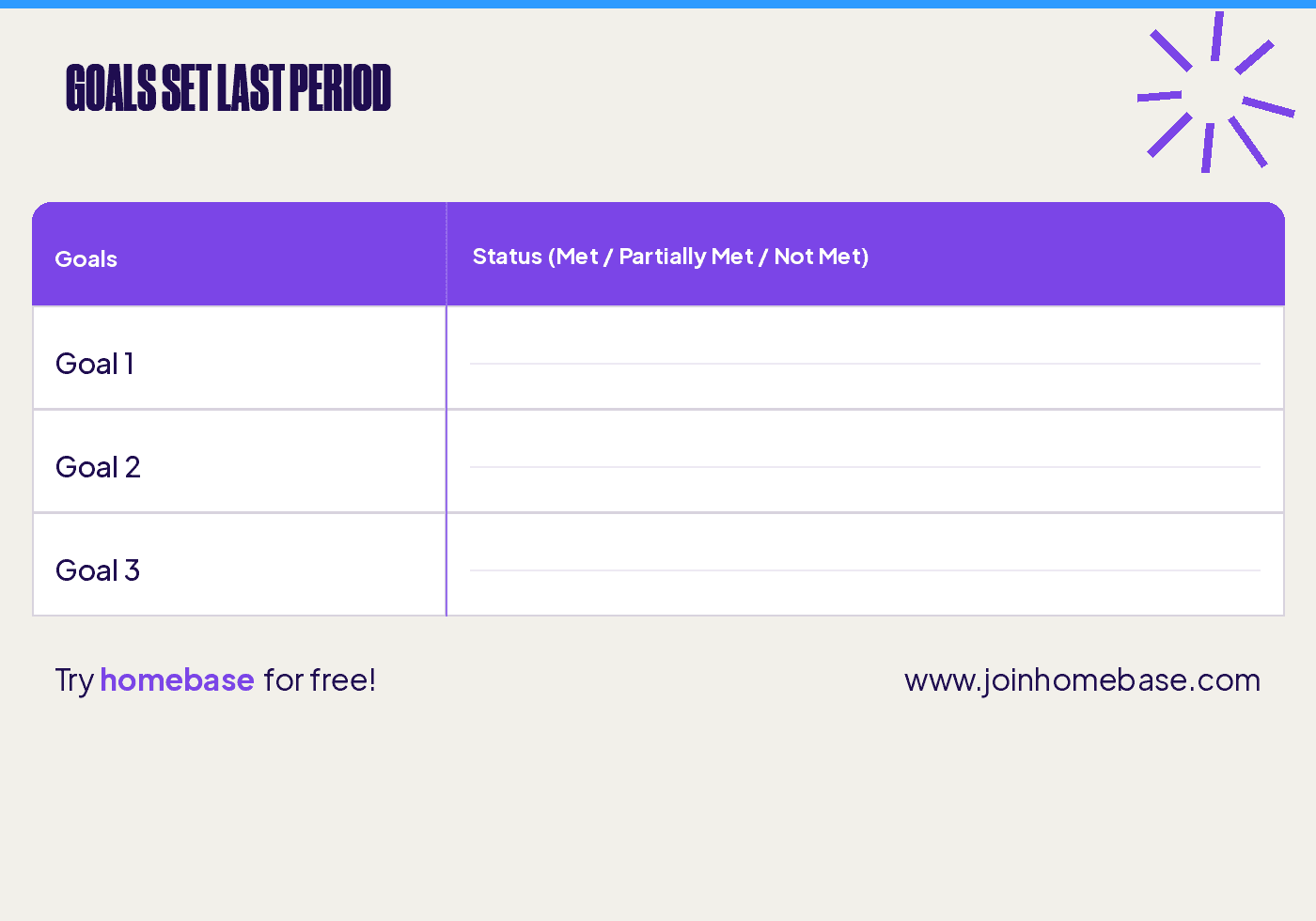
Goals set last period:
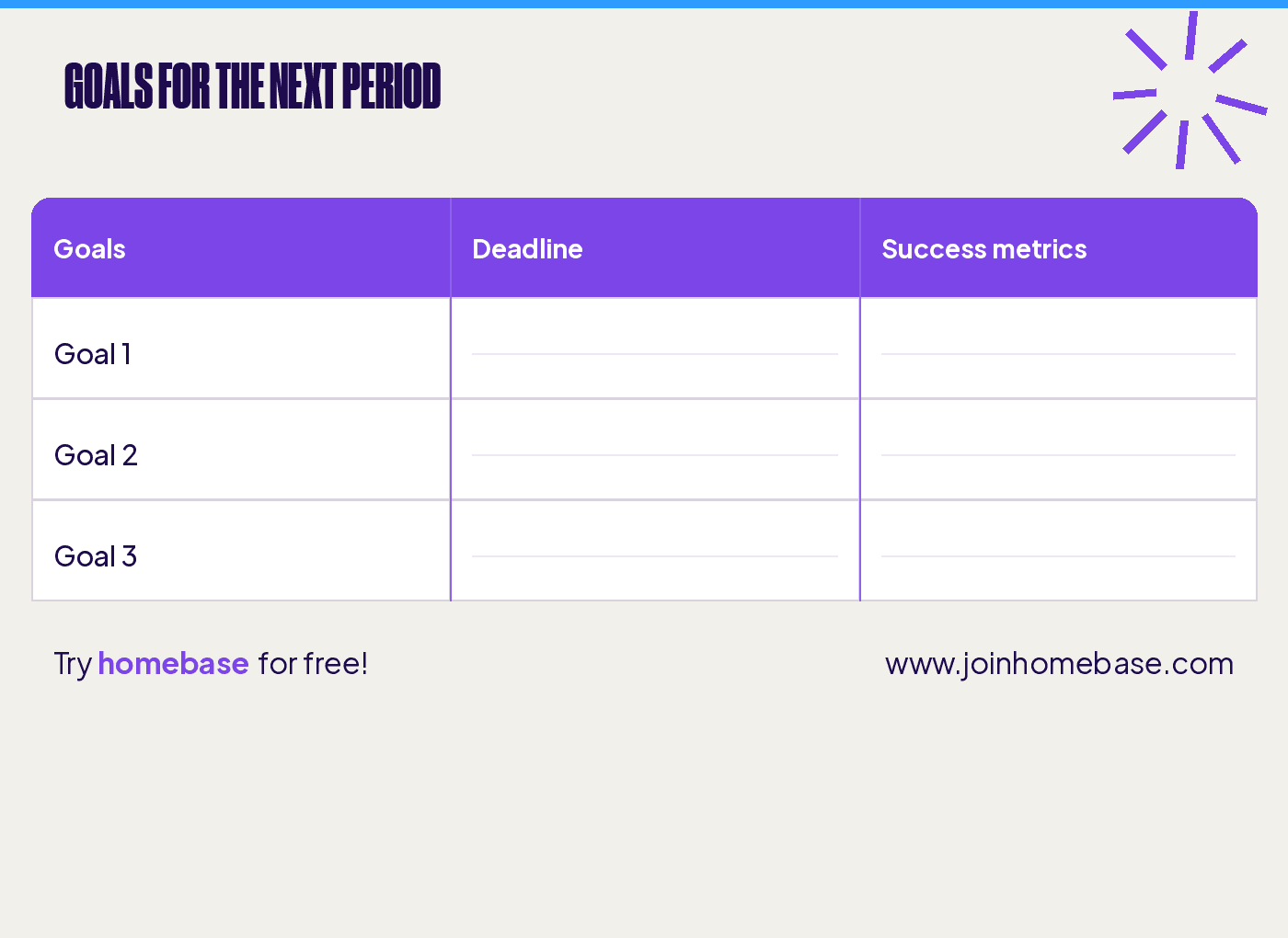
Goals for next period:
Development opportunities or training recommended:
- [Insert development opportunity]
- [Insert training suggestion]
Tip: The best goals for hourly teams are shift-relevant and specific enough that both of you will remember what you agreed on. “Zero unexcused absences over the next 60 days” is a goal. “Be more reliable” is a wish. Tie goals to things your team members actually control—shift coverage, customer interactions, training milestones—and the next review writes itself.
Comments + sign-off
Manager comments:
Employee comments:
Employee signature: _____________ Date: ________
Manager signature: _____________ Date: ________
How to write an employee evaluation
The form is the easy part. Writing feedback that actually lands? That’s where most managers get stuck. Below are some pointers to help.
Start with outcomes, then behaviors
Pull up the facts first. Did they hit their targets? How did their section look at the end of a busy Friday? Once you’ve got something concrete to anchor the conversation, then you can talk about the how—the habits and behaviors that got them there. This order keeps the feedback grounded rather than drifting into personality territory, and it makes the employee evaluation form a lot easier to fill out.
Use a simple feedback formula
Situation → Behavior → Impact. Describe a specific situation, name the behavior you observed, then explain the impact it had on the team or the business. For example: “During the Saturday rush (situation), you proactively restocked without being asked (behavior), which kept the line moving and prevented customer complaints (impact).”
Avoid the 3 common traps
Even well-meaning managers may fall into these traps:
- Recency bias. Whatever happened last week feels more vivid than something from month two of the review period. How to avoid it? A quick note after a standout shift (or a rough one) is worth its weight in gold when review season arrives.
- The halo/horn effect. One spectacular week can make everything else look better than it was. One bad spell can do the opposite. Rate each area independently on what you actually saw, not on the general feeling you’re left with.
- Vague language. “Could improve attitude” tells someone nothing. “Has interrupted teammates during briefings on three occasions this month” is actionable. Leave room for specifics, and your team members will know exactly what to work on.
Employee evaluation examples
Need a starting point? Here are short, realistic examples broken down by performance level and assessment type.
Exceeds expectations examples
- “Identified a recurring stock gap on weekend shifts and flagged it to management before it became a customer-facing problem.”
- “Took initiative to document a recurring equipment issue and proposed a maintenance schedule that’s already prevented two unplanned downtime incidents.”
- “Has received multiple unprompted customer compliments this period, including during some of our busiest rushes.”
Meets expectations examples
- “Reliably completes assigned tasks to the expected standard with minimal follow-up needed.”
- “Attendance and punctuality have been consistent throughout the review period.”
- “Completes assigned caseload to the expected standard and escalates concerns to the supervising clinician appropriately.”
Needs improvement examples (constructive, specific)
- “Has arrived late to three consecutive shift starts this quarter. On a job site, that can create downstream delays for the whole crew.”
- “Customer interactions have occasionally come across as abrupt during busy periods. We’d like to see more patience and warmth, especially during rushes.”
- “Has taken on fewer shifts than agreed this quarter without advance notice. We need a more reliable communication rhythm going forward.”
Development plan examples
- “Complete the updated safety certification by [date] and debrief with the site supervisor afterward.”
- “Shadow a senior team member on inventory management twice this quarter to build confidence in that area.”
- “Set a goal of zero unexcused absences over the next 90 days, with a formal check-in at the 45-day mark.”
These can be plugged directly into the goals section of your employee evaluation form. If you want your performance assessment to go beyond just task completion, consider building in these other types of assessment as well:
- Competency ratings (skills/behaviors). Rate observable skills like communication, reliability, and problem-solving on a simple scale. These are the building blocks of consistent performance.
- Goal progress (OKR-style). Did the employee hit the targets you set together last time? Anchoring the review in prior agreements takes a lot of the awkwardness out of the room.
- Output/quality metrics (role-based). Tie performance to role-specific numbers—tables turned, orders fulfilled, customer satisfaction scores, or tickets resolved. Hard data takes the guesswork out of the review.
- Values/behaviors (culture alignment). Does this person show up in a way that reflects how your team operates? Recognizing culture fit—or flagging culture gaps—matters as much as task performance.
- Growth trajectory (learning + initiative). Is this employee growing? Have they taken on new responsibilities, sought feedback, or developed new skills since the last review? For your top performers especially, this is the question that tells you whether they’re staying or quietly looking elsewhere.
The 5 most meaningful questions to ask in a performance review
The best employee performance reviews should feel like a conversation worth having, and not an annual obligation everyone just wants to get through. These five questions help.
- “What are you most proud of this period, and why?” Start here. This opens the review on a positive note and often reveals contributions you didn’t know about. Let your employees lead.
- “What slowed you down most—is it the process, tools, or people?” This is one of the most underused questions in any review. The answers will tell you as much about how your business runs as they will about the employee.
- “Where do you want to grow next, and what support do you need?” Growth conversations build loyalty. And if you don’t ask, you’ll never know what your team members are actually aiming for. For new hires especially, pair this with a structured onboarding plan to set them up for long-term success.
- “What should we do more of, less of, stop, or start as a team?” This question invites real honesty, and it also signals that you see the review as a two-way process.
- “What does ‘great’ look like next period, in two or three measurable outcomes?” End every review by defining what success looks like going forward. Specific, measurable targets make the next review far easier for both of you.
FAQs about employee evaluation templates
What is an example of a good employee evaluation?
A good employee evaluation is specific, balanced, and forward-looking. It names what the employee did well, where they need to improve, and what the plan looks like going forward. Instead of “great attitude,” a strong evaluation may say: “Stayed calm and kept the line moving during an unexpectedly slammed Friday night shift.”
How do I write an employee evaluation?
Start with the facts: attendance, goal progress, output. Then move to behaviors and development. Use the Situation → Behavior → Impact formula to keep comments concrete. Fill out each section of your employee performance evaluation template in order, and always end with agreed-upon goals for the next period.
What rating scale works best?
A 3-point scale (Needs improvement / Meets expectations / Exceeds expectations) is fast, simple, consistent, and works well for most small businesses. A 5-point scale adds nuance, which can help when annual reviews are tied to pay or promotions. Either way, label every point clearly. Numbers without definitions aren’t useful to anyone.
How often should you do performance reviews?
Annual reviews are standard, but quarterly or monthly check-ins work better for catching issues early. A good rule of thumb: use a lighter employee review template for regular check-ins, and save the full employee performance evaluation format for annual reviews. New hires should get structured reviews at 30, 60, and 90 days.
Conclusion
A great employee evaluation template is only as good as the conversation it creates. The form keeps you organized, but the real work is showing up prepared, being specific, and making sure your team member leaves the room knowing exactly where they stand and what comes next. Do that consistently, and reviews stop feeling like a chore and start feeling like something your team actually values.
Ready to make performance management less painful? If a single software that tracks attendance, monitors performance, and keeps your whole team on the same page sounds good to you—Homebase may be the right fit for you.