Subcontractor vs Employee: Key Differences for Employers


SMALL BUSINESS INTEL, IN YOUR INBOX
Table of contents
It’s Tuesday afternoon in your restaurant, and someone is flat on the floor with a flashlight, fixing the walk-in cooler. Someone else is on the line, working through the lunch rush.
You’ll pay one off an invoice and the other through payroll. Most owners can feel that difference, but fewer can explain it to an auditor.
The good news is that it comes down to one idea. This guide walks through subcontractor vs employee, including how the Internal Revenue Service (IRS) decides and how to choose for the job in front of you.

Your workday, your way.
Every day, more small businesses use Homebase to build the exact workflows their teams need.
Subcontractor vs Employee: The Short Answer
Subcontractor vs. employee comes down to control, so here’s the quick version:
- Subcontractor: An independent contractor you hire for specific work. They run their own business, decide how the job gets done, pay their own taxes, and typically get a Form 1099-NEC.
- Employee: Works under your direction and gets a W-2, and you withhold their taxes and pay your share.
- The deciding factor: Control, because the IRS looks at how much you direct the work, not what you call the person.
- How to choose: Hire a subcontractor for defined projects, and hire an employee for ongoing work you schedule and direct.
What’s the Difference Between a Subcontractor and an Employee?
A subcontractor is a self-employed person or business you hire to complete specific work. They run their own business, decide how the work gets done, and pay their own taxes. An employee works under your direction, on your schedule, as part of your team. The deciding factor is control, no matter the job title or contract.
Is a subcontractor an employee? Generally, no. According to the IRS page Independent Contractor Defined, subcontractors are usually independent contractors, though status depends on the facts.
What Is a Subcontractor?
Think of the refrigeration tech who fixes your walk-in and sends an invoice, or a freelance photographer shooting your boutique’s product photos. In construction, a subcontractor is often hired by another contractor to finish one piece of a bigger job. For the 1099 side, see our 1099 vs. W-2 guide.
What Is an Employee?
An employee is part of your crew, like a line cook, a cashier, or a server. You set the schedule, train them your way, and provide the tools. You’re also responsible for their payroll taxes and workplace protections.
Subcontractor vs Employee: Key Differences at a Glance
| Factor | Subcontractor | Employee |
|---|---|---|
| Control and schedule | Decides how and when the job gets done | You direct what, when, and how |
| Pay | Agreed fee, usually per job | Hourly wage or salary on payroll |
| Taxes | Pays their own self-employment tax | You withhold taxes and pay your share |
| Forms | W-9, then 1099-NEC | W-4 and I-9, then W-2 |
| Benefits | None from you | Any you offer, plus what your state requires |
How the IRS Decides: The Employee vs Subcontractor Test
The IRS doesn’t hand you a scorecard, because worker classification under IRS rules follows common-law tests and no single fact settles it. According to IRS Topic no. 762, you weigh all the evidence of control and independence in three buckets: behavioral control, financial control, and the relationship of the parties.
Behavioral Control
Behavioral control covers whether you have the right to direct what work gets done and how, through instructions, training, or other means. If you write the prep list and set station procedures, you’re directing the work. The same goes for building someone’s weekly schedule and tracking their clock-ins.
Financial Control
Financial control looks at the business side of the job. It covers who pays expenses and supplies tools, how the worker is paid, and whether they can profit or take a loss. A plumber who brings a truck and parts and quotes a flat fee runs an independent business.
Relationship of the Parties
This category covers written contracts, employee-type benefits, how long the arrangement lasts, and whether the work is central to your business. A contract helps, but it can’t override the facts, and a cashier with a 1099 is still a cashier.
Subcontractor vs Employee Checklist
Try this gut check. If you answer “yes” to questions one through seven, that usually points toward employee. A “yes” to question eight points toward subcontractor.
- Do you decide the methods, not just the result?
- Do you set their hours?
- Do you train them in your procedures?
- Do they use your tools, equipment, or uniform?
- Do you pay by the hour or on a regular schedule instead of per job?
- Do they work only for you?
- Is the work ongoing and central to your business?
- Can they make a profit or take a loss, hire helpers, or advertise their services?
Why State and Department of Labor Rules Can Change the Answer
The legal definition of an employee depends on who’s asking. The U.S. Department of Labor (DOL) uses an economic reality test under the Fair Labor Standards Act (FLSA) to decide who gets minimum wage and overtime.
As of October 2026, the DOL’s 2024 rule is still the published regulation, though the agency has proposed replacing it, per its rulemaking page.
Some states add stricter tests of their own. According to the DOL’s questions and answers on its proposed rule, California and New Jersey apply an ABC test to state wage and hour laws.
That test presumes someone is an employee unless you show three things. They’re free from your control, their work falls outside your usual business, and they run an independent trade. A worker can pass the IRS test and still fail a state test.
Tax Forms and Payroll: What You Owe for Each Worker
Employee (W-2) Obligations
When you hire an employee, you withhold income tax and the employee’s share of Social Security and Medicare, then pay the employer’s share too. According to IRS Topic no. 751, the employer share is 6.2% for Social Security and 1.45% for Medicare. For 2026, Social Security tax applies to wages up to $184,500.
The IRS guide Hiring Employees says to keep a signed Form W-4 on file and use Form I-9 to verify work eligibility.
Subcontractor (1099) Obligations
A subcontractor means lighter paperwork, but not zero. You collect a Form W-9 up front for their tax ID, then report what you paid on Form 1099-NEC instead of withholding taxes.
People sometimes say “1099 employee,” but a worker paid on a 1099 is a subcontractor, not an employee.
The Instructions for Forms 1099-MISC and 1099-NEC say the reporting threshold increased to $2,000 for tax years beginning after 2025, up from $600 before that.
Your subcontractor pays their own self-employment tax. The IRS self-employment tax page puts the rate at 15.3%: 12.4% for Social Security and 2.9% for Medicare.
Roberto Bustillos, co-owner of Lombard Doggy Daycare, had never run payroll before. His biggest fear, he says, was getting into “a very complicated business” without knowing how to manage schedules or deal with payroll. Both turned out to be simple once he started using Homebase.
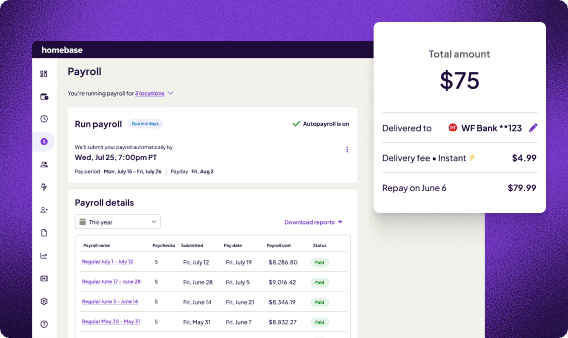
In Homebase, you can run payroll for W-2 employees and pay 1099 contractors side by side. We calculate and file your payroll taxes and handle year-end forms, so Sunday nights stay yours.
Your workday, your way.
Every day, more small businesses use Homebase to build the exact workflows their teams need.
When to Hire a Subcontractor vs an Employee
Hire a subcontractor for specialized or project-based work where the result matters more than the method. Hire an employee for ongoing work you schedule, train, and direct. Companies use contractors to flex capacity, tap licensed skills, and skip payroll and benefits costs. That only holds if the worker is classified correctly.
Contractor vs employee isn’t one-size-fits-all, and employee vs subcontractor calls can change job to job.
When a Subcontractor Makes Sense
Subcontractors fit best in these situations:
- Specialized or licensed skills: An electrician or refrigeration tech does work you can’t do yourself.
- Project-based work: A photographer shooting your seasonal launch has a start, an end, and a deliverable.
- Flexible capacity: A subcontractor adds hands in a busy stretch without adding payroll and benefits.
According to the Bureau of Labor Statistics (BLS), there were 11.9 million independent contractors in July 2023, or 7.4% of total employment. BLS Table 9 shows about 80.3% of them preferred that arrangement.
When an Employee Makes Sense
Employees are the right call for ongoing work you schedule and direct, and for roles that face your customers. According to the BLS Employer Costs for Employee Compensation report for June 2026, benefits made up 30.0% of private-industry compensation costs, though retail trade ran lower at 23.5%.
With Homebase Hiring & Onboarding, you can post jobs to Indeed, ZipRecruiter, Glassdoor, and Google. You can also keep applicants in one place and send new hires their I-9 and W-4 to e-sign, so the paperwork’s done before day one.
Subcontractor vs Employee Pros and Cons
| Subcontractor | Employee | |
|---|---|---|
| Pros | Pay for the result; no payroll taxes; specialized skills | More control and consistency |
| Cons | Less control; may be unavailable; classification risk | Payroll taxes and benefits; more admin work |
What Happens If You Misclassify a Worker?
If the IRS or a state agency decides your subcontractor was an employee, you can owe back payroll taxes, penalties, and interest. You may also owe back pay for minimum wage and overtime, plus unemployment insurance contributions. The exact cost depends on the case and your state.
Penalties and Back Taxes
It happens: in 2023, a DOL investigation recovered $330,367 in back wages and damages for 20 workers a North Carolina general contractor had misclassified.
A Government Accountability Office (GAO) report says a DOL-commissioned study from 2000 found misclassified workers at 10% to 30% of firms audited in nine states. GAO adds that the national extent is unknown.
How to Fix a Misclassification
If you’ve caught a mistake, you have options. The IRS Voluntary Classification Settlement Program (VCSP) lets eligible employers reclassify workers as employees going forward. According to the IRS, participants pay 10% of the employment tax liability for the most recent year, figured at reduced rates, and apply on Form 8952. You can also ask the IRS to determine a worker’s status by filing Form SS-8.
Check with a tax professional or employment attorney first, since this article isn’t legal or tax advice.
Good records are your best backup. Bryan Tublin, co-founder and CEO of Kitava, says his team wanted a tool to “back up our practices as proof and evidence that we were doing the right thing.” Our time tracking follows hours and breaks and alerts you before someone hits overtime, and we store timecards in line with FLSA record-keeping rules.

Frequently Asked Questions About Subcontractor vs Employee
What Are the Downsides of Being a Subcontractor?
Subcontractors pay self-employment tax on their net earnings, with no employer match. They buy their own health coverage and insurance, and they typically get no paid leave or unemployment benefits. Income can swing between jobs, and clients may pay late. The trade-off is control over how and when they work.
What Is the Difference Between a Subcontractor and a 1099 Contractor?
A 1099 contractor works directly for a client and gets Form 1099-NEC. The difference between a contractor and a subcontractor is who hires them. A subcontractor is hired by another contractor, not the project owner, for part of a job. For taxes, they’re the same, since both are independent contractors and the IRS applies one control test.
Can an Employee Also Be a Subcontractor?
Yes, if the work is separate and distinct. The IRS page on when to provide a W-2 and a 1099 to the same person gives the example of a school custodian with a snow plowing business. A line cook with a photography side business could shoot your menu. If the work overlaps with their regular duties, it’s still employment.
Does a Subcontractor Need Workers’ Compensation Insurance?
Rules vary by state, but independent contractors often aren’t required to cover themselves, and an uninsured subcontractor can leave you liable. The Minnesota Department of Labor and Industry and the South Carolina Workers’ Compensation Commission both say a general contractor can be responsible. Ask for a certificate of insurance, and check your state’s rules.
Do I Need a Written Agreement With a Subcontractor?
Putting it in writing doesn’t make someone a subcontractor, but it protects you. Spell out the scope of work, payment terms, timeline, insurance requirements, and who supplies tools and materials. The IRS treats a written contract as one factor among many, so how you work together matters more than the paper.
Can a Subcontractor Hire Their Own Helpers?
Often, yes: DOL Fact Sheet 13 counts the choice to hire helpers as managerial skill, which points toward independent contractor status. Those helpers become the subcontractor’s responsibility, not yours. Put it in your agreement, and confirm the sub carries workers’ compensation for them.
Making the Right Call for Your Team
You don’t need a law degree to get this right. You need to know who’s directing the work, whether the job is a project or an ongoing role, and what your state says. When you’re unsure, ask a tax pro.
When you’re ready to hire, we’ve got you covered from the first job post to the first paycheck. Try Homebase free and see how Hiring & Onboarding and Payroll fit your team.
Your workday, your way.
Every day, more small businesses use Homebase to build the exact workflows their teams need.