The Best States to Shop Small Businesses in 2026


SMALL BUSINESS INTEL, IN YOUR INBOX
Table of contents
Small businesses do more than give people a place to grab coffee, browse a bookstore, or pick up a last-minute gift. They help shape the feel of a neighborhood, create local jobs, and keep money circulating in the communities they serve.
But not every state makes it equally easy for consumers to shop at small businesses. In some places, shoppers have a deeper bench of local businesses to choose from, stronger access to independently owned retail and food spots, and signs that those businesses are growing rather than struggling to stay afloat.
To find out where shopping small looks strongest in 2026, we ranked all 50 states using a mix of internal Homebase data and external data from the U.S. Census Bureau and U.S. Bureau of Labor Statistics. We looked at 12 ranking factors tied to small business growth, worker stability, staffing, wages, and small business density. The goal was to identify the states where consumers have the strongest access to local small businesses and where those businesses show the clearest signs of growth, resilience, and day-to-day momentum.
Key takeaways
- New York ranks as the best state to shop small businesses in 2026, thanks to its massive small business footprint, strong per-capita business density, and above-average shift coverage.
- California ranks #2 and leads the country in total small business establishments, retail small businesses, and accommodation/food small businesses, while also posting the highest net increase in small business establishments in the study at 6.05%.
- Vermont stands out for small-business worker pay, with the highest adjusted average hourly wage in the study at $16.77, meaning small business wages there have the strongest purchasing power relative to local living costs.
- South Dakota posted the largest year-over-year increase in small business employees in the study, with employment up 6.7%, alongside 12.4% growth in hours worked and 6.6% wage growth for small business employees.
- North Carolina ranks in the top 10 and is notable for small-business wages, with wages up 3.2% year over year and an adjusted average hourly wage of $14.03, which is 93.5% higher than the state’s minimum wage.
- Washington earned the highest shift-coverage rate in the study at 84.7%, suggesting small businesses there are especially likely to fill the shifts they schedule and deliver a smoother customer experience.
The top states to shop small business
The best states for small business shopping are:
1. New York — Score: 70.31 (Out of 100)
New York lands in the #1 spot because it pairs small-business scale with real shopper access.
has 539,544 total small business establishments, more than 3.2x the study average of 166,275, plus 71,894 retail small businesses and 55,358 accommodation and food-service small businesses, both also more than 3x the average.
And this isn’t just a volume story: New York also beats the study average on density, with 2,756.8 small businesses per 100K residents versus 2,577.8 nationally, 367.3 retail small businesses per 100,000 versus 331.2, and 282.9 accommodation/food businesses per 100,000 versus 242.7. New York also posts a strong 71.9% shift-coverage rate, meaning small businesses there are more likely to fill the shifts they schedule. That can make it easier for shoppers to get the service they expect.
2. California — Score: 64.92
California comes in at #2 thanks to the sheer size and continued momentum of its small-business ecosystem. No state has more total small business establishments than California at 1,026,974, and it also leads the country in both retail small businesses (106,616) and accommodation/food small businesses (95,869).
What really helps California separate itself, though, is growth: the state posted a 6.05% net increase in small business establishments, the highest in the study and more than 4x the national average of 1.45%. California also beats the study average on pay for small business employees, with an adjusted average hourly wage of $14.92 compared to $14.24 nationally. In this study, the adjusted wage reflects purchasing power — or how far small business wages go relative to the cost of living in each state.
3. New Jersey — Score: 64.76
The Garden State posted a 4.3% year-over-year increase in the number of small business employees, well above the 1.0% study average, along with a 9.2% increase in hours worked, compared to 6.7% nationally. That points to real growth among small businesses in the state. New Jersey also has 237,266 total small business establishments — about 43% more than the study average of 166,275.
4. Vermont — Score: 64.00
Vermont takes the #4 spot thanks to a standout mix of growth, wage strength, and small-business density. On the growth side, Vermont is one of the strongest performers in the study: the state saw a 4.0% year-over-year increase in small business employees, 10.5% growth in hours worked, and 6.9% growth in wages. Vermont also posts the highest adjusted average hourly wage in the study at $16.77, so the state stands out as a place where small business pay stretches further than it does in most states. Lastly, Vermont has 452.9 retail small businesses per 100K residents, the second-highest in the study.
5. Florida — Score: 63.68
Florida ranks fifth with 644,139 total small business establishments, which is about 287% more than the study average of 166,275. It also far exceeds the national benchmark in customer-facing categories, with 75,953 retail small businesses and 48,772 accommodation and food-service small businesses. The state also posted a 2.58% net increase in small business establishments year over year, well above the 1.45% average.
6. Georgia — Score: 62.14
Georgia comes in at #6, seeing a 7.9% increase in hours worked by small business employees, above the 6.7% study average. What’s more, Georgia posts a standout 74.4% shift-coverage rate, comfortably above the 67.8% study average, meaning small businesses there are more likely to fill the shifts they schedule. The state also has 260,513 total small business establishments, about 57% more than the study average.
One especially notable stat is Georgia’s adjusted average hourly wage for small business employees of $12.51, which is 72.6% higher than the state’s minimum wage ($7.25). That suggests small business employees in Georgia are earning far above the legal wage floor, giving workers more breathing room than the minimum wage alone would imply. Pay levels like that can also help small businesses attract local workers and reduce turnover, making it easier to staff up and keep operations running smoothly.
7. Pennsylvania — Score: 61.73
Pennsylvania claims the #7 spot thanks to a balanced mix of staffing strength and a deep bench of small businesses across the state. It posts a 74.6% shift-coverage rate, the fifth-highest rate in the study and well above the 67.8% study average. On top of that, the state is home to 306,066 total small business establishments, about 84% more than the study average, and 40,211 retail small businesses.
Another bright spot for Pennsylvania is pay. The state’s adjusted average hourly wage for small business employees is $13.64, which is 88.1% higher than Pennsylvania’s $7.25 minimum wage. That can signal a healthier small-business ecosystem: one where employers offer more competitive pay to attract workers, keep them on staff, and reduce churn.
8. South Dakota — Score: 61.53
South Dakota ranks eighth by standing out on the labor side of the equation. No state in the top 10 posts a bigger increase in small business employment than South Dakota, where the number of small business employees rose 6.7% year over year, compared to the 1.0% study average. The state also saw 12.4% growth in hours worked and 6.6% growth in wages for small business employees, both far above the national benchmarks.
Its adjusted average hourly wage of $16.23 also comes in significantly above the $14.24 study average, meaning small business wages stretch further there relative to local living costs than they do in most states. Put together, those numbers point to a small-business sector that is expanding, adding workers, and increasing pay at the same time.
9. North Carolina — Score: 61.38
In North Carolina, wages increased 3.2% year over year for small business employees, well above the study average of -0.4%. The state’s adjusted average hourly wage for small business employees ($14.03) is also 93.5% higher than the state’s $7.25 minimum wage, which can help employers attract workers, reduce turnover, and build a more stable small-business workforce over time. NC also recorded a 3.13% net increase in small business establishments, more than double the 1.45% study average, pointing to continued expansion in the local business landscape.
10. Oregon — Score: 60.92
Oregon has a 4.4% year-over-year increase in the number of small business employees, more than four times the 1.0% study average, while hours worked jumped by 9.8%. Oregon’s adjusted average hourly wage of $15.66 is one of the highest in the study, giving OR’s small business employees a stronger cost-of-living-adjusted wage than many other states. What’s more, the state has 296 accommodation and food-service small businesses per 100K residents, above the 242.7 study average, helping Oregon stand out for shoppers looking to spend locally on dining, coffee, bars, and hospitality.
Other states worth a special mention:
A few states also stood out for excelling in specific categories, even if they didn’t land in the overall top 10. Wyoming had the highest number of small business establishments per 100,000 residents in the study at 4,016.6, far above the 2,577.8 study average. In other words, Wyoming has an especially high concentration of local businesses relative to its population size. The state also posted the largest year-over-year increase in wages for small business employees at 12.5%.
Washington is another state worth calling out. While it finished #12 overall, it earned the highest shift-coverage rate in the study at 84.7%, well above the 67.8% average. In this ranking, shift coverage reflects the share of scheduled shifts that actually received a clock-in, so a higher rate suggests small businesses are more consistently able to staff the shifts they plan for. For shoppers, that can translate to a more dependable experience, with better odds that local businesses are fully staffed and ready to help customers.
Where small business openings are outpacing closures
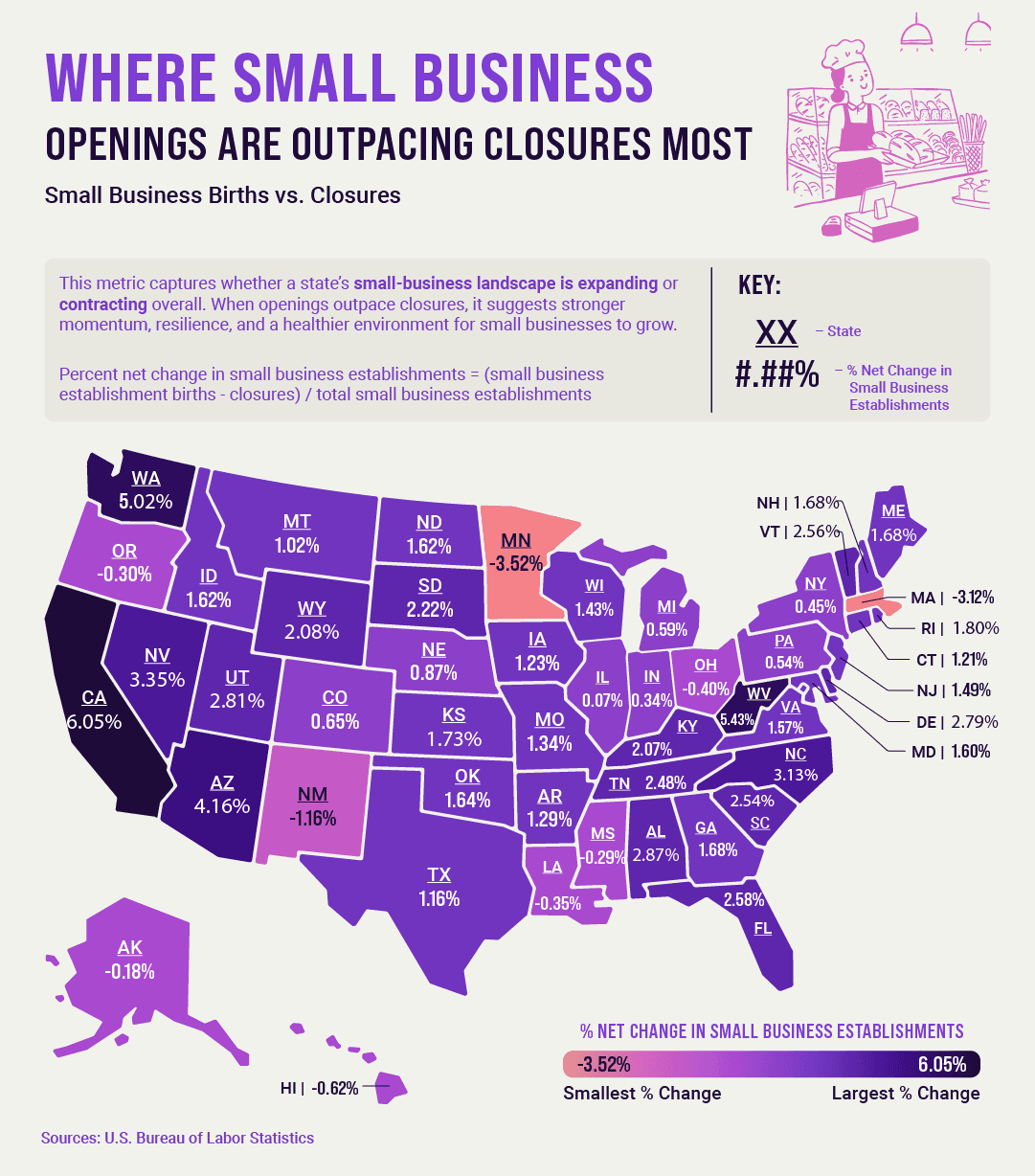
One ranking factor worth a closer look is the year-over-year net change in small business establishments, according to data from the U.S. Bureau of Labor Statistics. This metric helps show where small business openings are outpacing closures the most. In simple terms, it shows whether a state’s small-business footprint is growing or shrinking overall. When openings are outpacing closures, it points to a more expansion-friendly environment for small businesses — and, in many cases, more local places for shoppers to discover and support.
The states with the largest year-over-year net increases in small business establishments:
- California — 6.05%
- West Virginia — 5.43%
- Washington — 5.02%
- Arizona — 4.16%
- Nevada — 3.35%
- North Carolina — 3.13%
States like California, Washington, and North Carolina are especially notable here. These are places where the small business footprint is not just large or accessible, it is still actively growing.
And in states like West Virginia, Arizona, and Nevada, strong net gains suggest that small business growth is happening even outside the states that dominated the overall top 15 ranking. These results help show where small-business activity is still moving in a positive direction, and where local economies may be creating more opportunities for both entrepreneurs and consumers alike.
Where workloads are rising faster than wages for small business employees
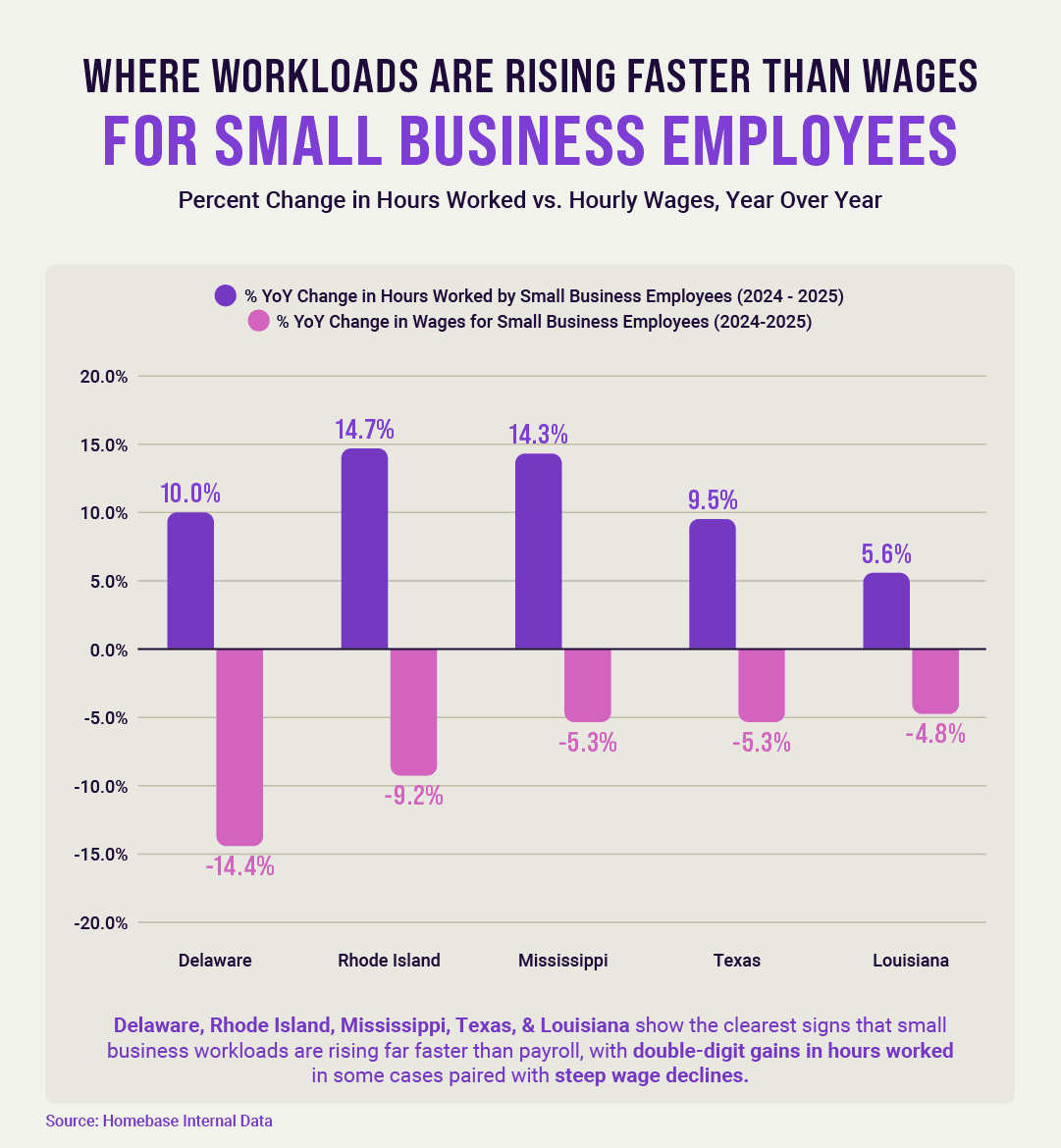
Another trend worth paying attention to is the growing gap between hours worked and wages for small business employees. Nationally, small business employees worked 6.7% more hours year over year, while wages decreased by 0.4%. That suggests labor demands may be rising faster than pay in some small-business settings. In practical terms, employees may be taking on heavier workloads, longer shifts, or more time on the clock, even as wages do not appear to be keeping pace. For workers, that can mean putting in more effort without seeing the same kind of improvement in their paychecks.
That pattern looks even more pronounced in a handful of states. Delaware, Rhode Island, Mississippi, Texas, and Louisiana show some of the clearest signs that workloads are rising much faster than wages for small business employees.
In Delaware, hours worked jumped 10.0% while wages fell 14.4%, the sharpest wage decline in this group. Rhode Island saw the biggest increase in hours worked at 14.7%, paired with a 9.2% drop in wages. Mississippi also stands out, with hours worked up 14.3% and wages down 5.3%. In Texas, hours rose 9.5% even as wages declined 5.3%, and in Louisiana, hours increased 5.6% while wages fell 4.8%.
Closing thoughts
Strong small-business ecosystems are about more than storefronts. They reflect local economies where entrepreneurs can grow, workers can find opportunity, and communities can keep dollars circulating close to home. In 2026, that matters even more. Small businesses are still navigating an uneven economy, but consumer spending is expected to keep growing this year, and states with stronger small-business ecosystems may be better positioned to turn that demand into new openings, stronger staffing, and more resilient main streets.
About Homebase
That bigger picture is exactly why Homebase cares so much about this space. Built for hourly teams, Homebase helps more than 150,000+ small businesses manage scheduling, time clocks, payroll, HR, and team communication — all with the goal of making work easier for owners and employees alike.
Founded in 2014, Homebase has been supporting small businesses across North America for the last decade. As part of our commitment to empowering hourly teams, we are always trying to find unique ways to leverage our data and bring insights about small businesses, hourly workers, and the economy to the broader media.
Methodology
We ranked the best states for shopping small businesses by building a composite score of 12 ranking factors that represent small-business growth, worker stability, and local small business density. Our analysis combined labor-market metrics such as year-over-year changes in small-business employment, hours worked, wages, adjusted hourly pay, and shift-coverage rates with business landscape metrics like the number of total small businesses, retail, and accommodation/food establishments, both overall and per capita. We also factored in each state’s net change in small-business establishments to capture whether more businesses are opening than closing.
Together, these measures help show not just where small businesses are plentiful, but where they appear to be active, growing, and better positioned to serve shoppers. In other words, the ranking is designed to highlight states where consumers have strong access to small businesses and where those businesses show signs of growth and resilience.
Each factor was weighted based on how much it contributes to a strong environment for shopping small. Using these weights, the individual factors were scored on a scale of 0 to 5 and then combined to produce a composite score from 0 to 100, with higher scores representing better states for shopping at small businesses.
The specific ranking factors, along with their respective weights and data sources, are detailed below:
Ranking Factors: Methodology Notes and Why They Matter
% YoY Change in Small Business Employees (2024 - 2025)
Methodology notes: Employee counts reflect distinct workers active at a qualifying business during the year, not an average headcount. A worker who appears across multiple months is counted once.
Why it matters: Hiring is one of the most tangible downstream effects of consumer spending. If people are shopping locally, businesses are more likely to add staff.
% YoY Change in Hours Worked by Small Business Employees (2024 - 2025)
Why it matters: Rising hours worked can signal stronger small-business activity, such as expansion, higher demand, or more staffed shifts.
% YoY Change in Wages for Small Business Employees (2024 - 2025)
Methodology notes: Wages are self-reported by businesses, and Homebase does not verify hourly wage entries.
Why it matters: Wage growth can help small businesses attract workers and reduce turnover.
Adjusted Average Hourly Wage for Small Business Employees (2025)
Methodology notes: Adjusted average hourly wage was calculated as average hourly wage divided by the U.S. Bureau of Economic Analysis cost of living index, then multiplied by 100. Wages are self-reported by businesses, and Homebase does not verify hourly wage entries.
Why it matters: This metric shows where small business wages have the strongest purchasing power relative to local living costs. Higher purchasing power can make small business jobs more attractive to workers.
Shift-Coverage Rate (2025)
Methodology notes: Shift-coverage rate is the share of scheduled shifts that received a clock-in via Homebase. It measures whether planned shifts were worked, not whether a replacement was found for an absent employee.
Why it matters: This metric helps show whether small businesses are able to staff the shifts they plan for. Higher shift coverage can make it easier for customers to get the service they expect.
No. of Total Small Business Establishments
Methodology notes: Pulled from the U.S. Census County Business Patterns Survey. Small businesses were defined as employer establishments with fewer than 500 employees.
Why it matters: A higher total number of small businesses points to a larger overall small-business presence in the state, giving shoppers more local businesses to support.
No. of Total Small Business Establishments (per 100K residents)
Methodology notes: Pulled from the U.S. Census County Business Patterns Survey. Small businesses were defined as employer establishments with fewer than 500 employees.
Why it matters: This per-capita measure shows where small businesses are most accessible relative to the size of the population.
No. of Retail Small Business Establishments
Methodology notes: Pulled from the U.S. Census County Business Patterns Survey. Small businesses were defined as employer establishments with fewer than 500 employees.
Why it matters: Retail small businesses are a direct measure of how many independent shopping destinations a state offers.
No. of Retail Small Business Establishments (per 100K residents)
Methodology notes: Pulled from the U.S. Census County Business Patterns Survey. Small businesses were defined as employer establishments with fewer than 500 employees.
Why it matters: This metric shows where retail small businesses are most concentrated relative to the population, making local shopping options more accessible to residents.
No. of Accommodation and Food Services Small Business Establishments
Methodology notes: Pulled from the U.S. Census County Business Patterns Survey. Small businesses were defined as employer establishments with fewer than 500 employees.
Why it matters: Restaurants, cafés, bars, and lodging businesses are a major part of the small-business economy and among the most visible places consumers spend locally.
No. of Accommodation and Food Services Small Business Establishments (per 100K residents)
Methodology notes: Pulled from the U.S. Census County Business Patterns Survey. Small businesses were defined as employer establishments with fewer than 500 employees.
Why it matters: This per-capita measure shows where accommodation and food-service small businesses are most concentrated relative to the population, making local food options more accessible to residents.
% Net Change in Small Business Establishments (Small Business Births vs. Closures)
Methodology notes: Calculated as small business establishment births minus closures, divided by the total number of small business establishments.
Why it matters: This metric shows whether a state’s small-business landscape is growing or shrinking overall. When openings outpace closures, it can point to a more resilient environment for small businesses.
Fair use
You are welcome to use, reference, and share non-commercial excerpts of this study with proper attribution. If you cite or cover our findings, please link back to this page so readers can view the full methodology, charts, and context.