Clocking in and Clocking Out Policy: Free Template, Rules, and Best Practices


SMALL BUSINESS INTEL, IN YOUR INBOX
Table of contents
Missed punches, unauthorized overtime, and messy timesheets can turn payroll into a nightmare. A clear clocking in and clocking out policy helps you set expectations and track hours accurately, while handling breaks, missed punches, and approvals more consistently — before any of those issues become expensive problems.
This post covers what to include in a clock in and clock out policy, a free template you can customize, and how to enforce it without creating payroll headaches.

TL;DR: What you need to know about clocking in and clocking out policies
A clocking in and clocking out policy is how small businesses document and enforce time tracking for hourly and nonexempt employees. It sets the rules for when and how employees record their hours — and what happens when those rules aren't followed.
Here's what a solid policy needs to cover:
- It goes beyond clock-ins: breaks, missed punches, overtime approvals, and off-the-clock work all need to be addressed
- Hourly and nonexempt salaried employees must be covered; exempt employees generally don't need to clock in and out
- The FLSA sets the federal floor — state and local rules may add requirements on top
- Without a clear policy, unauthorized overtime and payroll disputes are harder to challenge
- Digital time clocks make enforcement significantly easier than paper systems
What is a clocking in and clocking out policy?
A clocking in and clocking out policy is a set of written guidelines that govern how employees record their work hours. Businesses use these policies to maintain accurate records, calculate pay correctly, and stay aligned with FLSA recordkeeping requirements.
It's especially important for hourly employees and nonexempt salaried workers — the employees legally entitled to overtime pay. A strong time clock policy isn't just about when people clock in. It also covers employee break tracking rules, missed punch procedures, overtime approvals, and what counts as off-the-clock work.
Why every small business needs a clear time clock policy
A timekeeping policy protects you on multiple fronts. Here's what you're actually preventing when you put one in place:
Payroll disputes. When employees know the rules and managers enforce them consistently, there's less room for disagreement about hours worked.
Missed punches. A documented correction process and employee punch-in system means managers aren't chasing employees at the end of every pay period to piece together accurate timesheets.
Unauthorized overtime. Clear approval rules make it harder for employees to rack up unauthorized overtime without your knowledge — and easier to address it when they do.
Inconsistent treatment. Written policies mean every employee is held to the same standard, which reduces the risk of favoritism claims.
Compliance exposure. A time tracking policy that aligns with FLSA requirements gives you a paper trail if your records are ever questioned.
Without a reliable system behind your policy, enforcement is an uphill battle — missed punches, overtime risks, and timesheet discrepancies pile up fast. The right time clock flags all of it automatically before it hits payroll.
What to include in a clocking in and clocking out policy
A strong time clock policy covers more than just when employees clock in and out. Here are the key components every small business should address to keep time tracking accurate, consistent, and defensible.
Who must clock in and out
Your policy should clearly define which employees are covered. As a general rule:
- Hourly employees (full-time and part-time) must clock in and out
- Nonexempt salaried employees — those eligible for overtime — must also track hours
- Exempt employees are generally not required to clock in and out under the FLSA
Job classification isn't always straightforward, and state rules vary. Confirm classifications with an employment attorney or HR professional before finalizing your policy.
Approved methods for clocking in and out
Define which systems are acceptable for recording time:
- Mobile app
- Kiosk or tablet
- POS system
- Desktop or computer
Paper timesheets are still used by some very small teams, but they're harder to audit, easier to manipulate, and more time-consuming to process for payroll.
When employees should clock in and out
Employees should clock in at the start of every shift and clock out at the end. They should also clock out at the beginning of any unpaid meal break and back in when they return. Any role-specific exceptions — for example, field workers or employees who travel between locations — should be spelled out explicitly.
Break and meal period rules
Under the FLSA, rest breaks of 20 minutes or less are paid. Meal breaks of 30 minutes or more are unpaid — but only if the employee is completely relieved of their duties. If they're answering calls or responding to messages during lunch, that time is compensable. Your policy should make this distinction clear.
Overtime and manager approval
Overtime must be approved in advance. Your policy should state this explicitly and outline the approval process. Note that even unauthorized overtime may need to be paid depending on applicable law — the goal of an approval policy is deterrence and accountability, not a way to avoid paying worked hours.
Missed punches and correction requests
Employees should report missed punches to their manager as soon as possible. Managers verify and approve any corrections, and all edits should be documented. Repeated missed punches should trigger coaching — and your policy should say so.
Prohibited conduct
Your policy should name specific violations:
- Buddy punching (clocking in or out for another employee)
- Falsifying time records
- Working off the clock
- Repeated missed punches
- Unauthorized overtime
Free clocking in and clocking out policy template
Use this as a starting point. Have your attorney or an HR professional give it a look to make sure it’s the right fit for your business.
[COMPANY NAME] clocking in and clocking out policy
Purpose
This policy ensures accurate timekeeping and consistent treatment of all covered employees at [COMPANY NAME].
Scope
This policy applies to all hourly full-time, hourly part-time, and nonexempt salaried employees.
Clock in and out procedure
All covered employees must clock in and out at the start and end of each shift using [DESIGNATED SYSTEM]. Employees must also clock out at the beginning of any meal break and back in upon returning.
Time rounding
Employee hours will be rounded to the nearest quarter hour in compliance with FLSA guidelines.
Break rules
- Rest breaks: Short breaks of 20 minutes or fewer must be paid as hours worked.
- Meal breaks: Breaks of 30 minutes or more may be unpaid, provided the employee is fully relieved of all duties. If they perform any work during that time, it must be compensated.
Overtime
Any hours worked beyond 40 in a workweek are eligible for overtime at 1.5x the employee's regular rate. Overtime must be approved by a manager in advance.
Missed punches
Employees who fail to clock in or out must notify their manager immediately. Managers must verify and document all corrections before the timesheet is submitted for payroll.
Submission and approval
Employees are responsible for submitting accurate time records. Managers must review and approve all timesheets before payroll processing.
Manager responsibilities
Managers must review time records regularly, confirm they reflect actual hours worked, and address inaccuracies promptly.
Prohibited conduct and violations
Violations of this policy are subject to disciplinary action up to and including termination. Prohibited conduct includes:
- Buddy punching
- Falsifying time records
- Working off the clock
- Repeated missed punches
- Unauthorized overtime
Optional clauses to add based on your business:
- Early clock-in restrictions (e.g., employees may not clock in more than [X] minutes before their scheduled shift without manager approval)
- Mobile and GPS clock-in rules (e.g., employees must be on-site within [X] feet of [LOCATION] to clock in via mobile app)
- Remote or field team location verification requirements
- Progressive discipline language (e.g., first offense: verbal warning; second offense: written warning; third offense: termination)
How to customize this template:
- Confirm which employees are covered based on your state's exemption rules
- Specify your approved timekeeping system
- Add any state-specific break requirements (California, for example, has meal and rest break rules that go beyond federal minimums)
- Define your overtime approval process and chain of command
- Add progressive discipline steps that match your existing HR policies
How to create a clocking in and clocking out policy
Having a template is a good start, but building a clocking in and clocking out policy that actually works for your business means thinking through the details specific to your team.
Here's how to do it step by step:
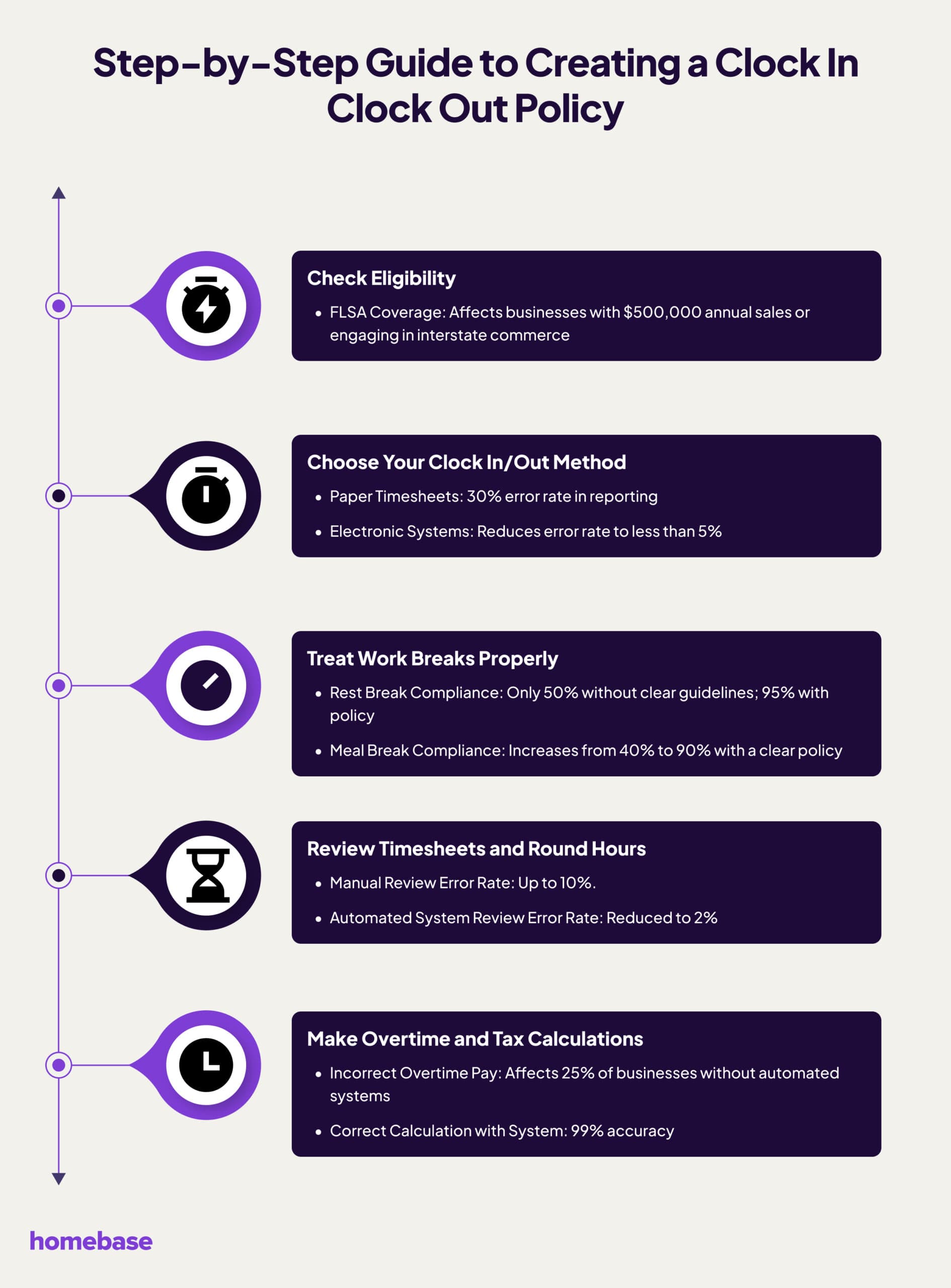
Step 1: Decide who needs time tracking
Identify which employees are hourly or nonexempt. When in doubt, consult an employment attorney — misclassification is a common and costly mistake.
Step 2: Choose your time clock method
Pick a system your team will actually use consistently. App-based time clocks work well for flexible or multi-location teams. Kiosks work well for fixed-location hourly teams. Whatever you choose, make it the only approved method.
Psst…still figuring out which system fits your team? Homebase’s free time clock works on phones, tablets, and POS systems — so your whole crew can clock in however makes sense for your business.
Step 3: Set rules for shifts, breaks, and overtime
Define exactly when employees clock in and out, how breaks are handled, and what the overtime approval process looks like.
Step 4: Define the missed-punch process
Make it easy for employees to report errors and clear for managers to approve corrections. Document everything.
Step 5: Train managers and employees
Roll out the policy in writing and walk your team through it. Get written acknowledgment from every employee.
Step 6: Review and update the policy regularly
Labor laws change. Your business changes. Review your time clock policy at least once a year and update it when needed.
What to do when an employee forgets to clock in or out
It happens — but how you handle it matters. Here's the process to follow every time:
- The employee reports the missed punch to their manager as soon as they realize it.
- The manager verifies the correction against the schedule and approves the change.
- The correction is documented before the timesheet is submitted for payroll.
- The employee continues working normally — never off the clock while waiting for a correction to be processed.
Occasional missed punches happen. Repeated ones are a pattern — and your policy should treat them that way. After a certain number of occurrences, a coaching conversation or formal employee disciplinary action is appropriate.
Common time clock policy violations to address
A clear policy is only useful if it's enforced. These are the violations worth calling out explicitly:
- Buddy punching: An employee clocking in or out on behalf of someone else. Photo verification and unique PINs make this much harder to get away with.
- Unauthorized overtime: Employees working beyond their scheduled hours without approval. Your policy should make the approval process clear and the consequences for skipping it explicit.
- Early clock-ins: Employees clocking in before their shift starts and expecting to be paid. Set a window — and enforce it.
- Working through unpaid meal breaks: If an employee works during their meal break, that time is compensable. Make sure managers are watching for this.
- Falsifying time records: Intentionally recording inaccurate hours is grounds for termination. Your policy should say so clearly.
- Repeated missed punches: After a certain threshold, this becomes a conduct issue, not an accident.
Manual vs. digital clock-in systems
Choosing the right system is part of making your time clock policy actually work. Here's how the main options compare:
- Paper timesheets — Low cost to start, but prone to errors, easy to manipulate, and time-consuming to process. Hard to audit and harder to defend in a dispute.
- Punch clock or terminal — Consistent entry point for fixed-location teams. Higher setup cost, but creates a reliable record.
- Kiosk or tablet — A lower-cost digital option that works well for on-site hourly teams. Dependent on a shared device, but easy to manage.
- Mobile or app-based time clock — Best for flexible or multi-location teams. Supports GPS location verification, photo check-ins, automatic timesheets, and payroll-ready hours. Requires clear policy setup to work well.
A digital time clock does more than record hours. It can flag discrepancies between scheduled and actual hours, alert you before employees hit overtime, and send timesheets directly to payroll — so you're not manually cross-checking anything at the end of every pay period.
And guess what? Homebase’s free time clock does all of the above and more.
How to communicate your time clock policy to employees
Putting a policy in writing is step one. Getting your team to actually follow it requires a little more.
Document the policy somewhere employees can always access it, like your employee handbook. When you roll it out (or update it), walk your team through the key points in person and give them a chance to ask questions. Get written acknowledgement from every employee confirming they've read and understood it.
Managers play a big role here. They need to reinforce the policy consistently — which means enforcing it the same way for every employee, every time. Written acknowledgment also matters for another reason: if a violation ever leads to a disciplinary action, documentation showing the employee knew the rules is important to have.
Make time tracking easier for your team
Chasing timesheets and tracking down missed punches at the end of every pay period isn't a good use of your time. A digital time clock handles the hard part automatically.
Homebase's free time clock gives your team flexible options and gives you the oversight you need:
- Clock in and out from a phone, shared tablet, or POS system
- GPS and geofencing confirm employees are where they're supposed to be
- Photo verification stops buddy punching before it starts
- Hours are automatically reviewed, approved, and ready for payroll — no manual math required
If you're spending more time on timesheets than on your actual business, it might be time to fix that. Try Homebase for free today.
FAQs about clocking in and clocking out policies
What is a clocking in and clocking out policy?
A clocking in and clocking out policy is a written set of rules that governs how employees record their work hours. It covers when to clock in and out, how breaks are handled, what to do about missed punches, and how overtime is approved. It's essential for any business with hourly or nonexempt employees.
Who has to clock in and out at work?
Hourly employees and nonexempt salaried employees — those eligible for overtime pay under the FLSA — are generally required to clock in and out at work. Exempt salaried employees are typically not. State laws may add additional requirements, so confirm classifications for your specific situation.
What happens if an employee forgets to clock out?
If an employee forgets to clock out, they should report the missed punch to their manager as soon as possible. The manager verifies the correct time, approves the correction, and documents the change. Employees should never work off the clock while waiting for a correction. Repeated missed punches should be addressed through coaching or formal discipline.
Can employers round employee time?
Yes, under FLSA guidelines, employers can round employee time — typically to the nearest quarter hour. Rounding must be applied consistently and fairly, meaning it can't systematically favor the employer. Some states have stricter rules, so check local requirements before implementing a time clock rounding policy.
What is buddy punching?
Buddy punching is when one employee clocks in or out on behalf of another employee who isn't actually present. It's a form of time theft. Photo verification and unique employee PINs are the most effective ways to prevent it.