Gusto vs. Rippling: Which Is Right for You?

SMALL BUSINESS INTEL, IN YOUR INBOX
Table of contents
Choosing between Gusto vs. Rippling comes down to one question: what happens if you pick the wrong one? The real cost of the wrong payroll and HR tool isn't just the monthly fee. It's the time spent on migration, the surprise charges, and the support line that goes quiet the week payroll breaks.
This guide compares Gusto vs. Rippling on pricing, features, support, and fit, using the latest data from 2026, so you can decide which one suits your team without second-guessing it later. We'll cover what each tool actually costs, where each one shines, what real users say, and which type of business each is built for.
Gusto vs. Rippling at a Glance
Gusto vs. Rippling breaks down cleanly by business type: Gusto for simple, transparent US payroll, and Rippling for teams that want HR, IT, and payroll in one connected system. Here's the short version before we dig in.
- Gusto is best for US small businesses that want simple, transparent payroll and HR. Published pricing starts at $49 per month plus $6 per employee.
- Rippling is best for growing or tech-forward teams that want HR, IT, and payroll in one system. Pricing is modular, and every plan requires talking to sales for a custom quote and signing a contract.
Why Trust Homebase's Gusto vs. Rippling Guide?
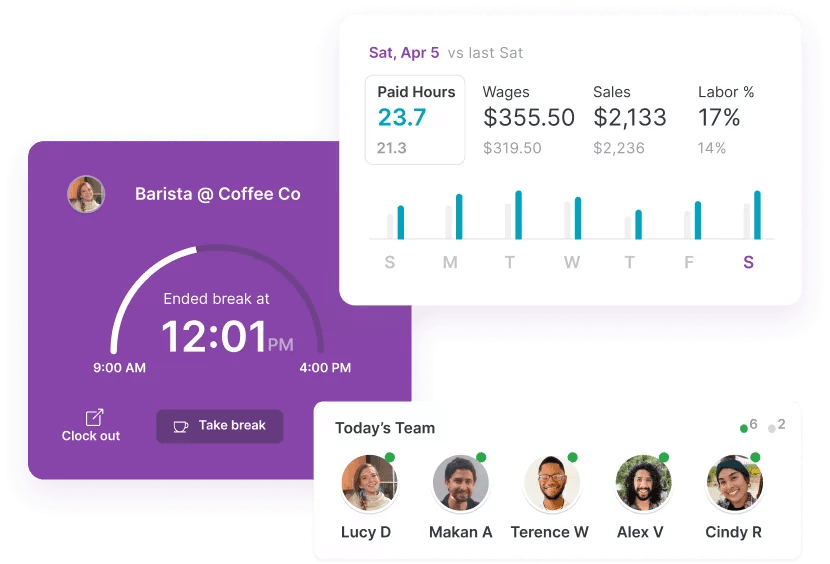
We're Homebase, and we make scheduling, time tracking, payroll, and hiring tools for small businesses with hourly teams, which means we spend our days close to the exact problem you're trying to solve.
As you know, running payroll for an hourly team is messier than running it for a flat salary. Shifts change, tips need splitting, overtime sneaks up on you. So we built our own payroll to keep up with that mess — your hours flow straight from your schedule into payroll, taxes file themselves, and things like break and overtime rules get caught before they turn into a problem, not after. That's the bar we are holding Gusto and Rippling to.
We judged Gusto and Rippling on their own merits. No one paid for placement, there are no affiliate links, and no backlink deal shaped a single word of what follows.
Picking payroll software is time-consuming and high-stakes, and we work with hourly teams every day, so we built this guide to help you decide.
How We Chose the Best Payroll Software
We looked at Gusto vs. Rippling through the lens that actually matters when you're picking payroll software:
- How clear the pricing is
- What it costs once everything's added up
- What each one actually covers, feature by feature
- How fast you can get set up
- Whether you can run it from your phone, not just a laptop
- How easy support is to reach
- How well each one fits an hourly, shift-based team
Want a wider view? Our guide to the best payroll software for small business covers more options.
We started with hands-on time in both tools, then checked each vendor's own pricing pages, then looked for patterns across G2 and Capterra reviews. Cambria Wallace, who works in payroll operations at Homebase, put this comparison together.
Pricing changes fast in this space, so we checked every figure against Gusto's pricing page and Rippling's pricing page — and we'd still nudge you to confirm current pricing before you buy. Curious how we review software? Read more on our methodology page.
Gusto vs. Rippling: Quick Comparison
Before the deep dive, here's how Gusto vs. Rippling stacks up across the factors most business owners weigh first.
- Starting price: Gusto payroll pricing starts at $49 per month plus $6 per employee (published). Rippling requires you to contact sales for a custom quote — no pricing is published.
- Best for: Gusto fits US small businesses that want simple payroll and HR. Rippling fits growing, tech-forward teams that want HR, IT, and payroll unified.
- Setup time: Gusto takes roughly one to two days, self-serve. Rippling takes several weeks, guided.
- IT and device management: Gusto doesn't offer it. Rippling does.
What Is Gusto?
Gusto is a cloud-based payroll, benefits, and HR tool built for US small and mid-sized businesses. Founded in 2011 as ZenPayroll, it handles full-service payroll, automated tax filing, benefits administration, and employee onboarding, all through one interface built to feel simple for owners without an HR background.
What Is Rippling?
Rippling is an all-in-one workforce tool, founded in 2016, that unifies HR, IT, payroll, and finance in a single system. It's built for growing and distributed teams that want automation and device management sitting alongside payroll, rather than stitched together from separate apps.
Gusto vs. Rippling: Feature Comparison
Comparing Gusto vs. Rippling on features, both tools cover the payroll and HR basics well. Where they differ is depth, breadth, and who each one was built for, so here's how they stack up on what matters most to you.
Gusto vs. Rippling payroll and tax filing
For payroll and tax filing, Gusto and Rippling starts from the same baseline: both tools run full-service US payroll with automated tax filing, so you're covered either way.
- Gusto payroll: files in all 50 states, gives you unlimited pay runs, and feels polished for everyday use.
- Rippling payroll: works as a module with deeper multi-state automation and native global payroll built in, which counts for more once your team crosses state or national lines.
Just note that you're still responsible for your own wage and hour compliance obligations under federal law.
Gusto HR and Rippling benefits
On HR and benefits, Gusto vs. Rippling splits along familiar lines.
- Gusto HR: covers benefits through a broker, handling health insurance, 401(k), and workers' comp, plus basic applicant tracking. Usually plenty if your team is small.
- Rippling: goes deeper, with more HR automation and benefits built in as one module of its wider system. Starts to pay off once you're scaling and things get complex.
Rippling vs. Gusto IT and device management
This is where Gusto and Rippling split sharply, and Rippling stands apart.
- Rippling: can set up laptops, manage app access, and handle device security right alongside payroll.
- Gusto: skips IT and device management entirely, which won't matter to most small businesses but could be a dealbreaker for a more tech-forward team.
Gusto vs. Rippling global payroll
On global payroll, Gusto and Rippling aren't even close.
- Gusto: pays contractors in 120+ countries and offers employer-of-record coverage, through a partnership with Remote, in 7 countries (Australia, Brazil, Canada, India, Mexico, the Philippines, and the UK), with more being added.
- Rippling: handles global payroll and employer-of-record natively in 185+ countries.
If hiring across borders is part of your plans, Rippling has a wider reach built in. Either way, you're still responsible for your own employment tax obligations.
Gusto vs. Rippling: Pricing Comparison
Pricing is where Gusto vs. Rippling diverges most, and it's the spot where a wrong assumption costs you the most. Here's what each one actually charges, plus the costs that don't show up on the sticker.
How much does Gusto cost?
Verified for 2026, Gusto pricing breaks into four plans:
- Simple: $49 per month plus $6 per employee
- Plus: $80 per month plus $12 per employee
- Premium: $180 per month plus $22 per employee
- Contractor Only: $35 per month plus $6 per contractor
Gusto raised its base pricing in March 2026, so older comparisons showing $40 are out of date. Note that paying employees across multiple states requires the Plus tier.
How much does Rippling cost?
Rippling doesn't publish pricing anywhere on its site. You give their sales team your headcount and the modules you want, and they send back a custom quote — there's no plan page to check for yourself, and no way to see a number before you talk to someone. That quote comes attached to a contract, so you're committing before you know what you're comparing it against.
The true cost of Gusto vs. Rippling
The sticker price isn't the whole picture, and this is where Gusto vs. Rippling separates most.
- Rippling: you don't get a number until you talk to sales, and that quote comes with a contract attached — multiple user reviews describe being locked into an annual term before they had a clear picture of total cost.
- Gusto: month-to-month with no setup fees, though per-employee costs climb as you move up tiers.
Gusto Reviews: What Users Say
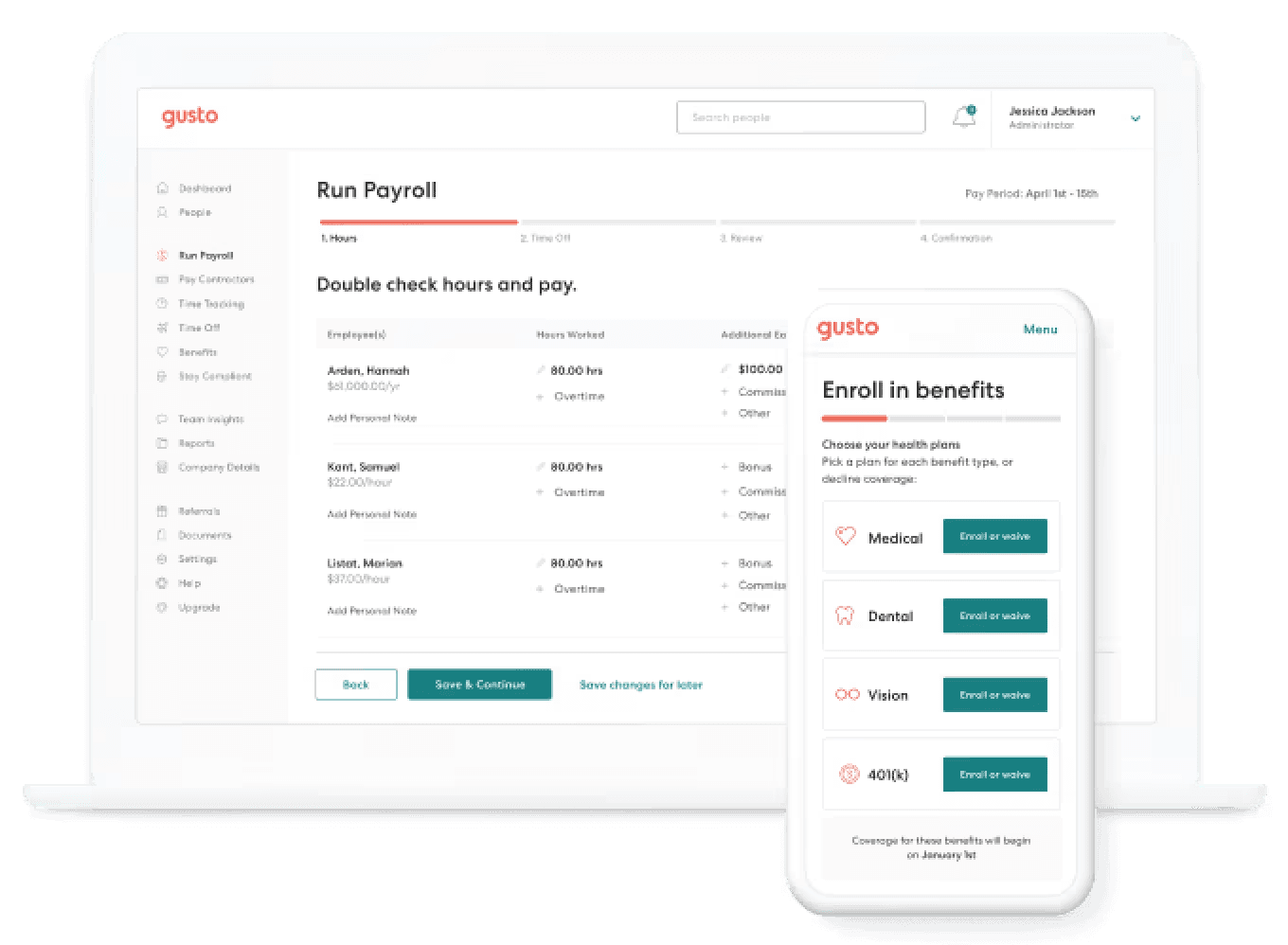
Gusto reviews tell a consistent story: small businesses love how easy payroll is, and customer support is where things fall short. Here's how it holds up across verified ratings and real user feedback.
Best for: US small businesses that want simple, affordable payroll and HR.
Ratings: G2 4.6 (11,550 reviews) and Capterra 4.6 (4,209 reviews, with a customer-service sub-score of 4.4). Verified July 2026.
Gusto is a cloud-based payroll and HR tool that's built its reputation on clean onboarding, reliable tax filing, and an interface small teams pick up fast. It covers full-service payroll, automated tax filing, benefits administration, onboarding, and contractor payments. Pricing starts at $49 per month plus $6 per employee.
What users like: On Capterra, one reviewer called it the "Easiest HR system I've used. Super simple and straightforward."
What users criticize: Support is the recurring theme. A Capterra reviewer noted that "customer support with Gusto can be slow and sometimes not helpful," and a long-time user on Reddit summed it up by saying Gusto is great as long as you never need to contact customer service.
Our take: Gusto is the honest default for a US small team that wants payroll to just work, as long as you can live with business-hours support and some tier-gating as you grow. If that tier-gating gives you pause as your team grows, our roundup of Gusto alternatives is worth a look before you commit.
Rippling Reviews: What Users Say
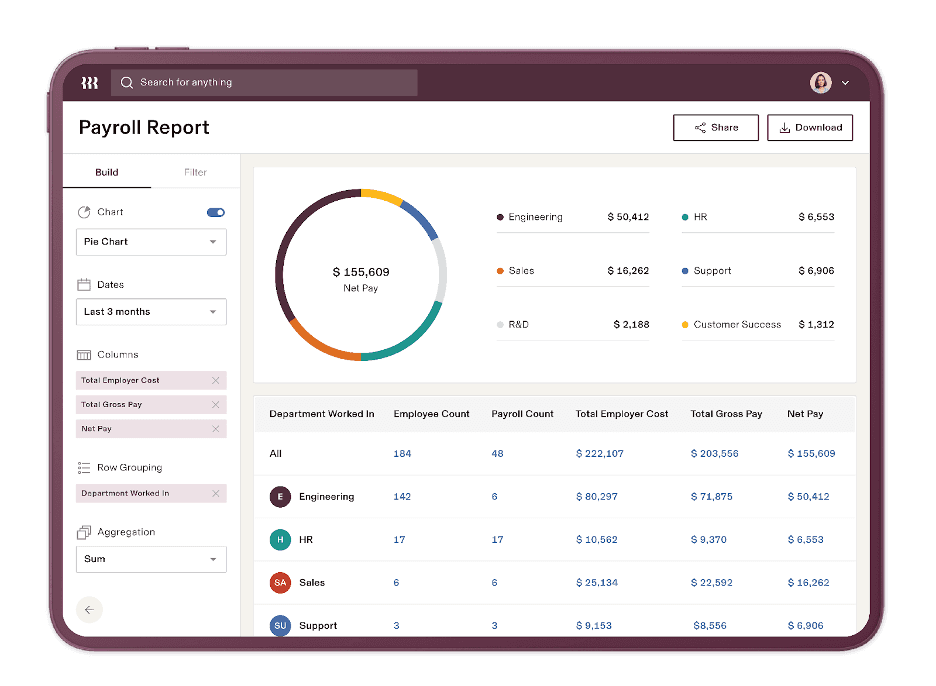
Rippling reviews paint the picture of a powerful, highly-rated system, praised for its depth and how well everything connects, but with frustration around pricing opacity and getting a human on support. Here's the full picture.
Best for: growing or tech-forward teams that want HR, IT, and payroll unified.
Ratings: G2 4.8 (12,984 reviews) and Capterra 4.9 (4,645 reviews, with a customer-service sub-score of 4.7). Verified July 2026. Worth noting: Rippling out-rates Gusto on both review sites.
Rippling is an all-in-one workforce tool that connects HR, payroll, IT, and finance in one system. It covers modular HR, payroll, IT, and finance tools, heavy automation, device management, and native global payroll and employer-of-record. Pricing isn't published; you contact sales for a custom quote and sign a contract before you see a number.
What users like: A Capterra reviewer highlighted how "payroll, timekeeping, PTO, and employee management all work together in one clean platform."
What users criticize: Support access draws the most frustration. One Capterra reviewer wrote that their "biggest gripe is the usage of a chatbot to navigate to support," adding that they'd prefer a phone number readily available. On Reddit, users describe Rippling as "a maze of options" compared with Gusto's simplicity, including one who switched away and then switched back.
Our take: Rippling is powerful and rates highly, but the quote-only pricing, contract lock-in, and support access gated by company size make it a bigger commitment than a small team may want.
Gusto vs. Rippling: Which Should You Choose?
When it comes to Gusto vs. Rippling, the honest rule of thumb is to buy for the complexity you actually have, not the complexity you imagine you'll grow into.
- Choose Gusto if you're US-based, under roughly 50 employees, and you want transparent pricing and fast setup.
- Choose Rippling if you're scaling quickly, need HR and IT unified, hire globally, and have someone on the team to manage a more complex system.
The trap to avoid is overbuying. Plenty of small teams pay for capability they never use, and the reviews reflect that regret. If you're weighing payroll software for small business, match the tool to your current reality first.
Gusto vs. Rippling: Finding Your Fit with Homebase
If your team is hourly and shift-based, though, there's a catch neither tool solves well: they weren't built with your team in mind. Payroll that runs straight off your schedule and timesheets, with taxes filed automatically and hours flowing in without manual re-entry, is a different job than either tool was designed for.
That's the job Homebase payroll does, and you can try it for your team. Because Homebase already runs your scheduling and time tracking, the hours your team works become the hours they're paid for, with no extra steps in between.
That connection is what Tiana Post, owner of Awaken Bakery, was after: "We just needed simple. Other solutions were built for big companies. Homebase is perfect for a small business like mine."

Gusto vs. Rippling: Frequently Asked Questions
What is the difference between Gusto and Rippling?
The difference between Gusto and Rippling comes down to focus. Gusto is a simple, transparent payroll and HR tool built for US small businesses, while Rippling is a modular, quote-based system that unifies HR, IT, and payroll for growing teams.
Is Gusto or Rippling better for small business?
For most small businesses, Gusto is the better fit thanks to transparent pricing, fast self-serve setup, and a focus on payroll and HR. Rippling suits small businesses only when they need IT management or global payroll alongside HR.
Is Rippling a PEO? Is Gusto a PEO?
Rippling PEO comes as an option that co-employs your team for benefits and compliance. Gusto is a licensed benefits broker rather than a PEO, though it partners to offer similar services.
How hard is it to switch between them?
Switching between Gusto and Rippling takes planning, since you'll migrate employee data, tax details, and payroll history. Rippling's annual contract can also make leaving mid-term costly, so confirm your terms before you commit.
Does Gusto integrate with QuickBooks?
Gusto integrates with QuickBooks Online, syncing payroll data directly into your accounting so you don't re-enter it by hand. This connection is one reason Gusto is popular with small businesses that already run their books in QuickBooks.