Double Time Pay: What It Is and How to Calculate It

SMALL BUSINESS INTEL, IN YOUR INBOX
Table of contents
Managing hourly employees who work long shifts or weekends? Understanding double time pay could save you thousands in labor costs—or keep you compliant if you're in California. Double time pay means paying employees twice their regular rate, which is significantly more expensive than standard overtime at 1.5x.
This guide explains when double time pay is required by law, how to calculate it correctly when running payroll, and practical strategies to avoid triggering unnecessary double time hours. Whether you're legally required to pay it or considering it as a voluntary benefit, here's everything you need to know.

TL;DR: What you need to know about double time pay
Double time pay is one of the most misunderstood parts of payroll for hourly teams. Here's what small business owners need to know before the hours start stacking up:
- Double time = 2× an employee's regular hourly rate (not 1.5×, which is overtime)
- It is not required by federal law under any circumstances
- California is the only state that mandates double time — after 12 hours in a single workday or 8+ hours on the 7th consecutive workday
- Bonuses and commissions change the calculation — you must recalculate the regular rate before multiplying
- The most cost-effective strategy is scheduling to prevent double time before it hits your payroll
What is double time pay?
Double time pay means paying employees twice their regular hourly rate for qualifying hours.
It typically applies to non-exempt (hourly) employees who work extremely long hours, work on holidays, or meet specific state requirements in California.
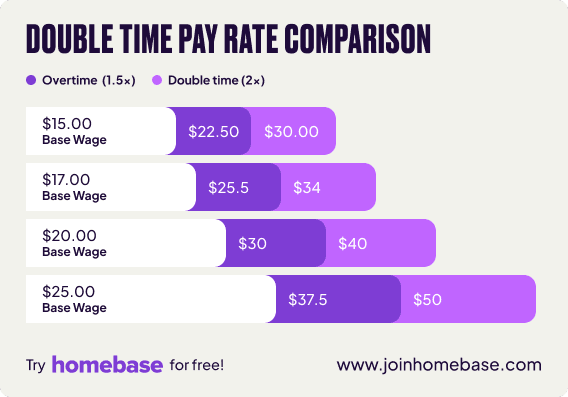
Quick reference: How much is double time?
- $15/hour → $30/hour double time
- $17/hour → $34/hour double time
- $20/hour → $40/hour double time
- $25/hour → $50/hour double time
Here's what catches most business owners off guard: double time is NOT required by federal law. The Fair Labor Standards Act (FLSA) mandates overtime at 1.5x after 40 hours per week, but it doesn't require double time under any circumstances.
What about "double overtime"? You might hear this term, but it's not official. Most people just mean double time (2x pay rate). Don't confuse it with regular overtime, which is 1.5x your regular rate.
If keeping track of who qualifies and when rates kick in feels like a lot on top of running a business, it doesn't have to be — Homebase time tracking handles it automatically.
Double time vs. overtime
Is overtime double pay? No—and understanding this distinction could save you thousands. Here's how the three pay rates actually compare:
Regular pay
- Rate: your standard hourly rate
- When it applies: first 40 hours/week (or first 8 hours/day in California)
- Example at $20/hr: $20/hr
Overtime (time-and-a-half)
- Rate: 1.5× your regular rate
- When it applies: after 40 hours/week federally; after 8 hours/day in California
- Example at $20/hr: $30/hr
Double time
- Rate: 2× your regular rate
- When it applies: not required federally; California mandates after 12 hours/day or the 7th consecutive workday
- Example at $20/hr: $40/hr
In California, you might pay all three rates in the same workweek — calculated separately based on when the hours were worked. Here's how they stack in a single 14-hour California workday:
- First 8 hours: $20/hr (regular) = $160
- Next 4 hours: $30/hr (overtime) = $120
- Final 2 hours: $40/hr (double time) = $80
- Total for 14 hours: $360
When does double time apply?
Figuring out when you're legally required to pay double time — and when it's optional — can save you from expensive compliance mistakes. Here's what you need to know, including when double time starts and what triggers it.
Federal law (FLSA) The FLSA does NOT require double time under any circumstances. Weekend work, holiday shifts, and long hours don't automatically trigger double time federally. There's also no federal hour threshold — after 40 hours per week, what kicks in is overtime at 1.5x, not double time. Employers can offer double time voluntarily through company policy or union contracts, but it's never mandated.
California — the only state requiring double time California is the only state that mandates double time by law, per California Labor Code Section 510, in two specific situations:
- After 12 hours in a single workday: all hours beyond 12 must be paid at double time for non-exempt employees
- After 8 hours on the 7th consecutive workday: if an employee works seven consecutive days in a workweek, any hours beyond 8 on that seventh day must be paid at double time
Alternative workweek schedules: If you use 4×10 shifts or other alternative schedules, double time still applies after 12 hours in a day. For days worked beyond your scheduled workweek, double time applies after 8 hours (not 12). These schedules require a two-thirds secret ballot vote by affected employees and must be reported to the state.
Washington State Washington requires double time only for workers on certain public works projects. Most Washington businesses follow standard 1.5x overtime rules.
Other states and voluntary policies All other states have no legal requirement for double time. Many employers choose to offer it voluntarily for federal holidays, weekend or overnight shifts, extreme overtime (50+ hours per week), or employee retention during busy seasons. Union contracts may also require double time in specific industries, regardless of state law.
The most common misconception: double time does not automatically start after 40 hours per week. That threshold triggers overtime at 1.5x. Double time after 40 hours only applies if your company policy or state law explicitly requires it.
Who qualifies for double time pay?
Not every employee on your team is eligible for double time pay. Understanding who qualifies — and who doesn't — protects you from compliance violations and unnecessary labor costs.
Is your employee eligible?
- Non-exempt employee (hourly or low-salary, non-managerial work)? → Can be eligible
- In California: worked 12+ hours/day OR 8+ hours on 7th day? → Required by law
- Your policy or union contract offers it for holidays/weekends/OT? → Required by agreement
- Exempt (salaried) employee? → Generally not eligible under any state law
Be mindful of classifications. Misclassifying non-exempt employees as exempt to avoid double time creates major liability — back wages, penalties, and potential lawsuits.
As Cambria Wallace, Project Lead III, Payroll Implementation at Homebase suggests: "Keep up with timecards daily so you are not surprised by the numbers of hours worked and OT amounts on payroll day."
The real cost impact of double time for hourly teams
One 14-hour shift instead of two 7-hour shifts costs you an extra $80. Do that weekly across three key positions? You've just added $12,480 to your annual labor costs.
Option A: One employee works 14-hour shift
- 8 hours regular ($20/hr) = $160
- 4 hours overtime ($30/hr) = $120
- 2 hours double time ($40/hr) = $80
- Total: $360 | Hourly average: $25.71
Option B: Two employees split coverage (7 hours each)
- 14 hours at regular rate ($20/hr)
- Total: $280 | Hourly average: $20
- Savings: $80 (22% reduction)
The compound effect:
- Weekly: $80 savings
- Annually: $4,160 savings
- Across 3 positions: $12,480 annual savings
When labor costs typically run 25–35% of revenue in restaurants and retail, double time hours directly impact your profit margins. Double time should be your last resort, not your default scheduling strategy.
If you're managing schedules manually, these costs are easy to miss until payday — Homebase scheduling flags them before they hit.
How to calculate double time pay
Calculating double time doesn't require special software or a math degree — just the right formula. Whether you're figuring out what you owe for a holiday shift or a 14-hour day in California, here's how to get it right every time.
Basic double time calculation in 5 steps
- Determine when double time applies (check your policy or state law)
- Verify the employee's regular hourly rate
- Count eligible double time hours
- Calculate double time pay: Regular rate × 2 × eligible hours
- Add to regular and overtime pay for total compensation
Quick examples:
- $20/hr → $40/hr double time rate
- $21/hr → $42/hr double time rate
- $25/hr → $50/hr double time rate
Let's see how this works in practice. Say your employee Lila earns $20/hour, and your company offers double time for holiday shifts. If Lila works 8 double-time hours on the Fourth of July:
- Double time rate: $20 × 2 = $40/hour
- Double time pay: $40 × 8 hours = $320
- Her 32 regular hours: $640
- Total pay: $960
What to keep in mind: double time with bonuses or commissions
If employees receive bonuses or commissions, you must recalculate the "regular rate" before applying the 2× multiplier. Say a retail employee works 50 hours at $20/hour and earns $200 in sales commissions. Their regular rate isn't $20/hour — it's $24/hour ($1,200 total compensation ÷ 50 hours).
That makes double time $48/hour, not $40/hour. Underpaying by $8/hour can compound into some serious compliance violations.
What to include in the regular rate:
- Non-discretionary bonuses (performance, attendance, production)
- Commissions
- Shift differentials
- Piece-rate pay
What you can exclude:
- Discretionary bonuses (unexpected gifts)
- PTO/vacation pay
- Expense reimbursements
Strategies to avoid double time
- Cap shifts at 10 hours maximum. Overlapping shifts give you the same coverage at a significantly lower cost than one employee working into double time.
- Track consecutive workdays. Flag employees approaching 6 consecutive days and give them a day off before the expensive 7th day (especially in California).
- Hire seasonal staff for peak periods. Part-timers during busy seasons are often cheaper than paying core team double time, even with training costs.
- Require manager approval for extended hours. Set a hard stop at 11 hours so no shift drifts into double time territory without sign-off.
- Use scheduling tools with double time alerts. Homebase flags when employees approach 12 hours or their 7th consecutive day so you can adjust before costs kick in.
With a wage calculator, you can easily calculate double time pay without risking calculation errors.
What is double overtime?
You might come across the term "double overtime" and wonder if it's a separate, higher pay tier — it's not. Double overtime is not an official legal category under federal law or in any state.
In most cases, when people say double overtime, they mean double time — a 2× pay rate applied to qualifying hours. The confusion usually comes from conflating overtime (1.5×, federally required after 40 hours/week) with double time (2×, only mandated in California).
If a union agreement or contract references double overtime, verify the exact rate. In practice, it almost always means double time pay, not a third tier above 2×.
Do you get double time on holidays?
The FLSA does not require any premium pay for holiday work. Working on Thanksgiving, Christmas, or any other federal holiday doesn't automatically entitle employees to double time or even time-and-a-half unless your state law or company policy says otherwise.
What actually determines holiday pay:
- Company policy: Many employers voluntarily offer double time on holidays as a retention benefit. If your employee handbook promises it, you're legally obligated to pay it.
- Union contracts: Collective bargaining agreements frequently mandate double time for holiday shifts, regardless of state law.
- State law: A small number of states have specific rules for certain industries, but none broadly require double time on holidays.
If you offer holiday double time, document it clearly and apply it consistently. Selective enforcement creates legal exposure.
Common double time mistakes employers make
Even experienced payroll teams make these errors, and they're expensive.
Mistake #1: Forgetting bonuses and commissions. The fix: always recalculate the regular rate whenever non-discretionary pay is added — never apply 2× to the base wage alone.
Mistake #2: Misclassifying employees as exempt. The fix: run regular classification audits, and when in doubt, treat employees as non-exempt.
Mistake #3: Confusing overtime with double time. The fix: use written documentation and automated payroll calculations to keep the two rates distinct.
Mistake #4: Not tracking the 7th consecutive day in California. The fix: use scheduling software that counts consecutive workdays and alerts you before someone hits day seven.
Mistake #5: Ignoring shift differentials in calculations. The fix: train payroll staff on every component of the regular rate — not just base hourly wage.
The stakes: in California, penalties can exceed $1,000 per violation, plus back wages, interest, and legal fees. A single misclassified employee over three years could cost your business $50,000 or more.
Make payroll and overtime calculations easier
You can't avoid every long shift or busy weekend, but you can avoid the expensive surprises that come with them. Homebase was built specifically to help small businesses with hourly teams stay ahead of costly premium pay.
Here's how Homebase helps you prevent double time:
- Real-time alerts when employees approach 12 hours or their 7th consecutive day — so you can adjust before expensive hours kick in
- Smart schedule templates that cap shift lengths and spread coverage across multiple employees automatically
- Integrated time tracking and payroll that calculates complex rates (including bonuses and commissions) correctly every time
You don't need to watch your schedule like a hawk — Homebase monitors your shifts and alerts you only when action is needed.
Try Homebase free. No credit card required.
FAQs about double time pay
Is double time required by law?
Double time is not required by federal law. California is the only state that mandates it — after 12 hours in a single workday or 8+ hours on the 7th consecutive day. Washington requires it on some public works projects. All other states leave it to employer discretion; the FLSA only requires overtime at 1.5× after 40 hours per week.
How do you calculate double time pay?
You calculate double time pay by multiplying the regular hourly rate by 2. Important: if bonuses or commissions were paid that week, you must first recalculate the regular rate by dividing total compensation by total hours worked, then apply the 2× multiplier.
When does double time start?
Double time starts after 12 hours worked in a single workday in California, or after 8 hours on the 7th consecutive day of a workweek. There is no federal hour threshold — outside California, double time only starts when your company policy or union contract says it does.
After how many hours do you get double time?
You get double time after 12 hours in a single workday in California — that's the only state with a legal hour threshold. Federally, there's no automatic trigger. After 40 hours per week, federal law requires 1.5× overtime, not double time.
Is double time the same as overtime?
No, overtime pays 1.5× your regular rate and is required by federal law after 40 hours per week. Double time pays 2× your regular rate and is only required in California under specific conditions. They're separate pay tiers, often applied to different hours in the same workday.
Do salaried employees get double time?
Salaried employees generally don't get double time under any state law. Exempt status means exclusion from both overtime and double time protections. A company could voluntarily offer it as a policy, but that's rare.
What is double time pay for $21 an hour?
Double time pay for $21 an hour is $42 an hour ($21 × 2 = $42). If an employee earns $21/hour and works 3 hours at double time, those hours would pay $126.
Remember: This is not legal advice. If you have questions about your particular situation, please consult a lawyer, CPA, or other appropriate professional advisor or agency.