Homebase vs. Sling (2026)
Discover how Homebase stands out against competitors in team management solutions for your business.
Compare
See How We Stack Up
Discover the advantages of Homebase over Sling.
| Homebase | Sling | |
|---|---|---|
| Auto-scheduling | Included in Homebase | Included in Sling |
| Automatic tax filing and payment | Included in Homebase | Not included in Sling |
| Built-in time tracking and scheduling features | Included in Homebase | Included in Sling |
| Open shifts & swaps | Included in Homebase | Included in Sling |
| GPS location verification | Included in Homebase | Included in Sling |
| Schedule templates | Included in Homebase | Included in Sling |
| In-app team messaging | Included in Homebase | Included in Sling |
| Live support from certified HR advisors | Included in Homebase | Not included in Sling |
| Tip pooling & distribution | Included in Homebase | Not included in Sling |
| POS clock-in integration | Included in Homebase | Not included in Sling |
| Earned wage access / on-demand pay | Included in Homebase | Not included in Sling |
| AI Hiring Assistant | Included in Homebase | Not included in Sling |
Trusted by 150,000+ small businesses and their teams.















Why businesses choose Homebase over Sling
Real numbers, real results. Hourly teams thrive with Homebase.

Scheduling
275 Million
Shifts logged on Homebase Scheduling

Time Clock
1 Billion
Hours tracked with Homebase Time Clock

Payroll
4 Million
Paychecks processed with Homebase Payroll
Table of contents

Conquer your workday.
Join the 150K+ small businesses using Homebase for time clocks, schedules, payroll, and HR.
Homebase vs Sling (2026): Which workforce management platform fits your team?
You're trying to figure out if you need everything in one place or if you're fine juggling separate tools. That's really what this comes down to.
Homebase runs your entire operation from one app. You build the schedule, your team clocks in, those hours flow straight into payroll software. Sling handles employee scheduling and time tracking, then hands off timesheets to whatever payroll software you already use.
If you run a restaurant, coffee shop, retail store, salon, or vet clinic where scheduling and payroll need to talk to each other, Homebase makes sense. If you've got payroll figured out and just need better work scheduling, Sling's focused approach works.
Here's what actually matters: Do you want to run payroll from the same place you built the schedule, or are you okay with managing two separate systems?
TL;DR: Sling vs. Homebase in 30s or less
Homebase handles shift-based hourly teams where operations run on schedules and timesheets—from employee scheduling through payroll processing. Sling works when scheduling is your core need and you want shift management without built-in payroll. For hourly operations requiring time tracking, payroll, and compliance tools working together, Homebase makes more sense.
When to choose Homebase:
- You're rebuilding the schedule every week because someone always calls out
- Free tier for 1 location, up to 10 people
- Built-in payroll that already knows how many hours everyone worked
- Tips flow straight into paychecks without manual math
- You want to see labor costs against sales targets right now
- GPS time clock with photo verification on all paid tiers
When to choose Sling:
- You've got payroll handled and just need better scheduling
- Per-user pricing works for small teams
- Shift swaps and open shift claiming matter most
- You only need time tracking and scheduling
- POS integration without payroll add-on
- Tight budget and basic scheduling solves your problem
What is Homebase?
Homebase handles scheduling, time tracking, payroll, and team coordination for hourly workers. You can build weekly schedules, verify hours with GPS-enabled time clocks, process payroll with automatic tax filing, and message your team—all from your phone without juggling multiple systems.
Homebase AI Assistants automate the repetitive stuff—screening applications, building optimized schedules, catching payroll issues before you run it—so you can focus on running your business instead of drowning in admin work.
What makes Homebase different:
- Start without entering credit card information—free tier works right away
- Process payroll for tipped workers with automatic calculations and distributions
- See labor spending as a percentage of revenue in real-time
- Replace scattered group texts with organized team messaging
- Control multiple business locations from one dashboard
- Automate tip distribution through Tip Manager
Over 150,000 small businesses use Homebase. The free Basic plan includes scheduling, time tracking, team messaging, and POS integration for up to 10 employees at a single location.
What is Sling?
Sling handles shift creation, time clock functionality, and team communication. Drag-and-drop scheduling, shift swap coordination, and labor cost visibility help you build schedules quickly. The system tracks time through mobile apps or kiosk mode, then exports timesheets to your payroll software through integrations with Gusto, QuickBooks, and other payroll providers.
What Sling does well:
- Straightforward shift scheduling interface
- Free plan for teams under 30 users
- Strong shift trade and open shift tools
- Labor cost reporting against budgets
- Team messaging and task assignment
Sling uses per-user pricing starting at $1.70 per person monthly (billed annually). The free plan works for up to 30 users with basic scheduling and time tracking. GPS clock-in and PTO management require paid tiers.
Here's the Pricing section and everything after it, edited for voice/tone while maintaining the exact formatting:
Homebase vs. Sling pricing
The platforms use different pricing models. Homebase bills per location with unlimited employees on certain paid tiers, while Sling charges per user. Understanding both structures matters when calculating actual costs for your operation.
Homebase pricing: a rundown
Homebase bills by location with unlimited team members on certain tiers. Payroll adds on to any plan level.
Basic — $0/month (1 location, up to 10 employees): Shift scheduling tools, clock-in/clock-out tracking, workplace messaging, and point-of-sale connections at zero cost.
Essentials — $30/month per location (unlimited employees): Adds GPS location verification for clock-ins, notifications when staff arrive late, better scheduling tools, and notes you can attach to specific shifts.
Plus — $70/month per location: Adds AI-powered schedule creation, labor forecasting against sales and weather patterns, paid time off policy setup, and department-based organization with permission settings.
All-in-One — $120/month per location: Adds workflows for bringing new hires onboard, analytics for labor spending, compliance resources for HR requirements, and direct access to Homebase HR Pro experts.
Homebase Payroll — $49/month + $6 per employee: Run payroll as many times as you need, submit taxes across state lines, coordinate multiple business locations, enable earned wage access through Cash Out, and handle all tax filings automatically. Tip Manager add-on ($25/month per location) distributes tips by hours worked or role.
Adding hourly employees doesn't increase your subscription fees—only payroll processing costs scale with headcount.
Sling pricing: a rundown
Sling bills per user across four tiers. Each tier unlocks additional workforce management features.
Free — $0/month (up to 30 users): Basic shift scheduling, time clock app access, shift swap functionality, availability management, and team messaging. Limited reporting and no advanced features.
Premium — $1.70/user/month (billed annually) or $2/month (monthly billing): Free features plus labor cost budgeting, sales integration, advanced reporting, shift notes, task assignments, and email support.
Business — $3.40/user/month (billed annually) or $4/month (monthly billing): Premium features plus PTO tracking, overtime alerts, GPS location verification, geofencing for clock-ins, detailed labor reports, and priority support.
Enterprise — Custom pricing (contact Sling): Business features plus dedicated account management, custom integrations, advanced security controls, and SLA guarantees.
Per-user pricing scales with team size. On top of that, Sling doesn't offer built-in payroll. Timesheets export to external payroll software through integrations with platforms like Gusto, QuickBooks, and ADP.
What this means for your budget
15-person bakery:
Homebase (Plus + Payroll): $70 + $49 + (15 × $6) = $209/month covering scheduling, time verification, payroll processing, and workplace messaging in one platform.
Sling (Business tier for GPS + external payroll): 15 × $3.40 = $51/month for scheduling and time tracking. Add external payroll costs (Gusto starts at $40/month + $6/employee = $130/month) for a total of around $181/month split across two separate systems.
28-employee salon:
Homebase (All-in-One + Payroll): $120 + $49 + (28 × $6) = $337/month including HR compliance, new hire workflows, and single unified system.
Sling (Business tier + external payroll): 28 × $3.40 = $95.20/month for Sling. Add Gusto payroll ($40 + 28 × $6 = $208) for a total of around $303/month managed across disconnected platforms.
8-person food truck (no payroll yet):
Homebase (Basic): $0/month covering up to 10 workers with scheduling, time verification, and POS connections at zero cost.
Sling (Premium): 8 × $1.70 = $13.60/month for scheduling and basic time tracking without GPS capabilities.
Sling's per-user pricing advantages shrink as teams grow. Per-location pricing benefits multi-location businesses and operations with fluctuating part-time rosters.
Breakdown: Homebase payroll vs. Sling payroll
It's Friday at 4pm and you need to run payroll. With Homebase, the hours are already there—just review and approve. With Sling, you're logging into Gusto, importing a CSV, checking for errors, then running it. Extra 20 minutes every pay period.
Homebase Payroll handles hourly operations and tipped employees. Hours flow automatically from scheduling and time tracking into payroll processing—no manual data entry. Run payroll unlimited times monthly, handle multi-state tax filings, and distribute tips through Tip Manager. All priced at $49/month base plus $6 per employee.
The AI Payroll Assistant flags issues before you run payroll. It will catch things like missed breaks or weird overtime patterns.
Homebase payroll software features
- Process payroll as many times as you need without extra fees per cycle
- Submit federal, state, and local taxes with automatic calculations and year-end documentation
- Hours captured during shifts automatically populate payroll—no manual timesheet entry
- Handle different wage rates across multiple locations and employee roles
- Offer Cash Out so employees can access wages they've already earned (zero cost to you)
- Distribute tips directly into employee paychecks through Tip Manager integration
Sling doesn't provide payroll processing. Instead, it integrates with external payroll software including Gusto, QuickBooks, ADP, and Paychex. Export timesheets with one click, then process payroll in your separate system. This works when you already have established payroll relationships or prefer keeping HR and payroll with specialized providers.
Sling payroll integration features
- One-click timesheet export to payroll systems
- Integrations with Gusto, QuickBooks, ADP, Paychex
- Wage and hour data transfers automatically
- Supports multiple pay rates per employee
- Overtime calculations included in exports
- Compatible with most major payroll providers
Homebase payroll works when you want scheduling through direct deposit in one workflow, especially for tipped employees and multi-location operations. Sling works when you prefer keeping payroll separate and just need timesheets exported to your existing provider.
Breakdown: Homebase scheduling vs. Sling scheduling
Building your weekly schedule shouldn't take all Sunday night. You're sitting there trying to remember who requested Tuesday off, who can't work mornings, and whether you've got enough people for Saturday dinner rush.
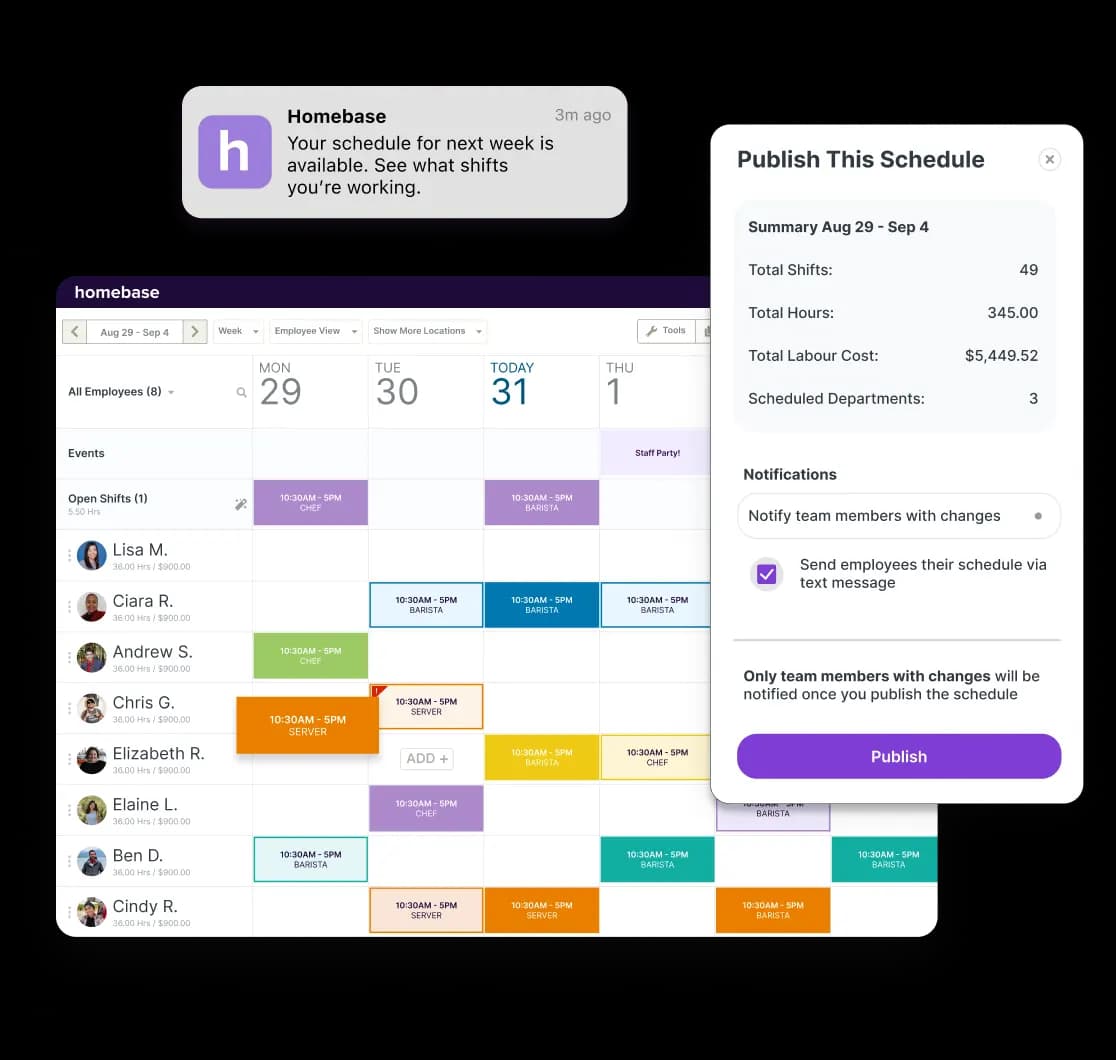
Homebase Scheduling handles employee scheduling and labor cost control. Build schedules in minutes using templates or let AI Scheduling Assistant analyze sales forecasts, employee availability, and labor budget targets to generate schedules automatically. Set labor percentage goals, get alerts when schedules exceed targets, and publish directly to employee mobile apps with instant notifications.
Homebase employee scheduling features
- AI analyzes historical sales data, weather forecasts, and employee availability to build optimized schedules
- Track projected labor spending against revenue goals with real-time cost visibility
- Get warnings about scheduling conflicts, overtime risks, and availability issues before publishing
- Workers claim available shifts and coordinate coverage trades through the mobile app
- Send instant alerts via push notification and text when schedules are published or modified
- Configure paid time off rules and track employee availability automatically
Sling handles shift scheduling with drag-and-drop simplicity. Create schedules visually, duplicate previous weeks as templates, and handle availability and time off requests. Employees claim open shifts, request shift trades, and receive schedule notifications through the mobile app.
Labor cost budgeting shows projected spend against targets. And it doesn't auto-generate schedules based on sales forecasts like Homebase does.
Sling scheduling software features
- Drag-and-drop schedule builder with templates
- Shift duplication and recurring schedule patterns
- Open shift posting and shift swap coordination
- Availability and time off request management
- Labor budget tracking and cost projections
- Schedule publishing with mobile notifications
Homebase scheduling works when labor costs directly impact your bottom line and you're trying to optimize schedules every week based on actual sales data. Sling works when you need fast scheduling and shift trade functionality without AI optimization or sales-driven labor targets.
Breakdown: Homebase time clock vs. Sling time tracking
Homebase Time Clock turns phones, tablets, and POS devices into GPS-verified time tracking systems. Photo verification prevents buddy punching on shared devices. Geofencing confirms employees are on-site before clocking in. Break tracking enforces compliance with local labor laws.
Early clock-in prevention and late arrival notifications protect labor costs. Overtime warnings alert you before employees hit premium pay thresholds. Timesheets flow directly into payroll—no manual entry.
Homebase time tracking features
- Capture GPS coordinates and geofence boundaries at clock-in and clock-out across all paid subscription tiers
- Require photo capture on shared devices to verify employee identity and prevent fraudulent time punches
- Send automatic reminders about required breaks and alert managers when breaks are missed
- Block employees from clocking in before scheduled start times and notify managers about late arrivals
- Monitor approaching overtime thresholds and get warnings before employees enter premium pay rates
- Support clock-ins from mobile devices, web browsers, tablets, and direct POS system integrations
Sling tracks time through mobile apps, web browsers, or kiosk mode on tablets. Employees clock in and out. The system generates timesheets automatically.
GPS location verification and geofencing require the Business tier ($3.40/user/month). Break tracking and overtime calculations work across all paid tiers. Timesheets export to your payroll software through integrations.
Sling time tracking features
- Mobile and web-based time clock app
- Kiosk mode for shared tablet clock-ins
- GPS location stamping (Business tier only)
- Geofencing for location verification (Business tier)
- Automatic timesheet generation and overtime tracking
- One-click export to external payroll systems
Homebase Time Clock fits when GPS verification, photo authentication, and compliance automation matter from day one without tier upgrades. Sling fits when basic time tracking works or when GPS features at Business tier pricing meets your requirements.
Breakdown: Homebase HR vs. Sling HR
You just hired someone. Now you need their I-9, W-4, state tax forms, direct deposit info, and emergency contact. With paper forms, you're chasing them down for a week. With digital onboarding, they complete everything before day one.
Homebase adds HR compliance tools, onboarding workflows, and direct access to HR advisors through Homebase HR Pro on the All-in-One plan. Digital onboarding collects I-9s, W-4s, and state tax forms before day one. Policy templates and custom handbook tools help create compliant employee documentation.
Labor law alerts notify you when regulations change. PTO tracking automates accrual and approval workflows. AI Hiring Assistant screens applications automatically, ranking candidates based on job requirements to speed hiring decisions.
Homebase HR compliance features
- Collect I-9 verification, W-4 forms, and state tax documents digitally with electronic signature capture
- Build employee handbooks using templates reviewed and updated by HR compliance experts
- Track FLSA compliance requirements and configure automatic paid time off accrual calculations
- Get notified when labor laws change in your state or locality
- Access live HR advisors for policy questions and compliance guidance (All-in-One tier)
- Conduct background checks and verify I-9 documentation through integrated tools
Sling focuses on scheduling and time tracking rather than HR software. Task assignment, team messaging, and shift notes help with daily operations. The system doesn't include onboarding workflows, policy templates, or compliance monitoring. HR functions remain separate—it gets handled through external HR platforms or manual processes.
Sling operational features
- Task assignment and completion tracking
- Team messaging and shift announcements
- Shift notes for role-specific instructions
- Employee availability and time off requests
- Basic team communication tools
- No built-in HR compliance or onboarding
Homebase works when you need onboarding software, compliance tools, and HR guidance alongside workforce management. Sling works when HR stays separate and you primarily need scheduling, time tracking, and team communication for daily operations.
Pros and cons of Homebase and Sling
Here's what each platform delivers best and where trade-offs exist.
Homebase pros ✅
- Begin using the platform immediately without entering payment information—free access for single-location teams
- Designed specifically for businesses where shift work and hourly wages define operations
- Comprehensive mobile functionality enables managers and workers to handle all tasks from smartphones
- Specialized payroll capabilities for hospitality businesses with tip pooling and variable pay structures
- Location-based geofencing available across all paid tiers without requiring premium upgrades
- AI Assistants automate scheduling, hiring, and payroll review
Homebase cons ❌
- Optimized for hourly vs. salaried office teams
- Payroll requires add-on purchase beyond base tiers
- Per-location pricing multiplies with multi-location expansion
Sling pros ✅
- Free plan accommodates up to 30 users
- Per-user pricing advantages for small teams
- Strong shift swap and open shift capabilities
- Integrates with major payroll software providers
- Straightforward scheduling interface with minimal learning curve
- Lower entry costs for basic scheduling needs
Sling cons ❌
- No built-in payroll—requires separate provider
- GPS and geofencing only on Business tier ($3.40/user)
- Per-user costs scale significantly with team growth
- Limited HR compliance and onboarding capabilities
- Lacks labor cost optimization and AI scheduling
- Advanced features gated behind premium tier upgrades
The bottom line
Here's what actually matters. You run a restaurant, coffee shop, or salon where tips are part of the deal. You're tired of juggling three different systems. Homebase makes sense. Build Monday's schedule, your team clocks in Tuesday, tips get calculated, run payroll Friday—all from the same app. Start free for up to 10 people.
You've already got payroll software figured out with Gusto or QuickBooks and it works fine. You just need better employee scheduling. Sling handles that. Your team swaps shifts themselves, claims open slots, and you're not the middleman. For 8 to 12 people, you're looking at $13 to $20 per month.
The math shifts as you grow. At 20+ employees, Sling's per-person pricing adds up while Homebase stays the same per location. But multiple locations? Homebase charges per location too. If you want scheduling, time tracking, and payroll in one place, go with Homebase. If you just need scheduling and already have payroll handled, Sling costs less upfront.
You can test Homebase free right now—no credit card required.
Our customers love us
"Homebase simplifies scheduling, payroll, and HR in a way that is easy to navigate and understand. We highly recommend it."
Mandana Shabani
Owner, Zood Restaurant
"As a small business I want to leverage tools that will help me with systems AND make things easier for my team."
Cadence Kidwell
Owner, Fuzzy Goat
"Our team members love using Homebase. It's user-friendly and has significantly improved communication and collaboration"
Jamila Wright
Owner, Brooklyn Tea
Related Posts


Top-rated app built for small business teams.
Best Payroll for Hourly Teams
2024

Best in Business for Best AI Implementation
2025

Best Employee Scheduling
2025

Best HR & Employee App
2025