Top 7 ADP Alternatives & Competitors for Small Businesses


SMALL BUSINESS INTEL, IN YOUR INBOX
Table of contents
You started looking at ADP alternatives for a reason. Maybe you sat through a sales call to get a quote, saw the setup fees stack up, and realized the whole thing was built for a company three times your size. Although ADP is the biggest name in payroll, it might not always be the best option for a small business.
The good news is, plenty of payroll and HR tools do what ADP does — without the long contracts, opaque pricing, or learning curve.
This guide breaks down why small businesses leave ADP, what to look for in a replacement, and seven alternatives worth comparing. We've grouped them by the reason for switching, so you can skip to the one that fits your situation, whether that's simpler pricing, better support, or a tool built for an hourly team.
The best ADP alternatives for small businesses at a glance
The top ADP alternatives for small businesses are Gusto, Paychex, OnPay, QuickBooks Payroll, Square Payroll, Rippling, and BambooHR. The best fit depends on why you're leaving ADP, like cost, complexity, or needing a tool built for hourly teams. Most of the options cost less than ADP and publish their pricing upfront.
- Gusto — Known for its simple, transparent payroll and benefits. It’s around $49/mo + $6/employee.
- Paychex — They give growing teams the feel of working with a larger provider. You’ll need a custom quote.
- OnPay — They provide flat-rate, full-service payroll costing around $49/mo + $6/employee.
- QuickBooks Payroll — This is your ideal option if you already use QuickBooks. It’s around $50/mo + $6/employee.
- Square Payroll — They’re great if you’re a retail and food service business that operates with tips. Costs around $35/mo + $6/employee.
- Rippling — Great for fast-growing teams needing HR and IT. Costs around $8/employee/mo.
- BambooHR — This is for HR-first teams that want an HRIS. You’ll need to get a custom quote.

One easy app to manage your hourly team.
Get your team in sync with our easy-to-use, all-in-one employee app.
Why look for an ADP alternative?
ADP does a lot well, but the things that make it a fit for a 500-person company are often what frustrate an owner with a 10-person team. Where that tension tends to show up:
- Pricing isn't transparent: ADP doesn't publish rates for most products, so you'll have to sit through a sales call to get a custom quote. Reported estimates put RUN (ADP's small-business payroll plan ) around $79 a month plus $4 per employee before setup fees and add-ons.
- Annual increases can creep up: Contracts often allow yearly rate bumps of 3 to 8%, so the price you sign in year one is usually the lowest you'll pay.
- It can be a lot for a small team: ADP was built to scale large, complex organizations, and smaller teams often use only a fraction of what they pay for.
- You may outgrow your plan: Small businesses start on RUN, then have to migrate to the separate Workforce Now product once they pass about 50 employees.
None of this makes ADP a bad choice — it just may be more than your team needs. If you'd rather have clear pricing and a tool you can run yourself, you can see how Homebase prices payroll.
What is ADP and who is it built for?
ADP, short for Automatic Data Processing, is one of the largest payroll and HR providers in the world. It handles payroll, tax filing, benefits, and HR administration for businesses of every size, from a single-employee shop to companies with thousands of workers. According to ADP, they work with over 900,000 small businesses and pay roughly one in six US workers through their platform.
Because it serves such a wide range of applications, ADP splits its products by company size:
- RUN Powered by ADP is built for small businesses, namely teams of roughly 1 to 49 employees. It covers essentials like running payroll, filing taxes, and basic HR tools.
- ADP Workforce Now is the step up, designed for midsize and larger companies in the 50 to 999 employee range. It adds deeper HR, benefits, and reporting features, along with the complexity and price tag to match.
So who is ADP really built for? While ADP can work at any size, its strength is scaling with bigger, more complex organizations. That's why the software can feel heavier and pricier than a small team needs. If you've got a handful of hourly workers and you want clear pricing and a tool you can run without a dedicated HR person, that's usually where smaller alternatives fit better, which is what the rest of this guide walks through.
What to look for in an ADP alternative
Once you start comparing options, the differences come down to what affects your day-to-day. Weigh your options against these before you switch:
- Transparent pricing: Look for a provider that posts a base rate and per-employee fee on its website, so you can budget without having to jump through multiple hoops.
- Full-service payroll and tax filing: The tool should calculate wages, handle direct deposit, and file your federal, state, and local payroll taxes automatically, including year-end W-2s and 1099s.
- HR and compliance support: Strong HR and payroll systems help with onboarding, store employee records, and keep you on top of labor laws.
- Time tracking and scheduling: If you run an hourly team, a tool that connects scheduling and time tracking to payroll saves you from stitching together separate apps and re-entering hours by hand.
- Integrations: Check that it works with the tools you already use, whether that's your POS system, your accounting software, or your benefits provider.
- Ease of setup: The best options let you run your first payroll within a day or two, not after a weeks-long implementation.
A lot of payroll-first tools are built for salaried office staff, so scheduling, shift coverage, and time clocks are an afterthought — if they're there at all. For a business with hourly workers, like a restaurant, shop, or service business, you need payroll software that works well for your hourly employees.
How we evaluated these ADP alternatives
We looked at each tool the same way a small business owner would and compared every option on the criteria above: pricing transparency, payroll and tax features, HR and compliance support, time tracking and scheduling, integrations, and how quickly you can get up and running.
We checked current pricing against each provider's own site, since rates change often, and we read recent verified reviews on G2 and Capterra to see what owners say after using the tool. If a product has limitations, we name them. We make one of the tools on this topic, so we've kept Homebase out of the ranked comparison and put our pitch in its own section below.
A note on Homebase
Homebase has a payroll tool as well, which is why we left it out of the ranked list above. But since you're comparing options, here's where we fit and where we don't.
Homebase is an all-in-one app for small businesses that run on hourly work. You get payroll, scheduling, time tracking, and HR and compliance in one place, with hours flowing straight into payroll and taxes are filed automatically.
You’ll find prices on our site — we have a free plan and flat, per-location monthly tiers, so you don’t need to chase custom quotes. On the HR side, HR Pro adds on-demand advice from certified experts, a handbook builder, and labor-law alerts — without enterprise pricing.
As Tiana Post, owner of Awaken Bakery in Bowling Green, Kentucky, put it:
"We just needed simple — and Homebase really simplified things for me… other solutions were built for big companies. Homebase is perfect for a small business like mine."
However, we are not typically the right fit for large enterprises with complex, multi-entity payroll or operations outside the US — these are better served by companies like ADP or Rippling. But if you want one app instead of five, you can try Homebase payroll free.
The 7 best ADP alternatives for small businesses
We’ve included a quick rundown of what each of these ADP alternatives does well, what it costs, and where it falls short. We've grouped them by the kind of business they fit best, so think about your own reason for leaving ADP as you go through this list.
Gusto: best for simple, transparent payroll and benefits
Gusto is the alternative most people land on first, and for good reason. It pairs full-service payroll with solid benefits and a clean, friendly interface that small teams pick up fast.
What you get:
- Full-service payroll that runs unlimited times a month, files your federal, state, and local taxes, and handles W-2s and 1099s automatically.
- Built-in benefits, including health insurance, 401(k), and workers' comp administration in most states.
- Hiring and onboarding tools, plus offer letters and self-service employee profiles.
Pricing: Starts around $49 a month plus $6 per employee on the Simple plan, with no charge per payroll run. Multi-state payroll and time tracking sit on the higher Plus plan, around $80 a month plus $12 per employee.
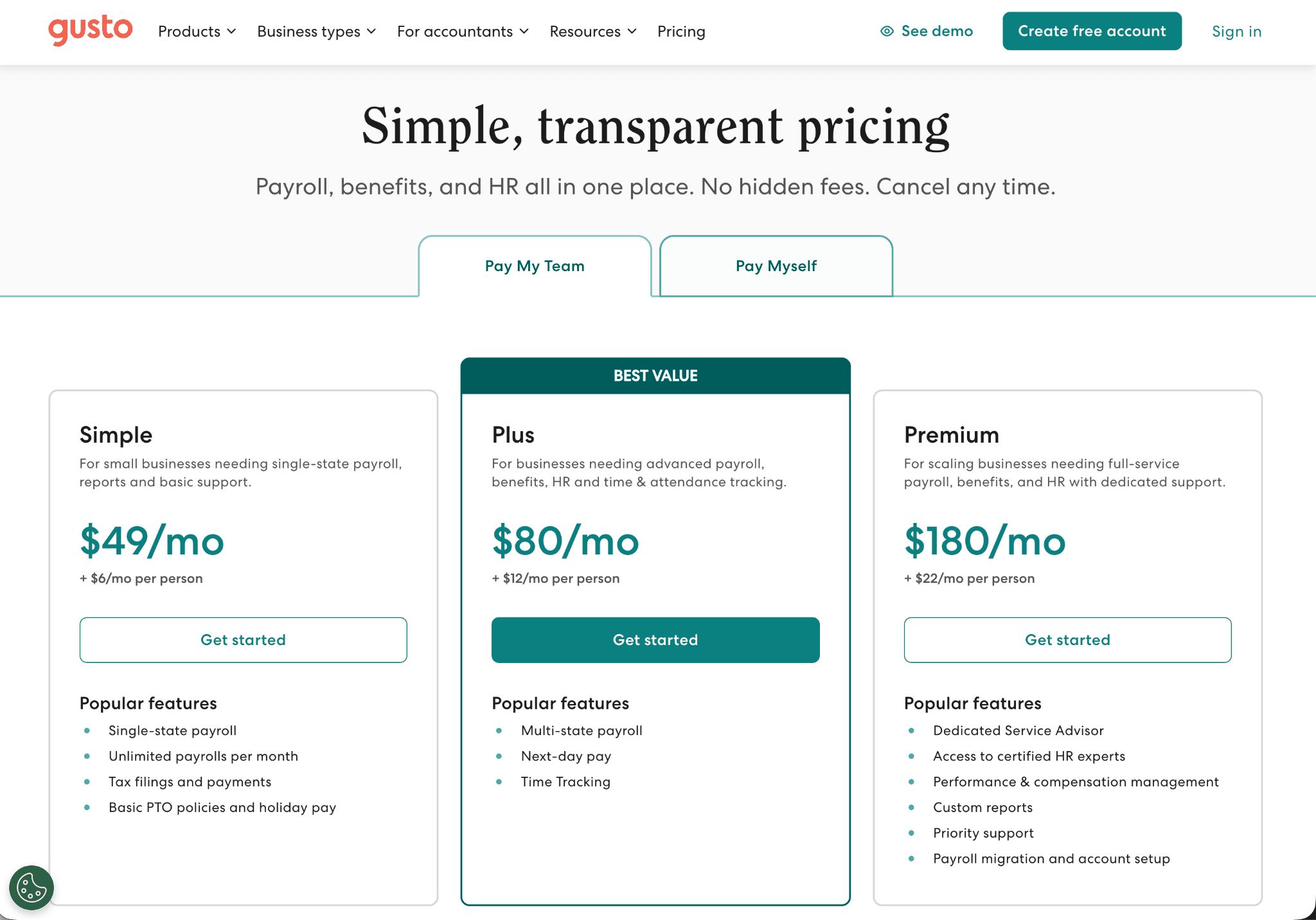
How it compares to ADP: Pricing is published right on Gusto's site, so you can sign up right away without a sales call or a custom quote.
Where it falls short: Some features you might expect, like multi-state payroll and time tracking, are locked behind the pricier Plus tier, so your cost can climb as you grow.
Rating: 4.6 on G2, 4.6 on Capterra.
Paychex: best for growing teams that want the safety net of a big provider
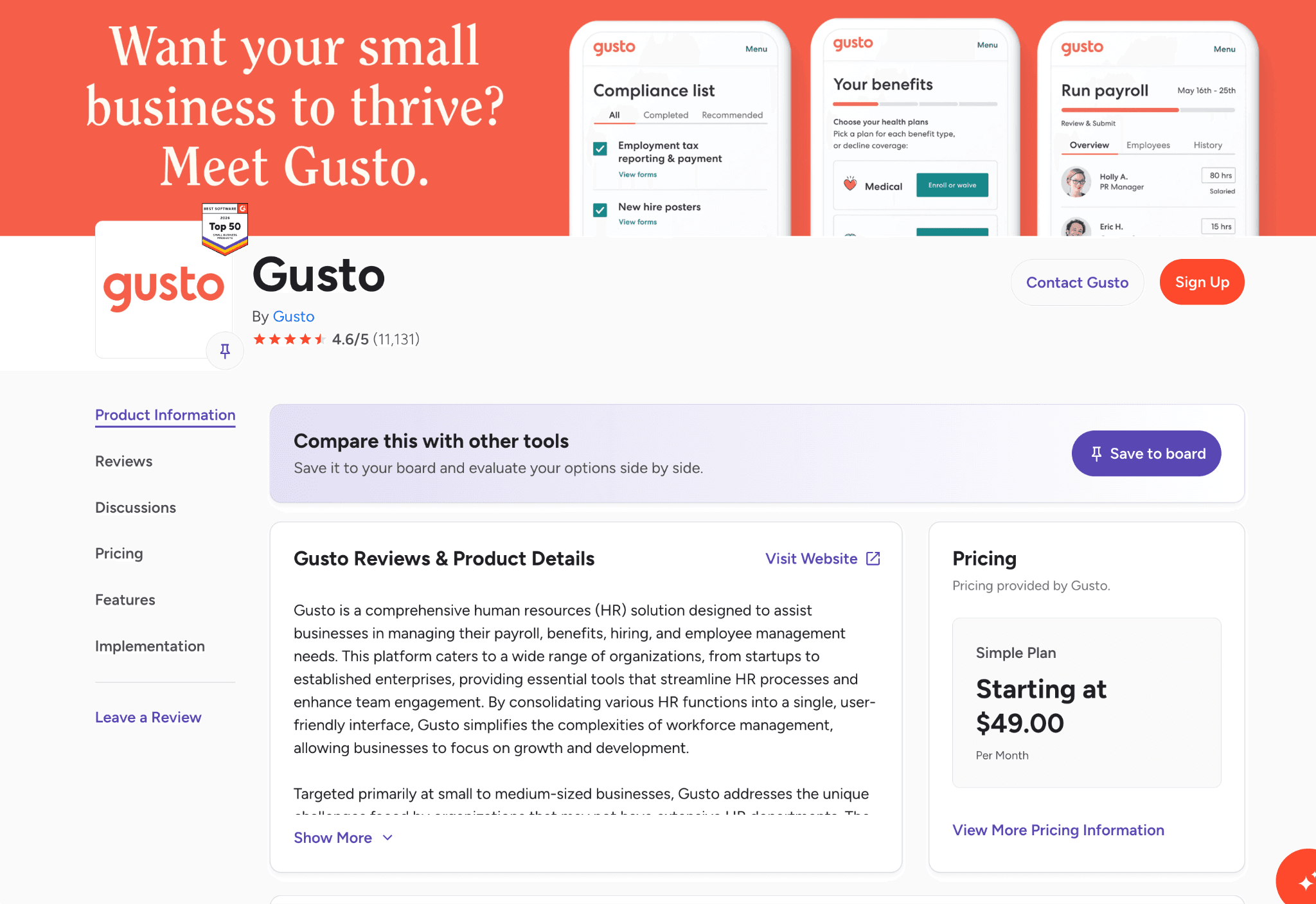
If you like the idea of a large, established provider but find ADP too much, Paychex is the closest comparison. It offers similar depth in payroll, HR, and benefits, with dedicated support reps and a long, reliable track record.
What you get:
- Full-service payroll and tax filing, with a mobile app that's well-rated by its users (according to G2 and Capterra).
- HR and benefits administration, including retirement plans and insurance, that scale as you add employees.
- A dedicated support contact on higher tiers, which appeals to owners who want a person to call.
Pricing is quote-based. Paychex doesn't publish standard rates, so like ADP, you'll need to contact sales for a number.
How it compares to ADP: You get a similar big-provider feel, often at a more flexible entry point, though you'll still go through a sales process to find out what you'll pay.
Where it falls short: Reviewers regularly flag the same things that frustrate ADP users, namely unclear pricing, add-ons that aren't obvious upfront, and early-termination fees, so read the contract closely.
Rating: 4.1 on G2, 4.2 on Capterra.
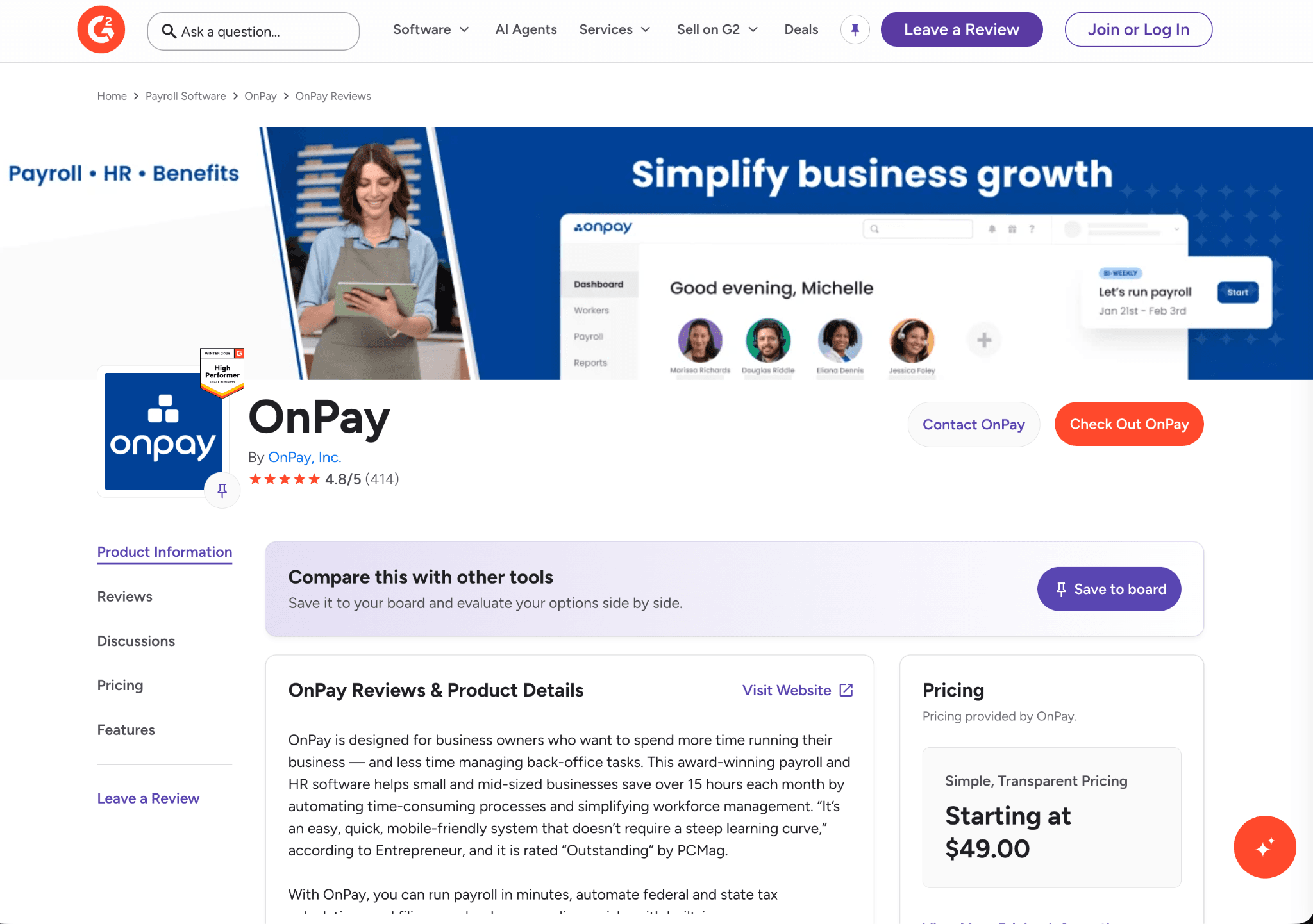
OnPay: best for straightforward, flat-rate payroll
OnPay keeps things refreshingly simple: it has one plan, one price, and every feature is included. For a small business that just wants full-service payroll without tier-shopping, it's one of the best values on this list.
What you get:
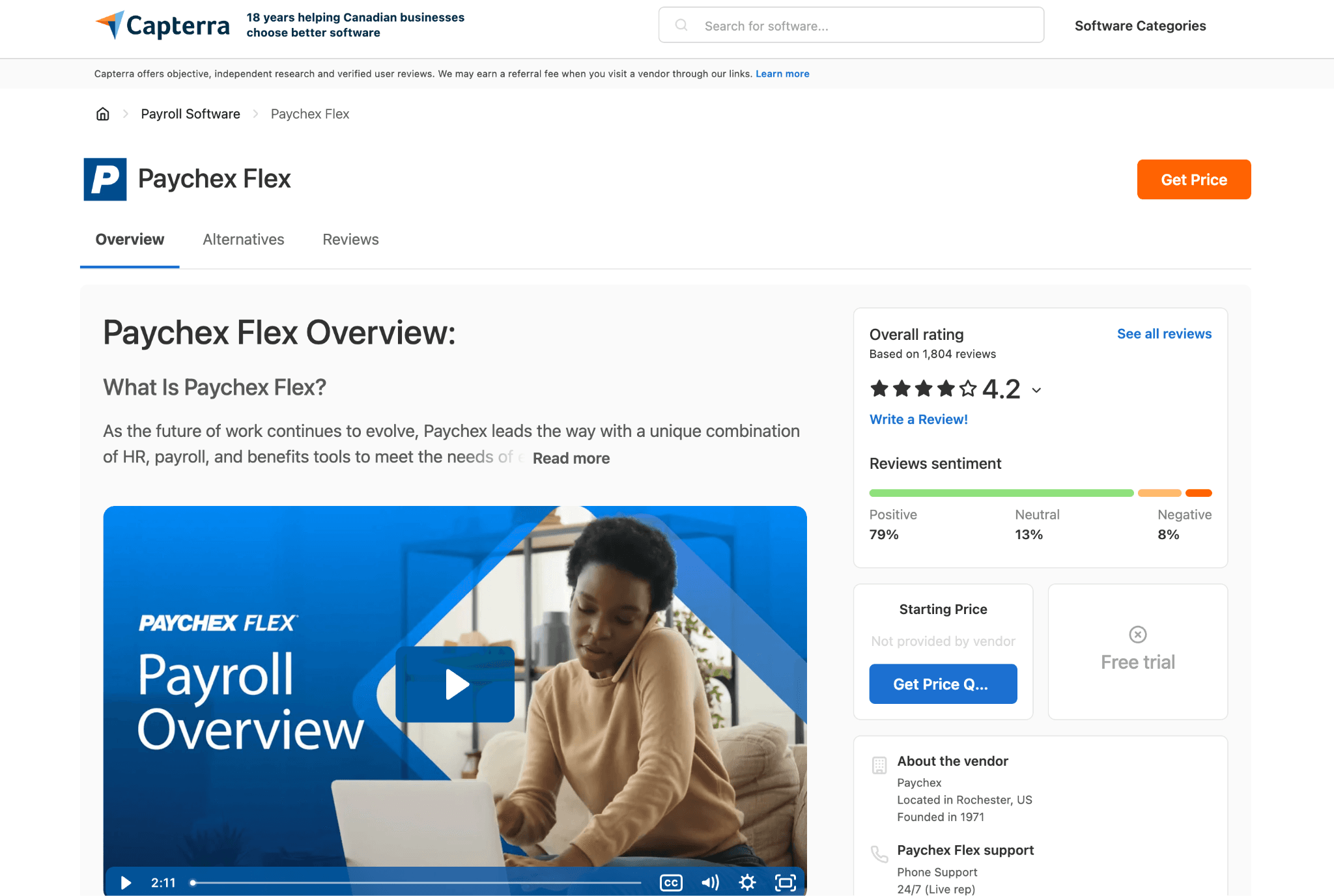
- Everything in one plan, including payroll, tax filing in all 50 states, and HR tools, with no feature gating.
- Multi-state payroll at no extra charge, which matters if you have workers in more than one state.
- Benefits administration and PTO tracking, plus support for tipped, hourly, and salaried pay.
Pricing: A flat $49 a month plus $6 per employee, with unlimited pay runs and no upcharges for multi-state payroll or HR features.
How it compares to ADP: What you see is what you pay. There's no quote, no per-run fee, and no sorting through tiers to find the feature you need.
Where it falls short: OnPay has no built-in time tracking, so if you run an hourly team, you'll need to connect a separate scheduling or time-clock tool.
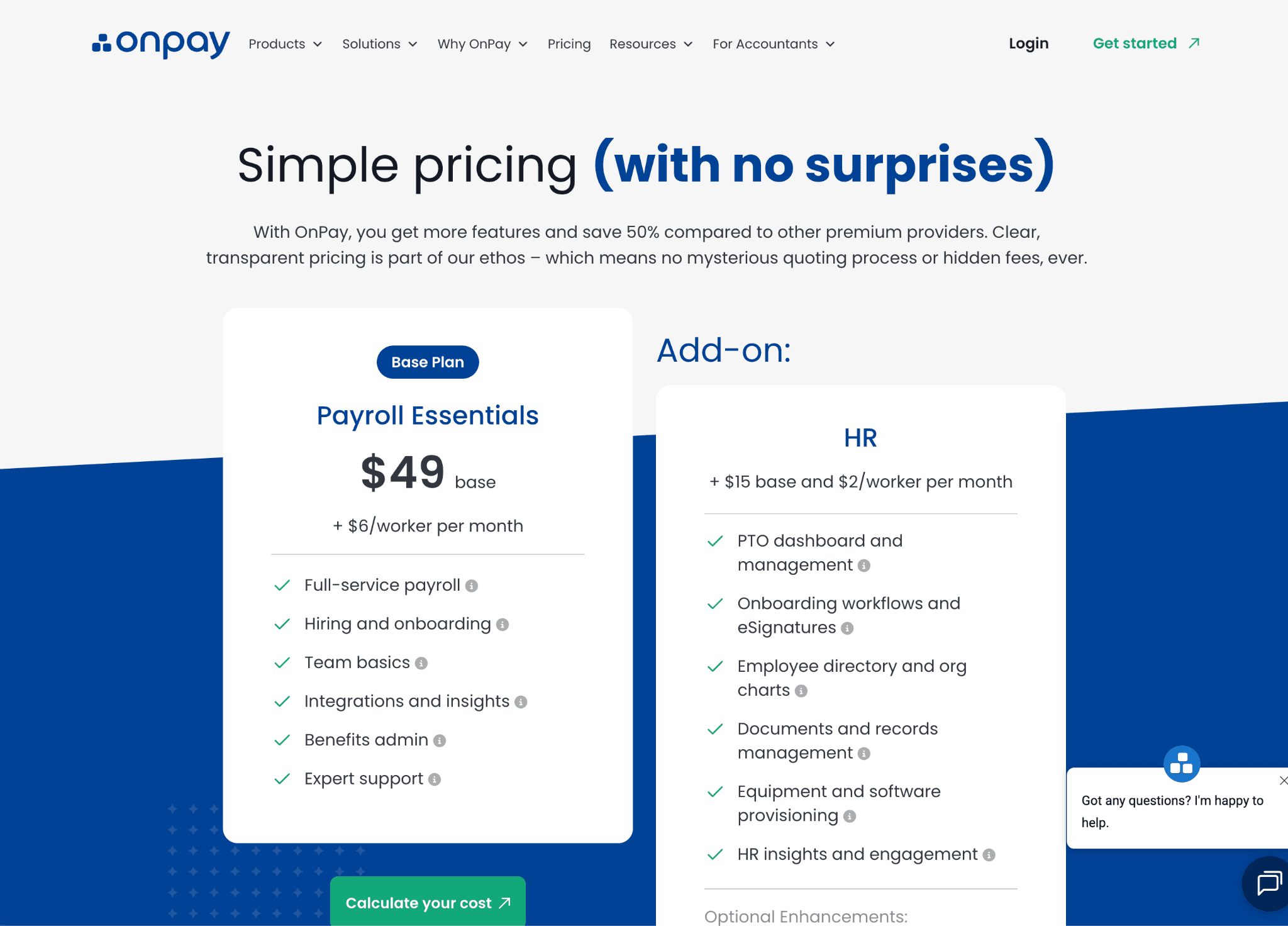
Rating: 4.8 on G2, 4.8 on Capterra.
QuickBooks Payroll: best if you already use QuickBooks
This is another big name If your books already live in QuickBooks, adding payroll keeps everything under one login. Hours, paychecks, and tax deposits flow straight into your general ledger, which is why so many accountants recommend it for existing QuickBooks users.
What you get:
- Payroll built into QuickBooks Online, so every pay run and tax deposit lands in your books automatically with no exporting between tools.
- Automated tax filing with a penalty guarantee on higher tiers, plus same-day direct deposit.
- Time tracking through QuickBooks Time on the upper plans, which ties employee hours to job costing.
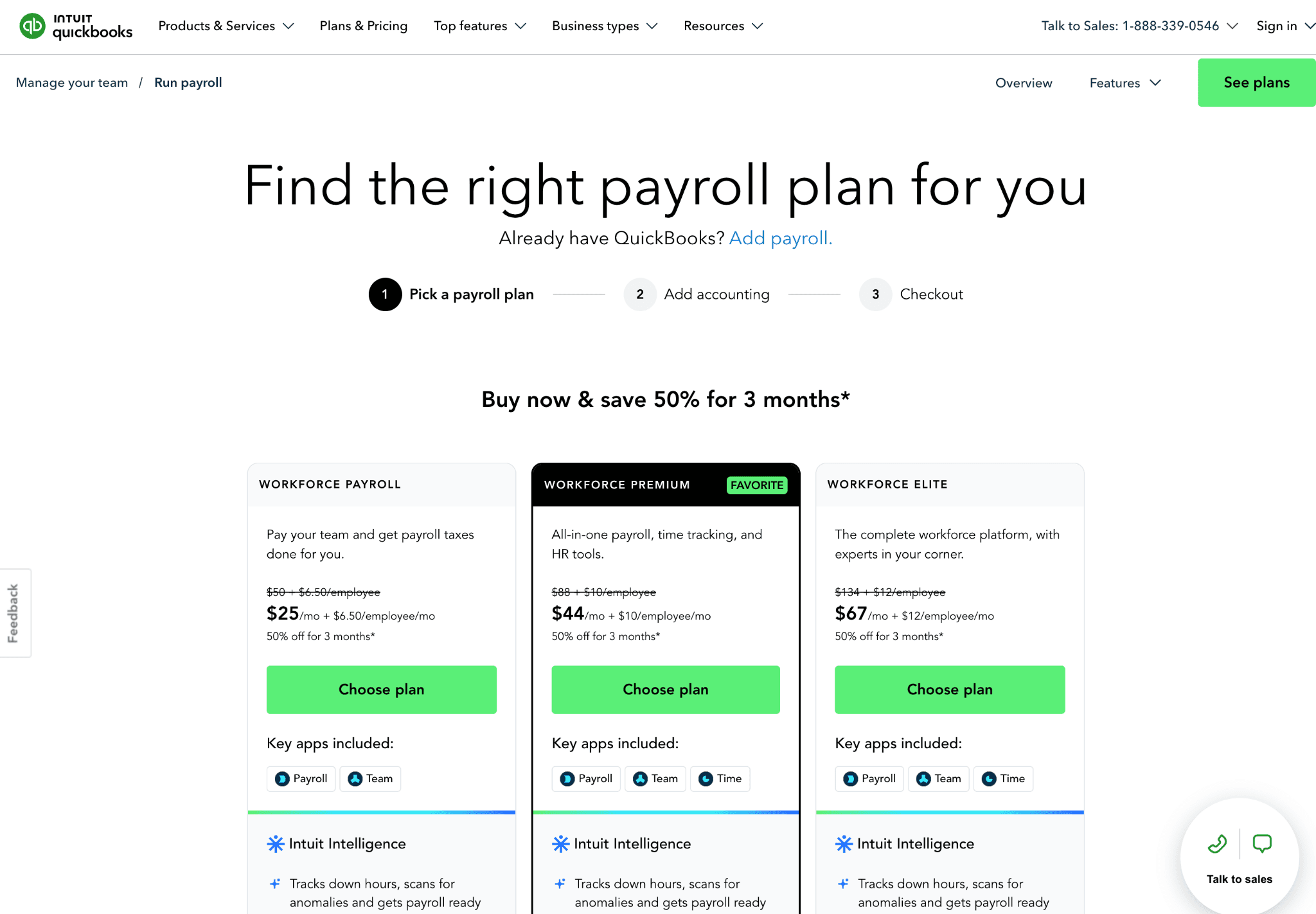
Pricing: Their regular pricing starts around $50 a month plus $6.50 per employee on the Core plan, billed monthly. Workers in more than one state add additional costs, but their website doesn’t state how much more. This screenshot shows their promotional pricing:
How it compares to ADP: Pricing is mostly published upfront (except for multi-state employees), and if you already run QuickBooks, setup is faster because your employee and company data is there already.
Where it falls short: The value depends on already using QuickBooks. Multi-state fees stack up, and Intuit raised prices noticeably in 2025, so check your renewal invoice against what you first signed up for.
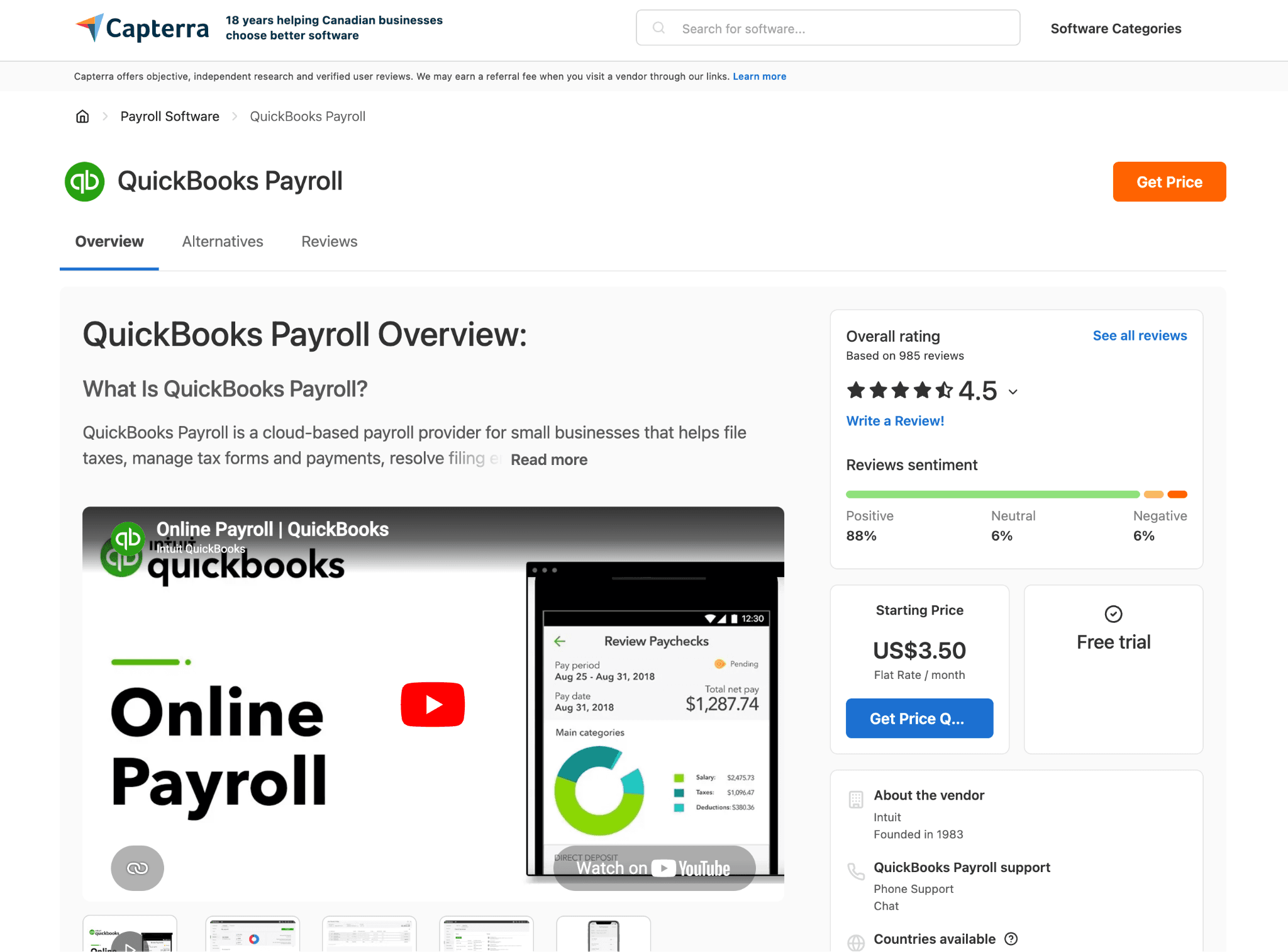
Rating: 4.4 on G2, 4.4 on Capterra.
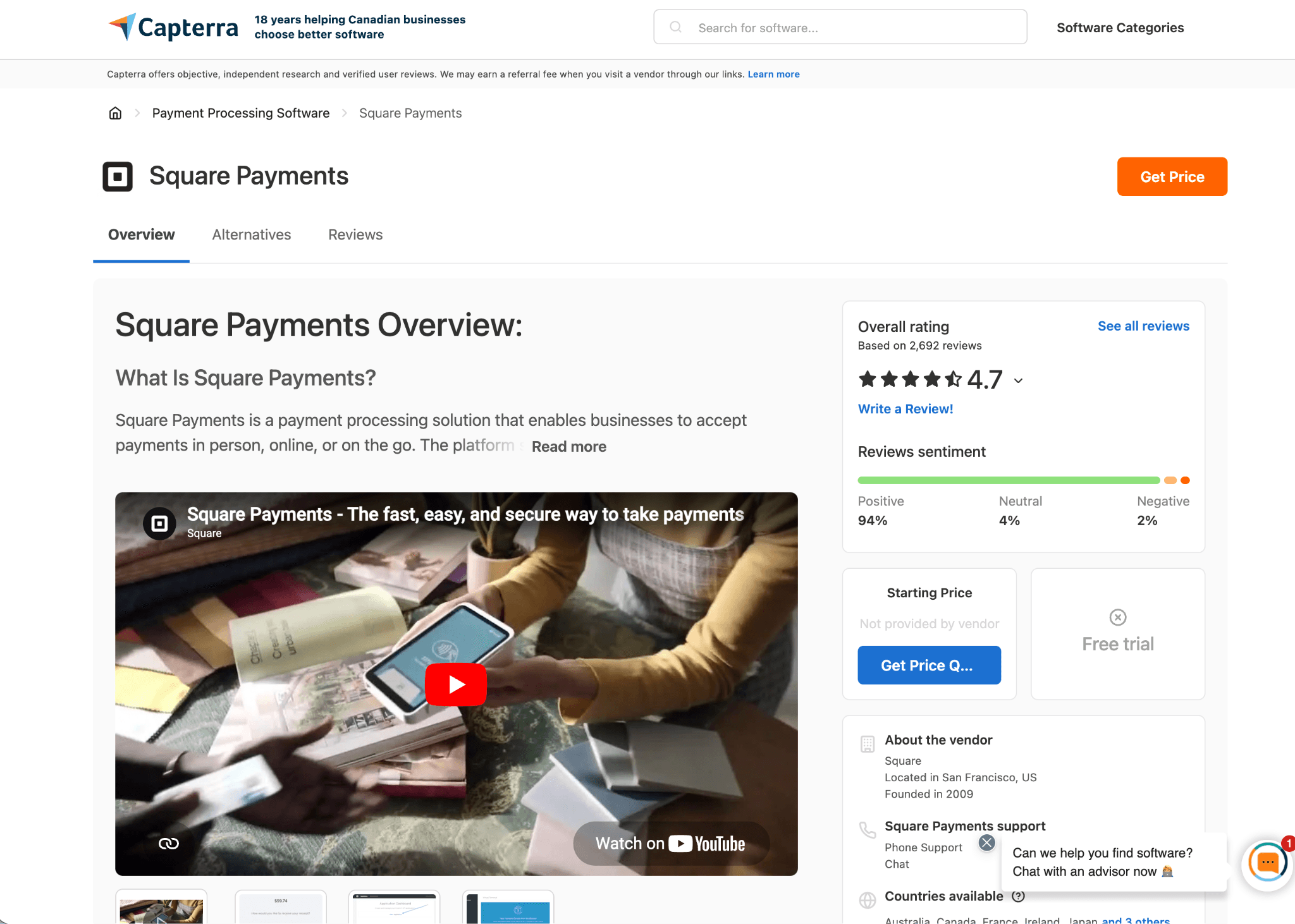
Square Payroll: best for retail and food service
If you run a shop, café, or restaurant on Square's point-of-sale system, Square Payroll is the natural extension. It pulls hours and tips straight from your POS, which makes it one of the easier options for tipped, hourly teams.
What you get:
- Tight integration with Square POS, so clocked hours and tips flow directly into payroll without re-entry.
- Full tax filing and payments at the federal and state level, with support for both employees and contractors.
- A low-cost contractor-only option if you mostly pay 1099 workers.
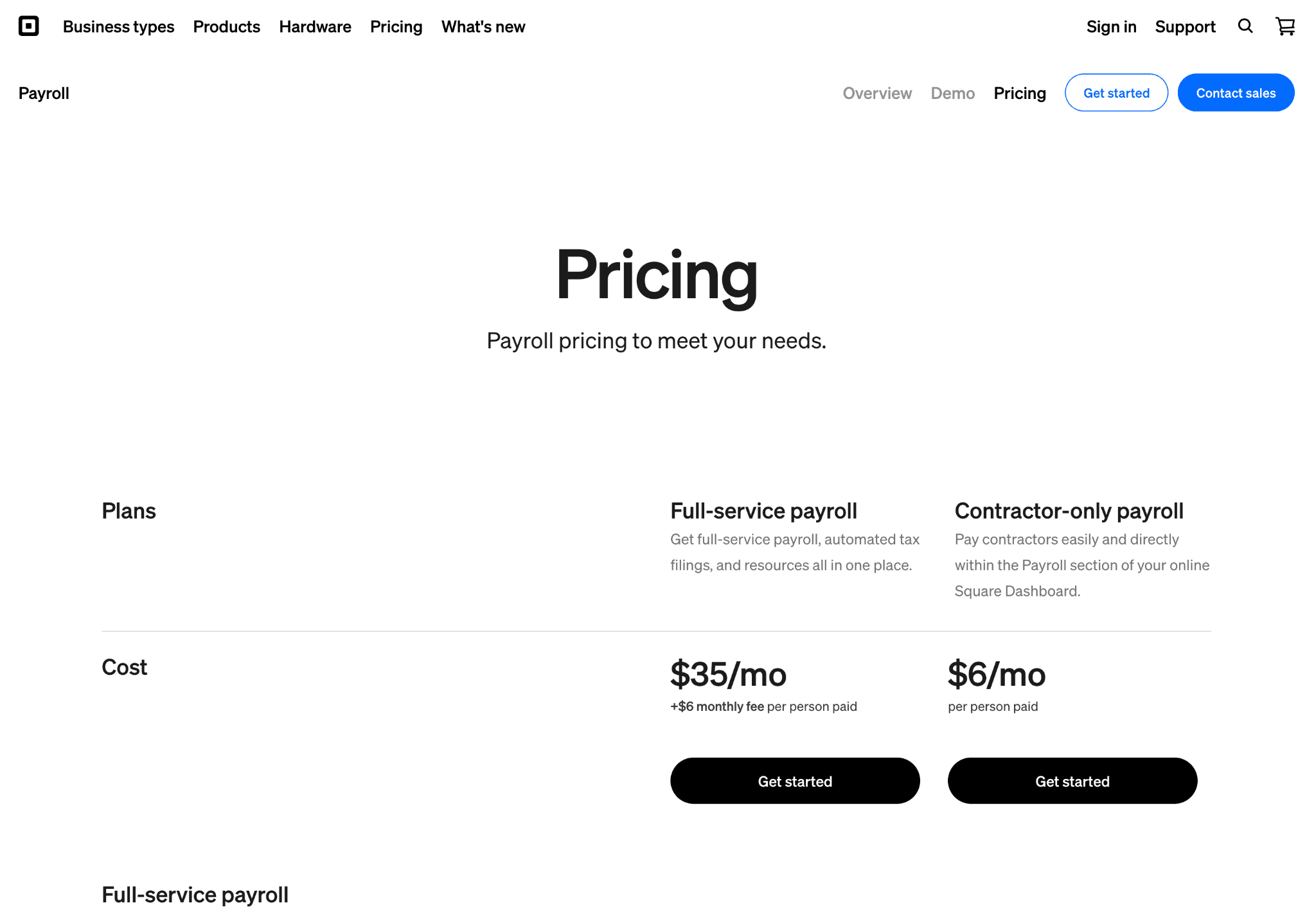
Pricing: $35 a month plus $6 per employee for the employees-and-contractors plan, or $6 per contractor a month for contractors only. Pricing is published, and you can cancel anytime.
How it compares to ADP: It's cheaper to start, the pricing is clear, and there's no sales call, though it's really designed for businesses already in the Square ecosystem.
Where it falls short: It tends to only work best if you're already on Square. Reviewers note tip handling can be manual, and payroll requires a few days of lead time before payday.
Rating: 4.7 on Capterra.
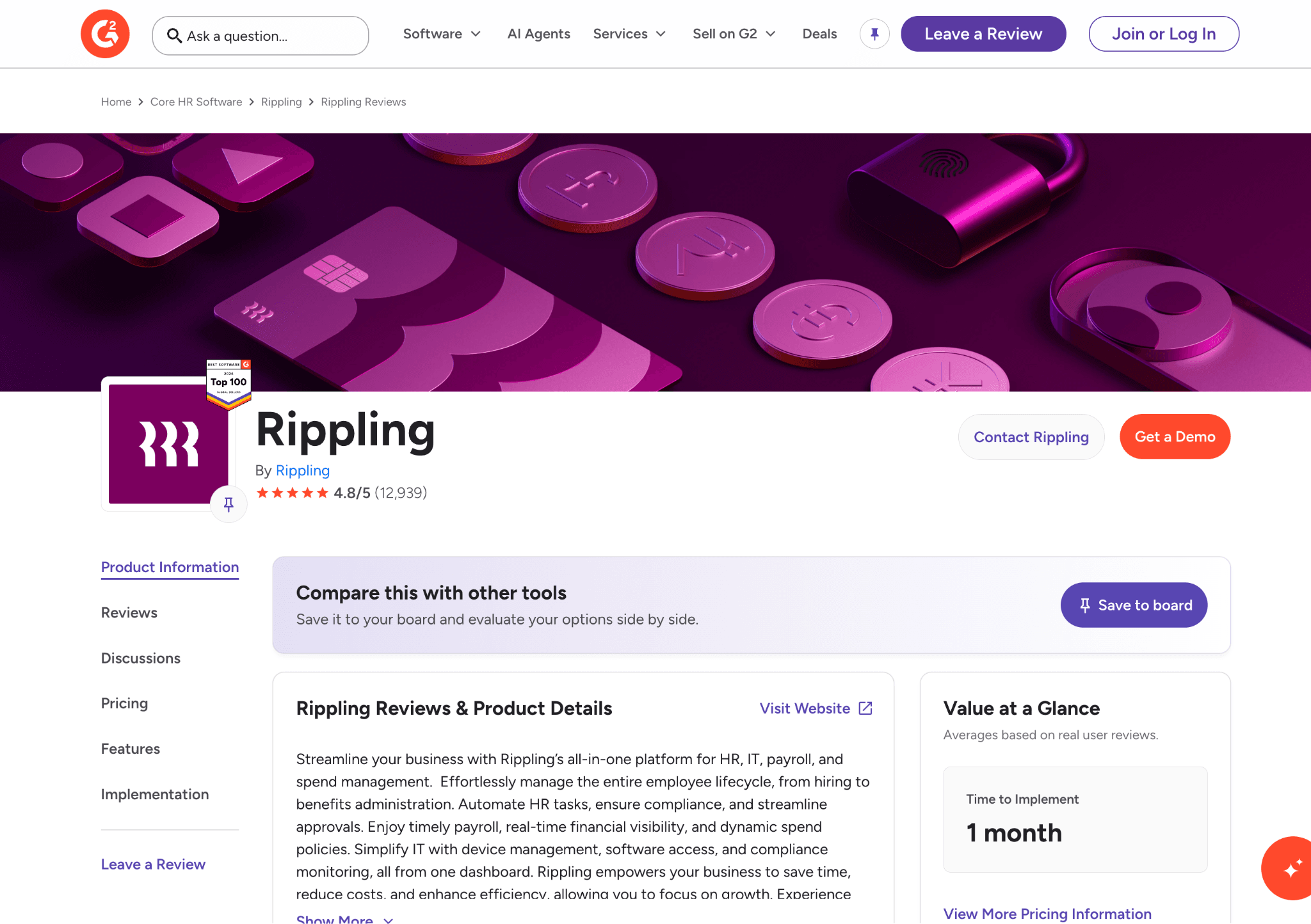
Rippling: best for fast-growing teams that need HR and IT
Rippling goes beyond payroll into a connected system for HR, IT, and finance. If you're scaling fast and are tired of managing payroll, app logins, and devices in separate tools, it pulls them into one platform built around a single employee record.
What you get:
- Payroll, benefits, and HR in one system, with automated onboarding workflows that set up a new hire's accounts and access in one step.
- IT management, including app provisioning and company device setup, which is rare among payroll tools.
- 650+ integrations and a flexible workflow engine for teams with more complex needs.
Pricing is modular and quote-based, starting around $8 per employee a month for core HR, with payroll and other modules added on top. Most teams end up between $15 and $45 per employee a month depending on what they turn on.
How it compares to ADP: It's more modern and automation-heavy than ADP, though like ADP, the modular pricing means you'll request a quote and watch the per-employee cost climb as you add pieces.
Where it falls short: All those modules add up, and the per-employee model gets expensive as you grow. It's also aimed more at fast-scaling and mid-market teams than at a small shop that just needs payroll.
Rating: 4.8 on G2, 4.8 on Capterra.
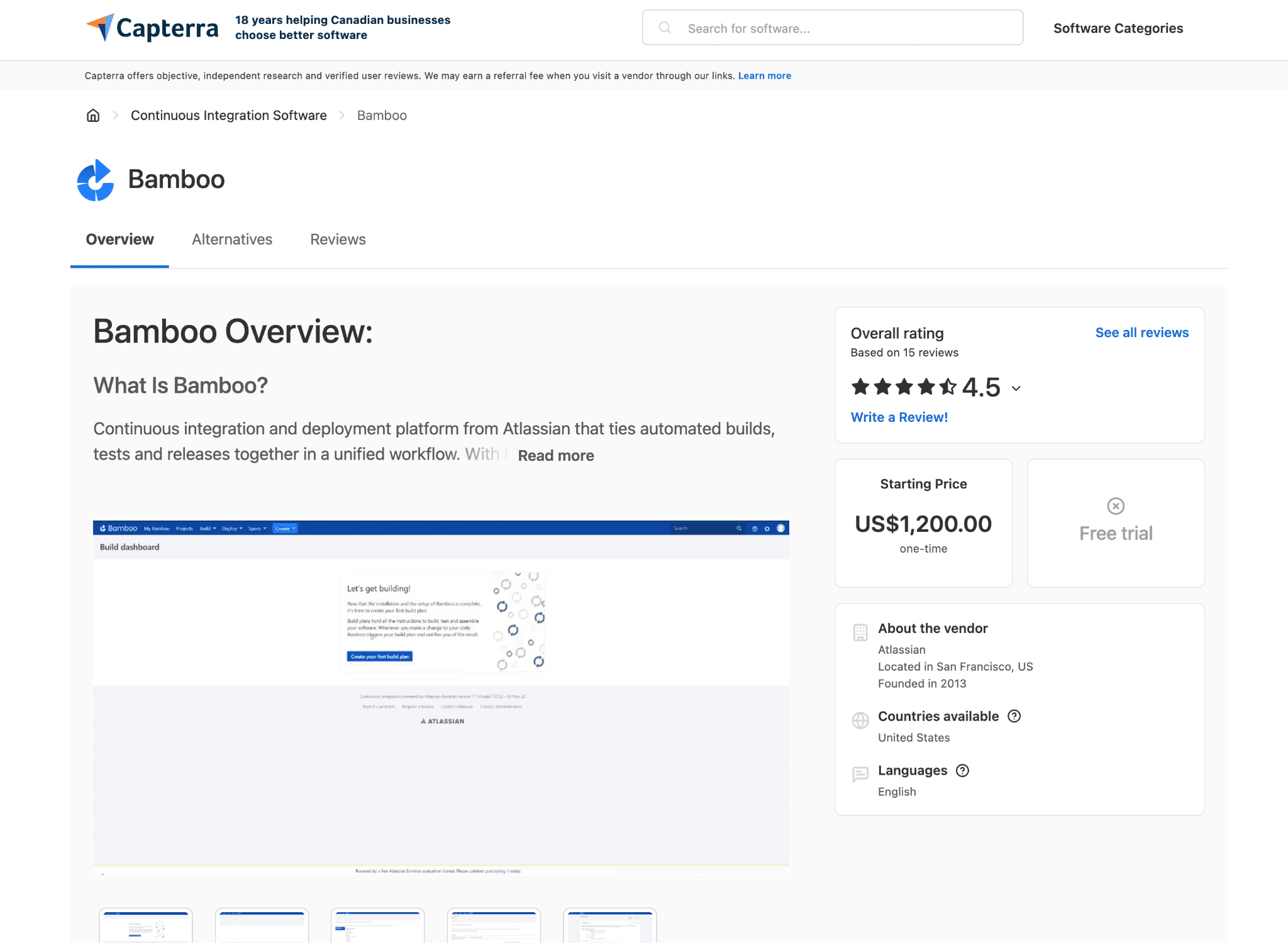
BambooHR: best for HR-first teams
BambooHR comes at this from the HR side rather than payroll. If your main pain point is scattered employee records, onboarding, and time-off tracking, this is a clean, well-liked system for managing your people. You can add payroll to their tiers.
What you get:
- Core HR in one place, including employee records, onboarding workflows with e-signatures, and time-off tracking.
- Hiring and performance tools, with applicant tracking and review features on higher tiers.
- A self-service portal that employees can use.
Pricing: Quote-based, with per-employee rates commonly in the $10 to $25 range depending on tier. Payroll, benefits administration, and time tracking are separate add-ons, and there's often a monthly minimum.
How it compares to ADP: It's easier to use and more focused on the employee experience than ADP's HR tools, but you'll still need to request a quote, and payroll isn't included by default.
Where it falls short: Payroll is a US-only add-on rather than a core feature, so if running payroll is your main goal, this isn't the most direct fit. Add-ons and renewal increases can push the real cost up.
Rating: 4.4 on G2, 4.5 on Capterra.
How to choose the right ADP alternative for your business
With seven solid options, the right one comes down to why you're leaving ADP in the first place. Here's a quick way to match your reason to a starting point:
- If transparent, predictable pricing is the priority, Gusto and OnPay both publish flat rates with no quote to chase, and OnPay includes every feature in one plan.
- If you want a big-provider feel that’s not ADP, Paychex offers similar depth and dedicated support, just with a sales process to match.
- If your books already live in QuickBooks, QuickBooks Payroll keeps everything under one login and syncs straight to your ledger.
- If you run retail or food service with tips, Square Payroll pulls hours and tips from your POS.
- If you're scaling fast and need HR plus IT, Rippling connects payroll, app access, and devices in one system.
- If your main need is HR rather than payroll, BambooHR centralizes records, onboarding, and time off, and payroll is available as an add-on.
Keep in mind that there's no single best ADP alternative, only the one that fits your team's size, budget, and how you work. If you're not sure where to start, look at what frustrated you about ADP and work backward from there.
Frequently asked questions about ADP alternatives
How much does ADP payroll cost?
ADP doesn't publish standard pricing, so the cost comes from a custom quote that you’ll have to get directly from them. Reported estimates put its RUN plan around $79 a month plus $4 per employee to start, with most small businesses paying between $100 and $300 a month once add-ons and setup fees are included.
Is Gusto cheaper than ADP?
For most small businesses, yes. Gusto's Simple plan starts around $49 a month plus $6 per employee, with taxes included and no setup fee or annual contract. ADP's small-business plans typically run higher once fees are factored in, though exact pricing depends on your custom quote.
What payroll companies are similar to ADP?
Paychex is the closest match in size and service model, and they offer comparable payroll, HR, and benefits depth with dedicated support. Gusto, OnPay, QuickBooks Payroll, Rippling, and Square also cover much of what ADP does, usually with clearer pricing and an easier setup for smaller teams.
Does ADP have a free version?
No, ADP doesn't offer a free plan, though it often runs promotions like a few months of free payroll for new customers. If a free option matters, Square Payroll has a free POS tier and Homebase offers a free plan for scheduling and time tracking, with payroll as a paid add-on.
What does ADP stand for?
ADP stands for Automatic Data Processing. The company was founded in 1949 as Automatic Payrolls, Inc., later adopted the ADP name, and has grown into one of the largest payroll and HR providers in the world, serving businesses from single-employee shops up to large enterprises.
The right ADP alternative is the one that fits your team
Switching payroll can feel like an overwhelming task, but most of these tools handle the migration for you, import your existing data, and have you running your first payroll fairly quickly, so the hardest part is comparing your options and deciding on the best one.
A good next step is to shortlist two or three options and request a quote or start a free trial. Put their numbers side by side, including any setup fees and add-ons, and you'll quickly see which one earns its price for a team like yours.
And if a one-app setup for your hourly team sounds like the fix, you can run payroll with Homebase free and see how it feels before you commit.
One easy app to manage your hourly team.
Get your team in sync with our easy-to-use, all-in-one employee app.