Set clear expectations around showing up, calling out, and clocking in. This ready-to-use template covers every rule your team needs to know from day one.
Attendance Policy

What's Inside the Policy Template?
A ready-to-customize policy written in plain language your team can follow. Fill in the blanks, hand it out, and keep a signed copy on file.

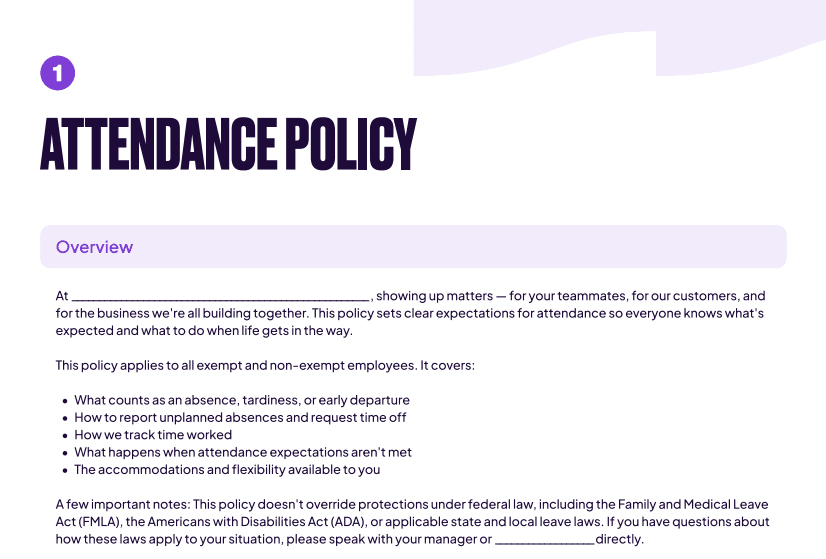
Attendance rules.
Makes clear what counts as tardiness, a planned absence, a no-call no-show, and job abandonment. Plus, your grace period, time off request requirements, and shift swaps.
Time tracking steps.
Explains your clock-in and clock-out requirements, how tardiness is defined and handled, and a five-step discipline process from verbal warning through termination.
Manager and employee sign-off.
The template outlines manager responsibilities too, like consistent enforcement and fair record-keeping. The signature page confirms employees have read and understood the policy.

Did you know?
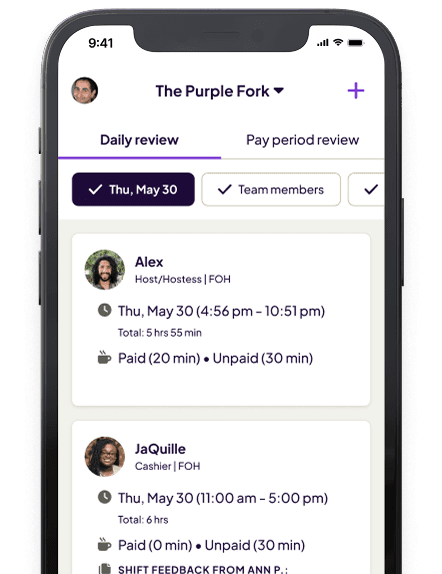
Homebase tracks attendance automatically. Every clock-in and clock-out is timestamped, so you always have what you need when attendance becomes a conversation.
Get a real-time alert when a team member hasn't clocked in by their shift start time.
See each employee's on-time rate, no-shows, and total hours worked in one place.
Save an attendance policy in the Homebase HR toolkit so your team can always find it.

Small business intel, in
your inbox
Table of contents
What is an attendance policy?
An attendance policy is a written document that tells your team exactly what you expect when it comes to showing up. It defines tardiness, explains how to report an absence, covers what happens when someone doesn't show up at all, and outlines the steps you'll take if attendance becomes a recurring problem.
For small businesses with hourly teams, a written policy does more than set rules. It keeps things fair, protects you if a situation ever escalates, and gives managers a consistent standard to apply, so no one's making judgment calls on the fly.
Why small businesses need one
When someone misses a shift without warning, it doesn't stay contained. A coworker has to cover. Service slows down. You get a call on your day off. And when it happens again, you're trying to have a disciplinary conversation without anything in writing to back you up.
A clear attendance policy changes that. It sets expectations before problems start, creates a paper trail when they do, and gives your whole team a fair, consistent reference. Not just the squeaky wheels.
What this template covers
This free employee attendance policy template is written in plain language, built for hourly teams at brick-and-mortar businesses, and fully customizable. Every section has fill-in-the-blank fields for your business name, specific rules, and contact information.
Here's what's inside:
- Overview and definitions. The first page opens with a summary of what the policy covers and a definitions section that establishes key terms: tardiness, planned absence, unplanned absence, no-call no-show, early departure, absenteeism, and job abandonment. Everyone starts from the same vocabulary.
- Attendance expectations. This section covers the basics of showing up: when to arrive, grace periods, break rules, and the expectation that team members communicate early if something comes up.
- Reporting absences and time off. Planned time off, sick days, and unplanned emergencies each have different rules. This section walks through how each type should be reported and by when. It also includes a PTO balance section with fill-in fields for accrual rates, waiting periods, and how unused PTO is handled at year-end.
- Time tracking and clock-in/out. Accurate time records protect your business and your team. This section covers when and how team members are expected to clock in and out, what counts as a timekeeping violation, and how errors in pay should be reported before the payroll deadline.
- Tardiness and early departures. Occasional lateness happens. This section draws the line between a one-off situation and a pattern, defines what "early departure" means, and tells team members what to do if they know they'll be late or need to leave before their shift ends.
- Job abandonment. If a team member misses consecutive shifts without making contact, this section explains the steps you'll take before making a formal determination, and notes it's never too late for them to reach out.
- Return to work after extended absence. Covers what team members should do when they're ready to return after illness, injury, or a personal emergency, including when a doctor's note may be required and how to handle FMLA or ADA-covered leaves.
- Disciplinary actions. A five-step progressive discipline process: verbal warning, written warning, disciplinary meeting, final written warning, and termination. The section also notes that serious violations (like a no-call no-show or falsifying time records) may skip steps entirely.
- Accommodations and special circumstances. A clear statement that the policy doesn't override ADA, FMLA, or applicable state and local protections. Team members with a medical condition, disability, religious observance, or caregiving responsibility that affects their attendance are directed to start a conversation with their manager.
- Manager accountability. The policy applies up the chain too. This section holds managers accountable for applying it consistently, keeping accurate records, and approaching attendance conversations with fairness.
- Employee sign-off. A signature page for team members to confirm they've read and understood the policy, with fields for employee name, date, and manager signature.
How to customize and roll out your policy
Download the template, then fill in the blank fields with your business name, specific rules (grace period length, PTO accrual rates, who to contact for absences), and any state or local requirements that apply to your location.
A few things to check before you finalize: many states and cities have mandatory paid sick leave laws that set minimum accrual rates and eligibility rules. These may override what you've set in the policy. Look up your local requirements before you lock in those numbers.
Roll it out with a team meeting, not just a signature. Afterwards, you can email your team so they have their own copies. Walk through the key sections, answer questions, and make clear the policy applies to everyone equally, including managers. Keep a signed copy on file for each team member. If a disciplinary situation ever escalates, documented acknowledgment matters.
Attendance policy FAQs
What should an employee attendance policy include?
A solid attendance policy covers definitions (tardiness, planned vs. unplanned absences, no-call no-show, job abandonment), how to report each type of absence, time tracking expectations, a step-by-step disciplinary process, and accommodations for situations covered by FMLA or ADA. This template includes all of those sections with fill-in fields so you can customize it for your business.
What is a point-based attendance policy?
A point-based attendance policy assigns a set number of points for each unplanned absence, late arrival, or no-call no-show. When a team member accumulates enough points within a rolling period, it triggers a disciplinary step. Points typically reset on a set schedule, like every 12 months. This approach makes patterns easier to track and gives you a clear, documented basis for any conversations you need to have.
What is a no-fault attendance policy?
A no-fault attendance policy tracks absences regardless of reason. Rather than deciding whether each absence was excused or unexcused, you assign points or incidents to each occurrence and take action when someone hits a set threshold. It removes subjectivity from the process and applies the same rules to everyone equally.
What counts as excessive absenteeism?
There's no universal standard. Most businesses define excessive absenteeism in their policy as a set number of unplanned absences or occurrences within a given time period. Your policy should define the threshold clearly so team members know exactly when a pattern becomes a problem and what will happen next.
What's the difference between an excused and an unexcused absence?
An excused absence is one approved in advance, like vacation or a scheduled appointment, or one covered by legal protections like FMLA or ADA. An unexcused absence is one that wasn't approved and doesn't fall under those protections. Your attendance policy should spell out how each type is handled and what team members are expected to do in both situations.
Do small businesses need a written attendance policy?
You're not legally required to have one, but it protects you when you do. Without a written policy, every absence becomes a judgment call. When a disciplinary situation escalates, having a signed policy on file protects you and shows consistent, fair treatment. It also gives managers a standard to follow instead of making decisions case by case.
Beyond the template: How Homebase helps track attendance
A policy is only as good as the records behind it. Homebase tracks clock-ins and clock-outs from any device, sends alerts when a team member hasn't clocked in by their shift start time, and gives you a running record of each employee's attendance history. That data does the documenting for you, so when you need to have a difficult conversation, you're working from facts.
You can also store your attendance policy in Homebase's HR toolkit alongside your other team documents, so it's always findable and easy to update when your rules change.
Related Templates
Check out moreSmall Business Tax Deductions
Starting a Small Business Checklist
Weekly Employee Schedule Template
Shift Report
Attendance Policy
Pay Stub Template

Manage your team better today.
Managers save 5+ hours a week with Homebase