Tax season is easier when you know exactly what to track. Use this checklist to cover 21 deduction categories, so nothing slips through the cracks.
Small business tax deductions template

What's inside the checklist?
Everything you need to bring your accountant for tax season, organized and ready to check off.

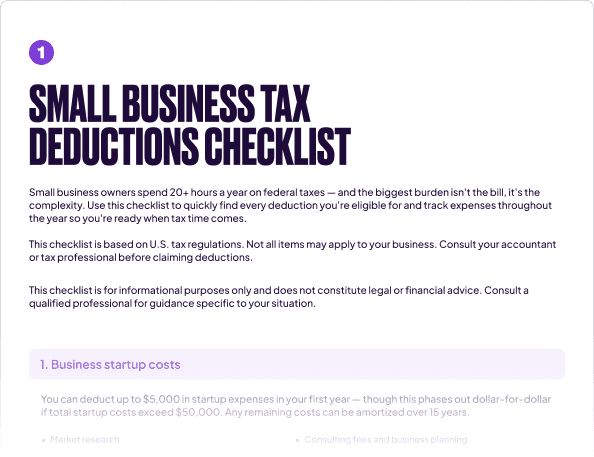
21 deduction categories.
From wages and rent to meals, mileage, and Section 179 equipment, every major deduction category is covered. Use this as a guide before you file or a year-round tracker for your records.
Built for hourly businesses.
Whether you run a restaurant, retail shop, salon, or service business, the deductions here apply to the way your business operates. No tax background required to use it.
Printable PDF, ready to share.
Download it once and it's yours. Print it, email it to your accountant, or fill it in digitally, whatever fits your workflow.

Did you know?
Homebase payroll automatically tracks wages, tips, overtime, and payroll taxes all year long. Your team's hours flow into timesheets and payroll. By tax time, your records are already done.
Wages, tips, and overtime are calculated automatically every time you run payroll.
Payroll taxes are filed and paid on your behalf, every pay period.
W-2s and 1099s are generated at year-end and ready to hand to your accountant.

Small business intel, in
your inbox
Table of contents
Every April, small business owners write bigger checks to the IRS than they had to. Not because they cheated. Because they didn't know what they could claim. A clear, current checklist fixes that.
That's why we put together this small business tax deduction checklist for you. Here's what you need to know to use this one well.
What Counts as a Tax-Deductible Business Expense?
The IRS has a two-part test: an expense must be "ordinary" (common and accepted in your industry) and "necessary" (helpful and appropriate for running your business). If it passes both, it's likely deductible.
Personal expenses never qualify. But many mixed-use expenses do. If you use your phone for work and personal calls, you can deduct the percentage that's business-related. The same logic applies to your vehicle, home office, and internet connection.
When in doubt, ask yourself: would I have this expense if I didn't have a business? If the answer is no, you're probably in good shape. If it's a gray area, flag it for your accountant.
These are the deduction categories every small business owner should know:
- Wages and compensation. Salaries, hourly wages, bonuses, commissions, and taxable benefits you pay your team are generally fully deductible. Your share of payroll taxes (the employer portion of Social Security and Medicare) is also deductible.
- Home office. If you use part of your home exclusively for business, you can deduct $5 per square foot using the simplified method, up to 300 square feet. That's up to $1,500 off your taxable income. The key word is "exclusively." A kitchen table where you also eat dinner doesn't qualify, but a dedicated room or office does.
- Vehicle and mileage. For 2026, the IRS standard mileage rate is 72.5 cents per mile for business driving. Alternatively, track your actual vehicle costs (fuel, maintenance, insurance) and deduct the business-use percentage. You can't switch methods for the same vehicle between years, so pick one and stick with it.
- Rent and utilities. Office and retail space rent is fully deductible, as are utilities like electricity, heat, and water for your business location. If you're also claiming the home office deduction, utilities are folded into that calculation rather than deducted separately.
- Equipment and depreciation. Under Section 179, you can deduct up to $2.5 million in qualifying equipment in the year you buy it, rather than spreading the cost over several years. Bonus depreciation, permanently restored to 100% starting in 2026, applies to both new and used equipment placed in service after January 19, 2025.
- Marketing and advertising. Website hosting, digital ads, print materials, and promotional costs are 100% deductible as long as they're directly tied to your business.
- Legal and professional fees. Accountants, attorneys, bookkeepers, HR consultants, and similar service providers are fully deductible when the work is for your business. Personal legal or financial fees are not.
- Health insurance premiums. If you're self-employed and not covered through a spouse's employer plan, 100% of health insurance premiums you pay for yourself, your spouse, and your dependents are deductible as an above-the-line deduction on your personal return.
- Retirement contributions. Contributions to a SEP-IRA, SIMPLE IRA, or solo 401(k) reduce your taxable income and are fully deductible. These also build long-term benefits well past any single tax season.
- Meals. Business meals are 50% deductible in 2026. The meal needs to have a legitimate business purpose: a working lunch with a client or vendor, not a team happy hour.
- Business travel. Travel that requires an overnight stay and has a legitimate business purpose is deductible: airfare, lodging, ground transportation, and incidental expenses. If you mix personal days into a business trip, you'll need to separate those costs out.
- Phone and internet. Deduct the percentage of your phone plan and internet bill that's used for business. If your phone is primarily a business tool, a majority of that cost can typically be claimed.
- Education and training. Courses, certifications, and professional development that maintain or improve skills needed for your current business are deductible. A new-career pivot doesn't qualify, but industry-specific training does.
- Contractors and freelancers. Payments to independent contractors are fully deductible. If you paid any contractor $600 or more during the year, you're also required to file a 1099-NEC.
- Interest and bank fees. Interest on business loans and credit cards, plus monthly service fees, transaction fees, and payment processing costs, are all deductible business expenses.
- Startup costs. In your first year of business, you can deduct up to $5,000 in startup costs and $5,000 in organizational expenses.
- Cost of goods sold (COGS). If your business sells physical products, the direct costs of making or buying them (materials, labor, and manufacturing overhead) reduce your gross profit before other deductions apply. For many product-based businesses, COGS is the largest single line item.
What's New for 2026
The One Big Beautiful Bill Act (OBBBA), signed in July 2025, made several changes that affect your 2026 tax return.
The qualified business income (QBI) deduction increased to 23%. This deduction lets pass-through businesses (sole proprietors, partnerships, S-corps, and most LLCs) deduct a percentage of their qualified business income. For 2026, that rate is 23%, up from 20%. There's also a new $400 minimum: anyone with at least $1,000 in qualified business income gets at least a $400 deduction, even if the standard calculation would phase them out.
100% bonus depreciation is now permanent. Businesses can deduct the full cost of qualifying equipment and property in the year it's placed in service, with no scheduled phase-down. This applies to both new and used assets.
If your accountant filed your 2025 return using the old rules, some of the math looks different for 2026. These are material changes worth a conversation before you assume last year's strategy still applies.
How to Track Your Deductions Throughout the Year
The hardest part of claiming deductions isn't knowing what qualifies. It's having the documentation when you need it.
A few habits that help:
Keep business and personal finances separate. A dedicated business bank account and credit card make it much easier to pull expense reports at year-end. It also makes your books cleaner if you're ever audited.
Hold onto receipts for anything over $75. The IRS doesn't require a receipt for expenses under $75, but you still need a record of the amount, date, location, and business purpose. For lodging, keep receipts regardless of amount. The safest habit is to document everything and let your accountant tell you what's required.
Track mileage as you go. Reconstructing business driving from memory at tax time is unreliable and hard to defend. A mileage log or app that captures trips in real time is much cleaner.
Let payroll handle the heavy lifting. Wages, payroll taxes, and tips are among your largest deductible expenses, and they're the easiest to document when a payroll app tracks everything automatically. If you're still doing this by hand or handing a spreadsheet to your accountant every December, that's the first thing to fix.
Small Business Deductions FAQ
What expenses can a small business write off?
Any expense that is ordinary (common in your industry) and necessary (helpful for running your business) is generally deductible. Common categories include wages, rent, utilities, marketing, equipment, professional fees, health insurance premiums, and contractor payments. The checklist above covers each category in detail.
What is the most overlooked small business tax deduction?
The home office deduction is consistently underused. Many small business owners work from home, at least part of the time, but don't claim it because they're not sure they qualify or worry it will trigger an audit. If you use a portion of your home exclusively and regularly for business, you likely qualify. The simplified method ($5 per square foot, up to 300 square feet) makes the calculation straightforward with a maximum deduction of $1,500.
Can I deduct employee wages and payroll taxes?
Yes. Wages, salaries, bonuses, and commissions paid to your team are fully deductible. Your share of payroll taxes (the employer portion of Social Security and Medicare) is also deductible as a business expense. Keep payroll records organized throughout the year so this is easy to document come tax time.
What's the difference between a tax deduction and a tax credit?
A deduction reduces your taxable income, which indirectly lowers your tax bill based on your bracket. A credit reduces your tax bill directly, dollar for dollar. A $1,000 deduction saves you $220 if you're in the 22% bracket. A $1,000 credit saves you $1,000 regardless of your bracket. Credits are generally more valuable, but deductions are more widely available for everyday business expenses.
Do I need receipts for every business expense?
The IRS doesn't require a receipt for expenses under $75, but you still need a record of the amount, date, place, and business purpose. For anything over $75, keep the receipt. For lodging, keep it regardless of amount. The safest approach is to document everything and let your accountant confirm what's required for your situation.
How do I track deductions throughout the year?
Separate your business and personal finances with a dedicated business bank account and credit card. Track mileage in real time rather than reconstructing it from memory. Use a payroll app that automatically records wages, taxes, and tips. Those are typically your largest deductible expenses and the ones where clean documentation matters most. At year-end, pull your expense reports and hand them to your accountant alongside this checklist.
Beyond the Checklist: Tracking Your Deductibles Year-Round
A tax deductions checklist isn't a shortcut around your accountant. It's how you show up to that meeting prepared. Go through it, note everything that applies to your business, and keep it somewhere you'll find it again come January.
The goal is simple: not to leave money on the table that was already yours to keep.
And if tracking wages, hours, and payroll taxes throughout the year feels like one more thing on an already long list, Homebase payroll handles it for you. Your team's time flows into payroll automatically, taxes are calculated and filed without you having to think about it, and your year-end tax documents are ready when you need them. Sign up free and see how it works.
Related Templates
Check out moreSmall Business Tax Deductions
Starting a Small Business Checklist
Weekly Employee Schedule Template
Shift Report
Attendance Policy
Pay Stub Template

Manage your team better today.
Managers save 5+ hours a week with Homebase